


Quick answer
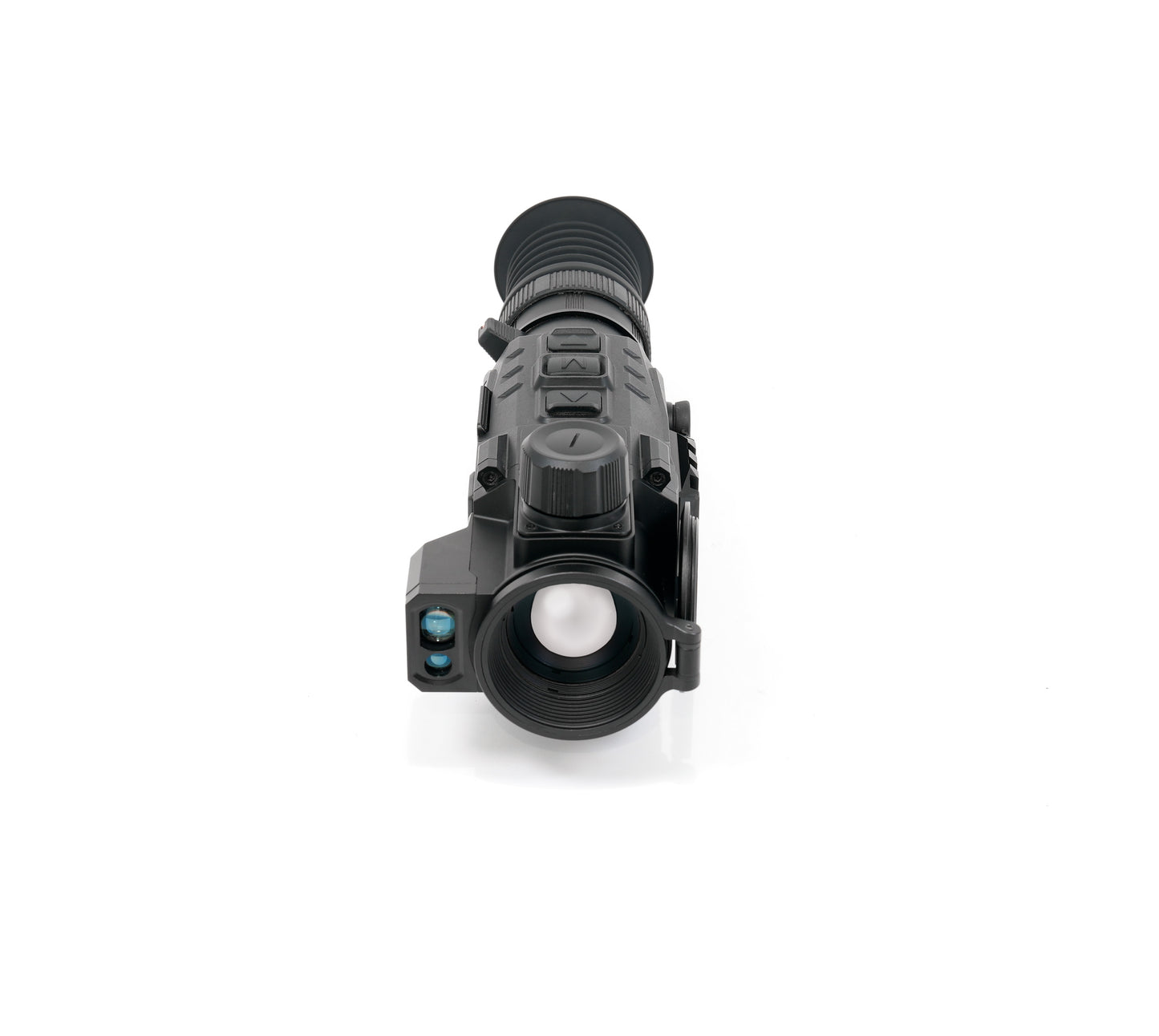
The Nocpix RICO 3 H35R carries the same 640×512 sensor as both 50 mm models in the family, behind a 35 mm lens at 2× base magnification. That combination produces the widest field of view...
Who this is for
Best for
Best for coyote, hog and predator hunters working mixed terrain who want premium 640-resolution image quality with a wider field of view than the H50R. It is especially well suited for: Typical hunting distances of 50–200 yards Creek bottoms, timber edges and brush Smaller crop fields and mixed terrain Following moving coyotes or hogs Hunters who use the rifle scope for occasional scanning Buyers who want 640 resolution without moving into a 50 mm optic First-time premium thermal buyers who want an all-around setup
Not ideal for
Not ideal for hunters who primarily shoot at extended distances across large, open fields and want the larger-looking native image provided by a 3×, 50 mm scope.
Quick specifications
- Category
- Thermal Rifle Scope
- Sensor Resolution
- 640x512
- Magnification
- 2-16x
- Objective Lens
- 35
- Detection Range
- 1990
- Rangefinder
- Yes
Why buy from Thermal Bros
You get real product guidance, financing options, and trade-in or consignment help when available.
Full product description
The Nocpix RICO 3 H35R carries the same 640×512 sensor as both 50 mm models in the family, behind a 35 mm lens at 2× base magnification. That combination produces the widest field of view in the RICO 3 series.
Field of view is the specification that decides whether you find the animal at all — and it is the one buyers most often trade away chasing reach.
Reach is what gets advertised. Finding things is what fills a night. If your hunting happens in timber edges, creek bottoms, brush lines, small fields and mixed ground where animals show up close and move fast, the H35R will put more animals in front of you than either 50 mm scope.
The RICO 3 H35R has the widest field of view in the RICO 3 family
The RICO 3 H35R delivers a 12.6° × 10.1° field of view, wider than any other model in the RICO 3 series. That comes from pairing the 640×512 sensor with the shorter 35 mm lens — the same sensor behind a 50 mm lens sees a narrower slice of ground.
Field of view is how much ground you can see through the scope at once. It sounds like a secondary concern next to sensor resolution or detection range, and for most hunters it is the opposite — it is the specification that governs the part of the night you spend actually looking for animals.
A narrow view means more panning to cover the same ground, more chances to sweep past something, and a harder time reacquiring an animal that moves. A hog that steps out at 60 yards and crosses at a walk is easy to lose in a tight field of view and easy to hold in a wide one. At 12.6° × 10.1°, the H35R shows you meaningfully more ground than the 50 mm models in the family.
The trade is that animals appear smaller at any given distance. At 2× base magnification, a coyote at 300 yards occupies less of the display than it would through the RICO 3 H50R's 3× and 50 mm lens. For hunters whose shots come at distance across open country, that matters more than the wider view. For everyone else, it does not.
The RICO 3 H35R uses the same 640×512 sensor as the H50R and PRO H50R
The RICO 3 H35R carries the identical 640×512 12 μm thermal core found in both 50 mm models, including the flagship. Sensor resolution is not what separates the H35R from its more expensive siblings — the lens is.
That sensor is also what separates the H35R from the L35R below it. A 640×512 array captures roughly 2.4 times as many thermal pixels as a 384×288, and that difference is what turns a warm blob into an animal you can identify with confidence — body shape, posture, whether it is the animal you came for.
The practical effect shows up at the edges of your range. Up close, both show you plenty. Farther out, the lower-resolution image degrades into something you can detect but not confidently identify, while the 640 holds usable detail longer. That gap is why the H35R and the RICO 3 L35R behave differently despite sharing the same 35 mm lens.
The RICO 3 H35R also carries a wider field of view than the L35R, because the larger sensor sees more through the same lens. It is the more capable optic in both directions — resolution and coverage — which is what accounts for the price difference between them.
The RICO 3 H35R runs 2× base magnification with 8× digital zoom
The RICO 3 H35R covers a 2× to 16× magnification range — 2× native from the 35 mm lens, extended to 16× by 8× digital zoom. The base figure is the one that describes what the optic actually resolves.
Digital zoom on any thermal optic works by enlarging pixels the sensor already captured. It makes what you are looking at bigger. It does not make it more detailed — push it far enough and you are studying larger, blurrier copies of the same information.
What determines how far you can actually identify an animal is the sensor and the lens. The magnification range is how you frame what those two have already resolved.
The RICO 3 H35R's 2× base is what produces its wide field of view rather than a limitation against the 3× models. The 8× digital zoom is there when you need to frame something tighter.
The RICO 3 H35R has an integrated 1,600-yard laser rangefinder and ballistic calculator
The RICO 3 H35R's laser rangefinder is built into the scope housing and rated to 1,600 yards with ±1-yard accuracy, supporting both single-measurement and continuous ranging. Continuous mode updates the displayed distance about once a second, which is what you want when a hog or coyote is working across a field rather than standing still.
The multi-variable ballistic calculator takes a range measurement and returns an aiming solution, with multiple rifle profiles and zero distances stored for different setups.
Ranging matters more on thermal than it does in daylight, where fence lines and familiar landmarks let you estimate distance without thinking about it. Thermal strips those cues away, and hunters misjudge range through it constantly — an error that costs little at 100 yards and a great deal past 250.
The RICO 3 H35R is remote-compatible, though a remote is not included. Only the RICO 3 PRO H50R ships with one.
How the RICO 3 H35R compares to the L35R, H50R and PRO H50R
The RICO 3 series is a four-model family built on one platform. The naming code tells you what you are getting: L = 384 sensor, H = 640 sensor. The number that follows is the objective lens size in millimeters. An R at the end indicates an integrated laser rangefinder — every RICO 3 has one.
-
RICO 3 L35R — the entry point. Best paired with a separate handheld scanner, since a narrower view and a smaller sensor make it harder to locate animals with the scope itself.
-
RICO 3 H35R — the widest field of view in the family and the strongest all-around choice for mixed terrain, timber edges and closer, faster encounters.
-
RICO 3 H50R — the same 640 sensor behind a 50 mm lens at 3× base. Built for open ground and longer shots.
-
RICO 3 PRO H50R — the H50R plus autofocus, Ocular Zoom 2.0 and an included remote. The flagship.
Moving between the H35R and a 50 mm model is a trade of field of view for native image scale, not a step up in image quality — the sensor is the same across all three 640 models.
Frequently asked questions
Who is the RICO 3 H35R the right choice for?
Hunters working mixed terrain, timber edges, creek bottoms and smaller fields, where finding and following animals matters more than native reach. It carries the same 640×512 sensor as both 50 mm models with a wider field of view. Hunters whose shots come at distance across open country are better served by the H50R or PRO H50R.
Is the H35R or the H50R better for my hunting?
Terrain decides it. The H35R's 35 mm lens and 12.6° × 10.1° field of view favor timber, creek bottoms, brush lines and smaller fields where animals appear close and move fast. The H50R's 50 mm lens and 3× base magnification favor open crop fields and longer shot opportunities. Both use the same sensor.
What is the difference between the H35R and the L35R?
Sensor resolution. The H35R uses a 640×512 sensor; the L35R uses a 384×288. Both share the 35 mm lens, rangefinder, ballistic calculator and battery system. The 640 sensor holds usable detail farther out and produces a wider field of view through the same lens.
Does the H35R have autofocus?
No. Focus is manual. Autofocus is exclusive to the RICO 3 PRO H50R, which is the first thermal riflescope from any manufacturer to offer it.
Why does the H35R start at 2× when the other models start at 3×?
The lower base magnification is what produces the wider field of view. It is a deliberate trade — you see more ground at once, and animals appear smaller at a given distance. The 8× digital zoom is available when you need tighter framing.
Why does the top magnification number matter less than it seems?
Digital zoom enlarges pixels the sensor already captured — it makes the image bigger without making it more detailed. Sensor resolution and objective lens size determine how far you can actually identify an animal. Treat the magnification range as framing, not reach.
How far will the rangefinder read?
The integrated laser rangefinder is rated to 1,600 yards with ±1-yard accuracy and supports both single and continuous ranging. Actual performance varies with target size, surface reflectivity, angle and conditions.
What does the 1,990-yard detection range actually mean?
Detection means the sensor registers a warm signature against a cooler background. It does not mean you can identify the animal or take a shot at that distance — recognition and identification happen much closer. Use detection figures to compare optics, not to plan a hunt.
Can I use a remote with the H35R?
Yes. The H35R is remote-compatible, but a remote is not included. Only the PRO H50R ships with one.
How long does the battery last?
Up to 10 hours per NBP-8 pack, and roughly 7 hours in sub-zero conditions down to −4°F. A spare battery is included, and the scope supports USB-C external power.
Which RICO 3 is best for coyote hunting?
The H35R suits mixed terrain, closer encounters and coyotes moving fast. The H50R and PRO H50R suit open fields and longer shot opportunities. Terrain and typical shot distance should drive the choice more than price.
Is the H35R a good first thermal scope?
It is a strong first scope for hunters who want to buy once. The wider field of view is more forgiving while you are learning to find animals through thermal, and the 640 sensor means you will not outgrow the image quality.
Nocpix App
Wi-Fi integration with iOS and Android devices


Technical Specifications
-
Sensor Resolution (px)
640x512 -
Display Resolution (px)
2560x2560 -
NETD Rating
15 -
Detection Range
1990 -
Refresh Rate (Hz)
60 -
Field of View
12.6
-
Weight
1.8 lb -
Dimensions
8.9 in 3.43 in 3.43 in -
HZ - refresh rate
60 -
Thermal Sensor Resolution
640x512 -
Display Resolution
2560x2560 -
Pixel Pitch
12 -
NETD Rating
15 -
Detection Range
1990 -
Range Finder
Yes -
Clip-On
No -
Magnification Base
2 -
Magnification Max
16 -
Objective Lens
35 -
Field of View
12.6