


Quick answer
The practical way into thermal clip-ons — a 384 clip-on with a 35mm lens, 1800m detection range, and the longest battery life in Zentron's C Series at up to 7 hours. Mounts ahead of your day scope so you keep your optic and your zero.
Who this is for
Best for
Adding thermal to a day scope you already shoot — coyote, hog, and predator hunting at typical distances, with the longest runtime in the C Series
Not ideal for
Hunters taking long shots who need maximum image detail, those wanting a built-in rangefinder, and buyers without a day scope or compatible adapter
Quick specifications
- Category
- Thermal Clip-On
- Sensor Resolution
- 384×288
- Magnification
- 1-1x
- Objective Lens
- 35
- Detection Range
- 1800
- Rangefinder
- No
Why buy from Thermal Bros
You get real product guidance, financing options, and trade-in or consignment help when available.
Full product description
The Zentron C35 is the practical way into thermal clip-ons. It runs a 384 sensor on a 35mm lens with 1800 meters of detection, and it holds the longest battery life in the C Series at up to 7 hours. Like every clip-on in the line, it mounts in front of the day scope you already shoot, so you keep your rifle, your optic, and your zero, and add thermal when the sun goes down. For hunters taking coyote and hog at typical distances, the C35 delivers a clean thermal image and a full night of runtime without paying for detail you won't use.
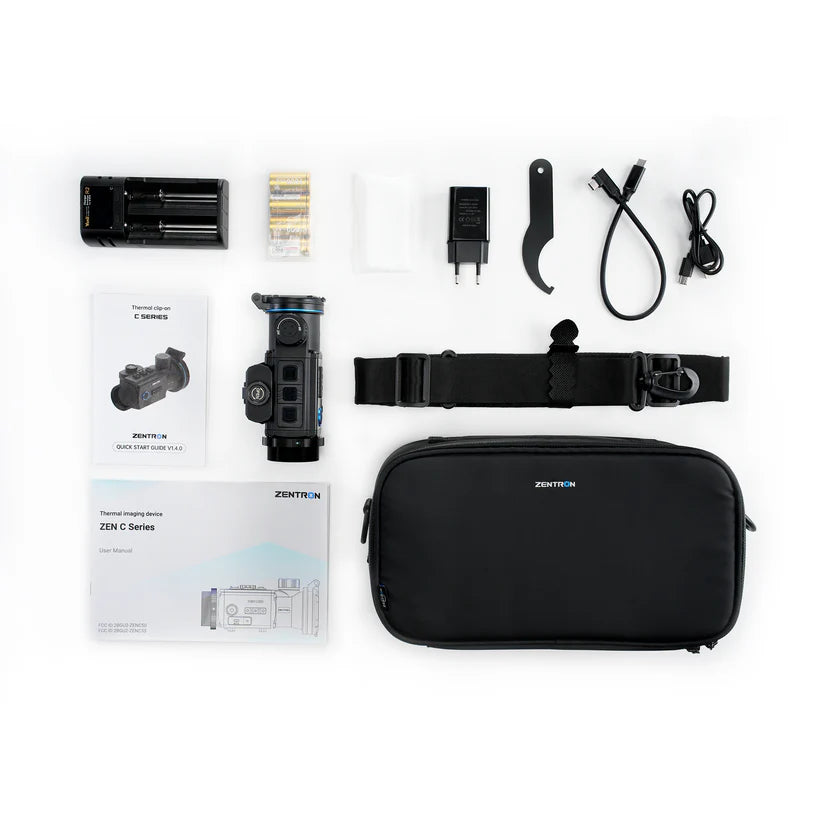
Zentron C35 thermal clip-on — 384 thermal clip-on with a 35mm lens and long battery life for coyote, hog, and predator hunting.
Full Description
What is a thermal clip-on and how is it different from a thermal scope?
A thermal clip-on is not a scope. It is a thermal device that mounts in front of the day scope you already own and shoot, projecting a thermal image through your existing optic. You look through your normal scope, using your normal reticle, at your normal magnification — the clip-on simply replaces what your eye sees with a thermal picture. A dedicated thermal scope, by contrast, replaces your day optic entirely: it has its own reticle, its own magnification, and it has to be zeroed on its own. That difference drives the whole buying decision. A clip-on means one rifle, one zero, and one optic you already trust, with thermal added on top when you need it. It also means you can move the clip-on between rifles far more easily than you could swap a full scope.
Who should buy a thermal clip-on instead of a dedicated thermal scope?
A clip-on makes the most sense if you already have a day scope you shoot well and don't want to give up, if you hunt in daylight as much as at night, or if you want thermal capability across more than one rifle without buying a thermal scope for each. It also appeals to hunters who don't want to learn and zero an entirely new optic. A dedicated thermal scope may be the better choice if you hunt almost exclusively at night, if you want the simplest possible setup with nothing stacked in front of your optic, or if you want thermal-native features like a purpose-built reticle. Neither one is better in the abstract — they solve different problems, and the right answer depends on how you actually hunt.
Is a 384 thermal sensor good enough for hunting?
For most hunting, yes. A 384 sensor produces a clear, usable thermal image that's more than capable of finding, tracking, and identifying coyote and hog at typical shooting distances. The difference between 384 and 640 shows up mainly at longer range and under heavy zoom, where the higher-resolution sensor holds detail that a 384 starts to soften. If you regularly take long shots or need to positively identify a target far out, a 640 clip-on like the C50 is the better tool. But if your hunting happens at the distances most predator hunters actually shoot, the C35 gives you a sharp picture and puts the savings back in your pocket. Buying more sensor than your shooting requires is one of the most common ways first-time thermal buyers overspend.
How does the Zentron C35 keep your zero?
The C35 runs at 1x magnification in clip-on mode, which is what allows it to sit in front of your day scope without changing your point of impact. Because it does not magnify the image itself, your day scope's magnification and your existing zero carry through. Zentron designed the C Series around a pre-zeroing process intended to hold a consistent point of impact when the unit is moved from one rifle to another. As with any clip-on, you should always confirm zero on your own rifle before hunting with it.
Will the Zentron C35 fit your day scope?
The C35 uses an M45 x 0.75 connection thread. Whether it mounts to your particular day scope depends on that scope's objective diameter and the adapter or ring you use to bridge the two — a clip-on does not thread directly onto most riflescopes without a matching adapter sized to your objective bell. Before ordering, check your day scope's objective diameter and confirm you have, or can get, an adapter that fits both your scope and the C35's M45 x 0.75 thread. There is also physical clearance to consider: a clip-on adds length and weight forward of your optic, so your rail and mounting setup need room for it.
How long does the Zentron C35 run on a set of batteries?
Up to 7 hours — the longest battery life in the Zentron C Series. Both 640 models in the line run up to 6 hours on the same dual 18350 batteries; the C35's 384 sensor is more power-efficient, and that efficiency turns directly into runtime. It ships with four rechargeable cells and a charger, so between a longer-lasting set and a quick field-swap to fresh batteries, staying out all night is not a concern.
How far can the Zentron C35 see?
The C35 has a detection range of up to 1800 meters. Detection range is the distance at which the device can pick up a heat signature and tell you something warm is out there; identifying that animal and placing a confident shot happens closer in and depends on target size, terrain, and weather. For practical purposes, 1800 meters of detection is far more range than you will ever shoot at, which is exactly why a 384 sensor on a 35mm lens makes sense for most hunters.
Is the Zentron C35 built to hold up in the field?
Yes, and it is built to the same standard as the rest of the line — you are not getting a cheaper build with the entry model. The C35 is rated to withstand recoil forces up to 1000g over 0.4ms, which matters on a clip-on because the device sits forward on the rifle and takes the full force of every shot. It uses the same magnesium-aluminum body as the flagship, weighs 410 grams, and is rated IP67 against dust and water. Its soundless buttons keep operation quiet on a stalk. The virtual reticle feature overlays a reticle in your video recordings, useful for hunters who need to document shots while complying with rules limiting visible reticles in recorded content. Through the ZEN LINK app, pre-record automatically saves the seconds before and after your shot to your phone.
Where the C35 Fits in the Zentron C Series
Which Zentron C Series thermal clip-on is right for you?
The C Series is three thermal clip-ons on one shared platform, separated by sensor resolution, lens length, and whether they include a rangefinder. All three mount in front of your existing day scope and run at 1x so your zero carries through. Here's where each one lands:
-
Zentron C35: 384 sensor, 35mm lens, 1800m detection range, and the longest battery life in the series at up to 7 hours. The practical-value entry point — a capable clip-on matched to typical predator and hog distances. — this model
-
Zentron C50: a 640 sensor on a longer 50mm lens for 2600m of reach and sharper detail at distance, and the lightest clip-on in the series at 390g. The upgrade if image clarity and range are priorities.
-
Zentron C50R: the flagship — the same 640 sensor and 50mm lens as the C50, plus the only built-in laser rangefinder in the series and its most sensitive detector. For long-range hunting where exact distance matters.
Full Specifications
Sensor
Resolution: 384 x 288
Detector type: VOx uncooled
Pixel size: 12 μm
Frame rate: 50 Hz
Spectral range: 8–14 μm
NETD: High sensitivity
Optics
Objective lens: 35mm f1.0
Field of view: 7.5° (H) x 5.6° (V)
Magnification: 1x (clip-on)
Close-up range: 5m
Detection range: 1800m
Mounting
Connection thread: M45 x 0.75
Display
Type: OLED
Resolution: 800 x 600
Power
Battery: 2 x 18350 (rechargeable)
Battery life: Up to 7 hours per set — longest in the C Series
Included: 4 batteries + charger
Interface: Type-C
Build
Housing: Magnesium-aluminum alloy
Protection: IP67
Max recoil: 1000g / 0.4ms
Weight: 410g
Dimensions: 142 x 65 x 63mm
Features
Digital compass, auto screen-off, soundless buttons, virtual reticle in recordings, pre-record (via ZEN LINK app), easy mode, UI zoom, Wi-Fi / Bluetooth, multiple color palettes.
FAQ
What is a thermal clip-on?
A thermal clip-on is a thermal device that mounts in front of your existing day scope rather than replacing it. You continue looking through your own optic and using your own reticle, but the image you see is thermal. It lets you add night capability to a rifle you already shoot without buying and zeroing a separate thermal scope.
Is a 384 thermal clip-on good enough for coyote and hog hunting?
Yes. A 384 sensor like the C35's produces a clear, usable thermal image that will find, track, and identify coyote and hog at the distances most hunters actually shoot. The advantage of a 640 sensor shows up mainly at long range and under heavy zoom. If your hunting happens at typical predator distances, the C35 is a capable and practical choice.
Should I buy a 384 clip-on or save up for a 640?
It depends on how you hunt. If you take longer shots, need to positively identify a target far out, or want the sharpest possible image, the extra detail of a 640 clip-on like the C50 is worth it. If most of your shooting happens at typical predator distances, a 384 clip-on like the C35 gives you a clean image and full capability without the additional cost. Buying more sensor than your shooting requires is one of the most common ways first-time thermal buyers overspend.
Does a thermal clip-on change your zero?
A clip-on runs at 1x magnification specifically so it does not change your point of impact — your day scope's zero carries through. Zentron designed the C Series with a pre-zeroing process intended to hold a consistent point of impact when moved between rifles. As with any clip-on, you should always confirm zero on your own rifle before hunting.
Will the Zentron C35 fit my day scope?
The C35 uses an M45 x 0.75 connection thread. Fitting it to a specific riflescope depends on that scope's objective diameter and on using an adapter sized to bridge your objective bell to the C35's thread. Check your day scope's objective diameter and confirm you have a compatible adapter before ordering. You also need physical clearance on your rail for the added length forward of your optic.
How long does the Zentron C35 battery last?
Up to 7 hours per set on dual 18350 batteries — the longest battery life in the Zentron C Series. Its 384 sensor is more power-efficient than the 640 models, which run up to 6 hours. It ships with four rechargeable batteries and a charger, so you can field-swap to a fresh set and hunt all night.
What is the difference between the Zentron C35 and the C50?
The C35 uses a 384 sensor on a 35mm lens with 1800 meters of detection, while the C50 uses a 640 sensor on a 50mm lens with 2600 meters of detection. That means the C50 gives you sharper detail and more reach; the C35 gives you a longer battery life at up to 7 hours and a lower price. Choose the C50 if image clarity and range are priorities; choose the C35 for practical value at typical hunting distances.
Should I buy a thermal clip-on or a dedicated thermal scope?
A clip-on suits hunters who already have a day scope they shoot well, who hunt in daylight as much as at night, or who want thermal across more than one rifle without buying a thermal scope for each. A dedicated thermal scope suits hunters who hunt almost entirely at night and want a single, simpler optic with a thermal-native reticle. Neither is better in the abstract — they solve different problems.
Thermal Bros Take
The Zentron C35 is the more compact, more affordable clip-on in the C Series. It makes the most sense if you want to keep your existing day scope and add thermal capability without moving into the higher cost of a 640 clip-on.
If you hunt mostly tighter cover, smaller fields, creek bottoms, or normal calling distances, the C35 is the cleaner fit. If you hunt open fields, crop edges, pastures, or longer setups and want more image detail and reach, step up to the Zentron C50.
Technical Specifications
-
Sensor Resolution (px)
384×288 -
Display Resolution (px)
800 × 600 -
NETD Rating
20 -
Detection Range
1800 -
Refresh Rate (Hz)
50 -
Field of View
7.5
-
Weight
1.2 lb -
HZ - refresh rate
50 -
Thermal Sensor Resolution
384×288 -
Display Resolution
800 × 600 -
Pixel Pitch
12 -
NETD Rating
20 -
Detection Range
1800 -
Range Finder
No -
Clip-On
Yes -
Magnification Base
1 -
Magnification Max
1 -
Objective Lens
35 -
Field of View
7.5