


Quick answer
The bro's love the size and picture with this one! The XP line has proven it is still one of the best for your buck.
Who this is for
Best for
Best for hunters, ranchers, and outdoor users who want a handheld thermal monocular for scanning, scouting, and finding animals before moving into position.
Not ideal for
Not ideal for buyers who want a rifle-mounted thermal scope, need the comfort of binocular-style viewing, or expect premium long-range detail from a smaller handheld unit.
Quick specifications
- Category
- Thermal Handheld
- Sensor Resolution
- 640x480
- Magnification
- 2.5-10x
- Objective Lens
- 50
- Detection Range
- 1900
- Rangefinder
- No
Why buy from Thermal Bros
Full product description
The Pulsar Telos XP50 is a handheld thermal monocular built on a 640x480 sensor behind a 50mm F1.0 lens. It is the unit in the Telos family bought for the nights when the weather does not cooperate: heavy dew, ground fog, drizzle, and the thick humid air that makes everything in a thermal look like everything else.
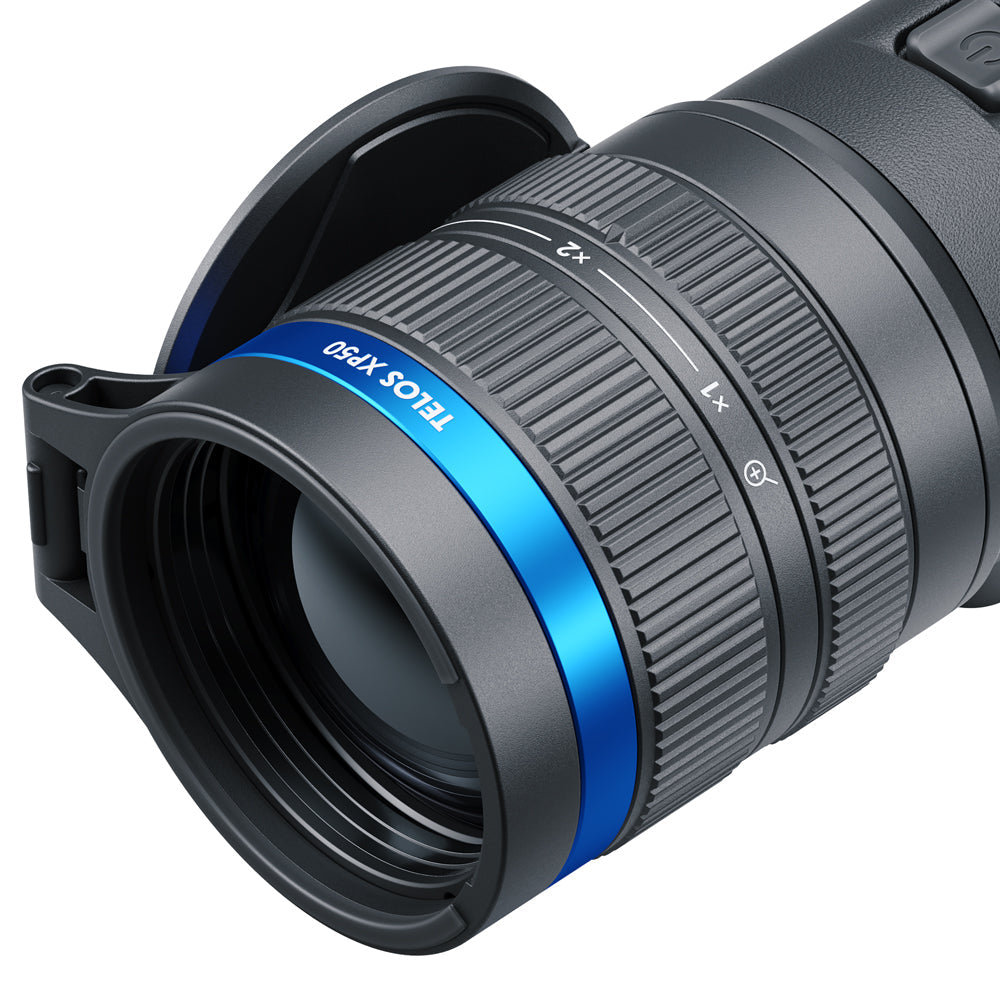
The focus and zoom rings ride together on the lens, so bringing an animal from a glow to a readable image is one continuous motion of the same hand. The rubber coated body is sealed to IPX7, which covers full submersion, not just rain.
High Thermal Sensitivity Keeps the XP50 Readable in Humidity and Fog
Thermal contrast is the difference between an animal and the ground behind it. On a cold dry night that difference is huge and any sensor looks good. On a warm humid night, after rain, or over wet ground, the temperature differences shrink, and a sensor with ordinary sensitivity renders the scene as flat gray mush.
The XP50's sensor is tuned for exactly those shrunken differences. Coyotes still separate from wet pasture, hogs still stand out against a drizzled-on field edge, and a bedded animal still reads as an animal instead of a warm rock. If your season includes more damp nights than dry ones, this is the spec that decides whether the scanner earns its keep.
The XP50 Runs a 2.5x Base With Digital Zoom to 10x
The optical base is a fixed 2.5x, and the zoom ring carries the image digitally to 10x. The low base keeps the field of view wide at 12.4 degrees, which is what you want in a scanner: more ground in the frame per sweep, less time waving the unit around looking for the edge of a field.
A 640x480 sensor also means the digital zoom has real pixels to work with, so pushing in on a heat source keeps enough detail to make the call.
Pixels on Target Set What the XP50 Can Identify
Detecting a heat source and identifying what made it happen at different distances, and the gap between them is set by how many pixels land on the animal. The XP50's 640 sensor puts enough pixels on a coyote or a hog to identify at the distances open pasture and crop field work actually produce, well before the detection number on the spec sheet becomes relevant.
The XP50 Records Footage and Runs 8.5 Hours on a Pack
Video and photos record at 1024x768 to 64GB of internal memory, and move to your phone over Wi-Fi through the Stream Vision 2 app on either the 2.4 or 5 GHz band.
The battery is the removable LPS 7i, rated for 8.5 hours, charged over USB-C from any common charger including the one in your truck, with wireless charging supported. One pack covers a full night; a spare in a pocket covers a bad one.
Weatherproofing and the Upgrade Service Extend the XP50's Life
The operating range runs from -25 to +40 degrees C, and the IPX7 rating means a dunked unit is an inconvenience rather than a loss. This is equipment built for wet boots and truck beds.
The Telos platform is also built to accept hardware upgrades through Pulsar's upgrade service, including a laser rangefinder, a different sensor, or a different objective lens. What you buy today is a starting configuration, not a final one.
Who the XP50 Fits and Who Should Keep Looking
Buy the XP50 if your hunting happens in a climate with real humidity, if you glass over water, irrigated ground, or river bottoms, or if last season taught you that your thermal goes soft exactly when the conditions get interesting.
If your ground is close and your distances short, the smaller XQ35 covers the same job for less money. If you want distance readouts built into the scanner, the LRF XP50 is this same optic with a rangefinder in the housing.
Telos XP50 FAQ
What makes the Telos XP50 good in humid conditions?
Its sensor is built for high thermal sensitivity, which means it renders the small temperature differences that humid air, fog, and wet ground leave behind. The practical result is an image that keeps contrast on nights when conditions are working against you.
How far can the XP50 detect heat?
Detection means noticing a heat source, and identification always happens much closer. The rated detection figure is in the specifications on this page; plan your hunting around identification distance, not the detection number.
Does the XP50 have a rangefinder?
No. This is the non-rangefinder version. The same optic is sold as the Telos LRF XP50 with a laser rangefinder built in, and the Telos platform is built to accept a rangefinder upgrade later through Pulsar's service.
What battery does it use?
The removable LPS 7i pack, rated for 8.5 hours, charging over USB-C or wirelessly. Spare packs swap in the field without tools.
Can the XP50 record and share video?
Yes. It records at 1024x768 to 64GB of internal memory and streams or transfers to a phone through the Stream Vision 2 app.
Stream Vision 2
Wi-Fi integration with iOS and Android devices


Technical Specifications
-
Sensor Resolution (px)
640x480 -
Display Resolution (px)
1024x768 -
NETD Rating
18 -
Detection Range
1900 -
Refresh Rate (Hz)
50 -
Field of View
10.5
-
Weight
1.3 lb -
Dimensions
9.3 in 2.8 in 3.5 in -
HZ - refresh rate
50 -
Category
Thermal Handheld -
Handhelds
Yes -
Thermal Sensor Resolution
640x480 -
Display Resolution
1024x768 -
Pixel Pitch
17 -
NETD Rating
18 -
Detection Range
1900 -
Range Finder
No -
Clip-On
No -
Magnification Base
2.5 -
Magnification Max
10 -
Objective Lens
50 -
Field of View
10.5