


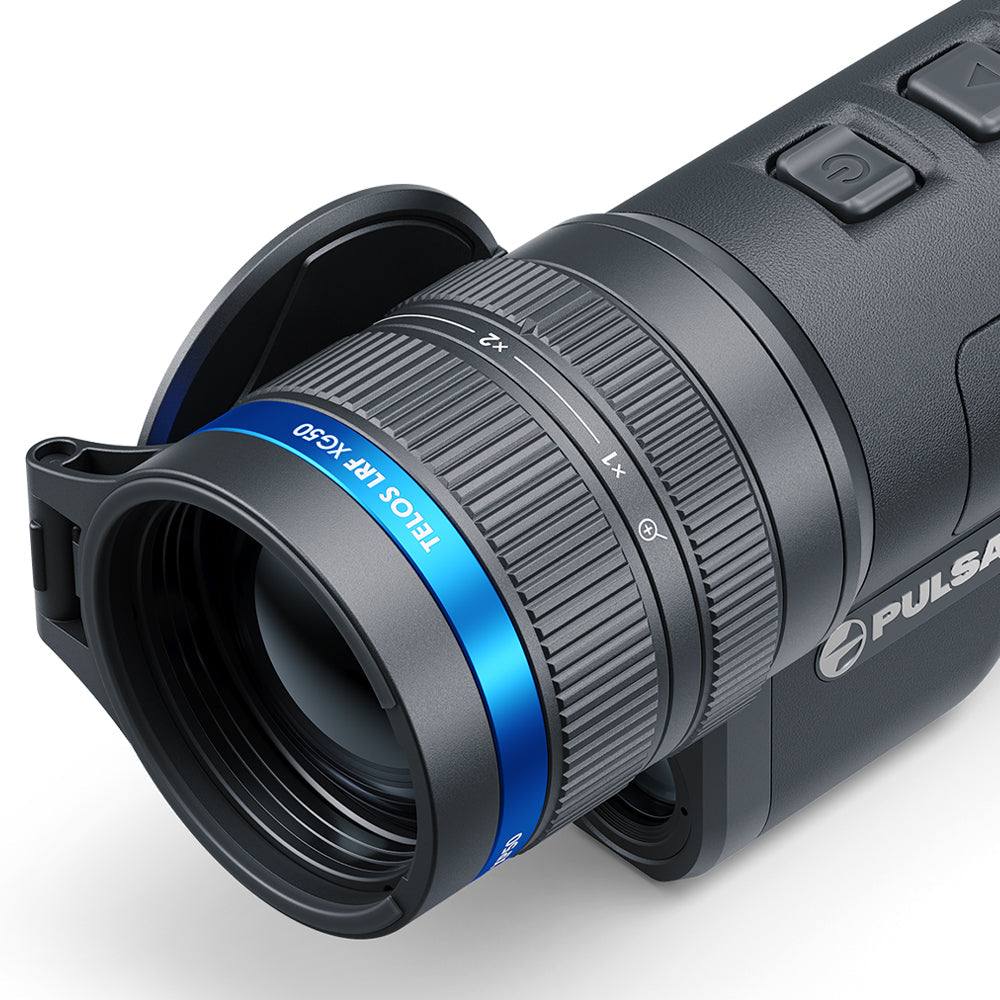
Quick answer
Clear picture, rangefinder, and a great design? We have seen a lot of handhelds and this telos line is at the top.
Who this is for
Best for
Best for serious hunters and landowners who want a premium handheld thermal monocular with laser rangefinding for scanning, locating heat fast, and judging distance before they ever shoulder a rifle.
Not ideal for
Not ideal for buyers who want a dedicated rifle-mounted thermal scope, need two-eye viewing comfort for long sits, or only want the cheapest way to try thermal.
Quick specifications
- Category
- Thermal Handheld
- Sensor Resolution
- 640x480
- Magnification
- 3.5-14x
- Objective Lens
- 50
- Detection Range
- 2500
- Rangefinder
- Yes
Why buy from Thermal Bros
Full product description
The Pulsar Telos LRF XG50 Starts at 3.5x and Runs to 14x
The Pulsar Telos LRF XG50 is a handheld thermal monocular built for looking a long way. Magnification starts at a fixed 3.5x optical base, and the zoom ring carries the image digitally to 14x.
A high base magnification means the animal is already sized up when the unit comes to your eye. There is no rolling the zoom forward to figure out what you are looking at; the image arrives at working magnification.
A Narrow 8.8 Degree Field Is the Tradeoff for That Reach
Field of view is 8.8 degrees, and that number is the honest cost of the magnification. You see less ground per sweep, so clearing a field takes more passes and more time.
Whether that is a problem depends entirely on your ground. Down a long lane, a power line cut, or a crop row, a tight field is not a limitation because the ground itself is narrow. Across an open pasture where animals can appear anywhere, the narrow view will cost you.
The 640 Sensor Here Uses Smaller Pixels
This unit runs a 640x480 sensor on 12 micron pixels behind a 50mm lens. Smaller pixels make for a physically smaller sensor, and behind the same lens that produces the higher magnification and the narrower field the model is built around.
That is worth understanding before you shop by resolution alone. Two 640 scanners can behave completely differently in the field depending on pixel size, and this one is built to reach rather than to sweep.
Distance Readings Come Built In
A laser rangefinder is integrated into the housing, so you can range what you are looking at without lowering the unit or reaching for a second device. The distance appears on the display and is captured in recorded footage.
Laser reach and identification distance are not the same measurement. The laser returns a number off a surface well beyond the distance at which the thermal image will tell you what animal is standing there, and identification is what governs an ethical shot.
Recording, Streaming, and Power on the XG50
Video and photos record to 64GB of built-in storage and transfer to your phone over Wi-Fi through the Stream Vision 2 app.
Power comes from a removable battery pack rated for 8.5 hours, charged with the same USB-C cable that charges your phone, or wirelessly. Swapping a spare takes seconds and no tools.
Built for Weather and for Later Upgrades
The housing is rubber coated, runs the same in either hand, and is fully waterproof, rated to survive a drop into shallow water rather than just shedding rain.
The Telos platform accepts hardware upgrades through Pulsar's upgrade service, including a higher tier sensor or a different lens, so a change in how you hunt does not have to mean a new unit.
Who Should Skip the XG50
If most of what you find is inside a couple hundred yards, the magnification here is working against you, and a wider unit will find animals faster. If your nights are mostly humid, foggy, and wet, image contrast in bad air matters more than reach, and the XP50 is built around that instead.
If you want a wide view and deep zoom rather than a fixed reach bias, the XL50 covers more of that range. Still deciding? Call us and tell us what your ground looks like, because terrain settles this choice faster than any spec sheet will.
Telos LRF XG50 FAQ
Why does the Telos LRF XG50 magnify more than other 640 scanners?
It uses 12 micron pixels rather than 17, which makes the sensor physically smaller. Behind the same 50mm lens, a smaller sensor yields higher magnification and a narrower field of view.
Is the narrow field of view a problem?
It depends on your terrain. Down lanes, cuts, and rows, the ground is narrow anyway and the tight field costs you nothing. Across open country where animals can appear anywhere, you will sweep more to cover the same area.
How far does the rangefinder reach?
The rated maximum is in the specifications on this page. It describes the laser returning a reading under good conditions, not a distance at which an animal can be identified or ethically shot.
What is the battery life?
A removable pack rated for 8.5 hours, charged over USB-C or wirelessly. Ranging draws extra power, so heavy use shortens that figure.
Does the XG50 record video?
Yes, to 64GB of built-in storage, with transfer to a phone through the Stream Vision 2 app.
Stream Vision 2
Wi-Fi integration with iOS and Android devices


Technical Specifications
-
Sensor Resolution (px)
640x480 -
Display Resolution (px)
1024x768 -
NETD Rating
40 -
Detection Range
2500 -
Refresh Rate (Hz)
50 -
Field of View
8.8
-
Weight
1.5 lb -
Dimensions
9.3 in 2.8 in 3.5 in -
HZ - refresh rate
50 -
Category
Thermal Handheld -
Handhelds
Yes -
Thermal Sensor Resolution
640x480 -
Display Resolution
1024x768 -
Pixel Pitch
12 -
NETD Rating
40 -
Detection Range
2500 -
Range Finder
Yes -
Clip-On
No -
Magnification Base
3.5 -
Magnification Max
14 -
Objective Lens
50 -
Field of View
8.8