


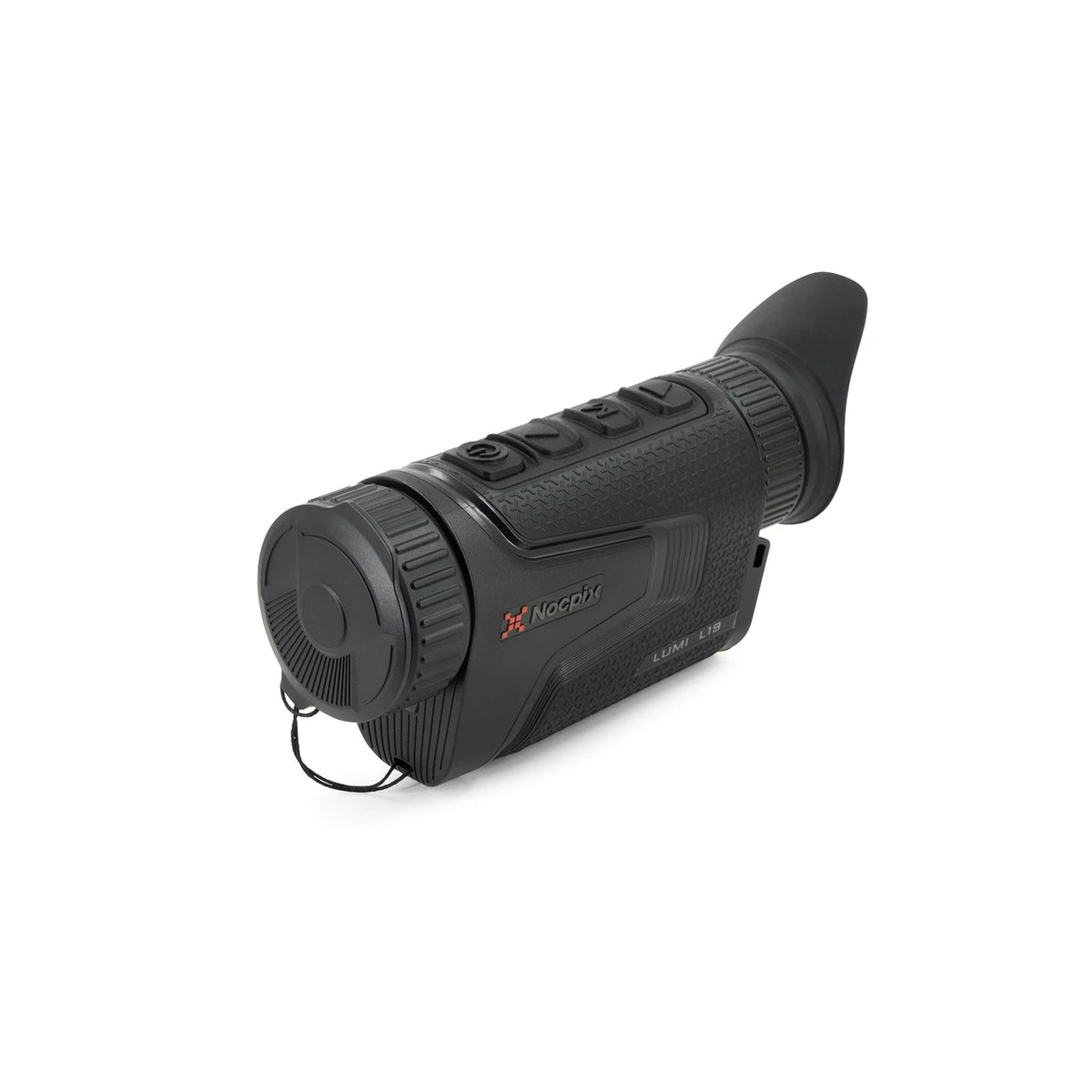
The Nocpix LUMI L19 is a compact handheld thermal monocular for hunters, ranchers, and landowners who want to locate heat without raising a rifle. Its 384x288 thermal sensor, 19mm f/0.9 lens, and 2x native magnification make it a practical scanner for mixed terrain, field edges, and property checks. Nocpix lists a maximum detection distance of 1,070 yards. That is a heat-detection figure, not a guarantee of identifying an animal at that distance.
Why Choose the Nocpix LUMI L19?
- 384x288 thermal resolution: The L19 has 2.25 times as many thermal sensor pixels as the 256x192 LUMI P13, providing more image information for interpreting heat signatures.
- 19mm f/0.9 objective lens: A practical combination for scanning fields, timber edges, pastures, and mixed terrain.
- 2x base magnification: Starts with a useful field of view rather than an overly narrow image, making repeated scanning easier.
- High-sensitivity thermal imaging: A manufacturer-listed sensitivity of less than 18 mK NETD helps reveal subtle temperature differences.
- 1024x768 AMOLED display: Provides a detailed viewing screen, supported by Reality+ image processing and a 50 Hz refresh rate.
- Compact handheld design: Weighs approximately 10.93 ounces according to the model-specific manufacturer specifications, with a rubberized polymer housing and ambidextrous controls.
- Recording and connectivity: Includes 32 GB internal storage, photo and video recording, audio recording, Wi-Fi, and mobile app compatibility.
- Replaceable battery system: Uses rechargeable 18650 batteries and supports external USB-C power.
Who Is the LUMI L19 Best For?
Coyote and Predator Hunters
When hunting coyotes or other predators, a separate handheld scanner lets you search a field without continuously looking through a rifle-mounted optic. The L19 is a practical option for locating heat along tree lines, field edges, and open ground before evaluating the animal more closely.
Hog Hunters
Finding a group of hogs often requires scanning larger areas and checking multiple heat signatures. The L19 provides a portable way to locate animals before transitioning to your primary observation or shooting optic. Its 2x starting magnification is useful when scanning, although the image becomes less detailed as digital magnification increases.
Ranchers and Landowners
The compact L19 can be useful for checking livestock areas, fence lines, property edges, and heat signatures around buildings. Thermal imaging works in daylight and darkness because it detects temperature differences rather than visible light. It does not see through solid walls, ordinary glass, or dense obstacles.
Where the LUMI L19 Falls Short
The L19 is a handheld observation monocular, not a thermal riflescope, helmet-mounted navigation optic, or dedicated laser rangefinder. Its 384x288 sensor provides useful detail for its class, but it cannot match the image information available from a higher-resolution 640 or 1280 thermal sensor.
Digital zoom enlarges the original sensor image rather than creating additional detail. Hunters who regularly scan very large, open fields or need to distinguish animals at longer distances may benefit from a higher-resolution or longer-lens handheld.
Nocpix LUMI L19 vs. LUMI P13
The L19 and P13 are both compact handheld thermal monoculars with 2x native magnification, 50 Hz refresh rates, AMOLED displays, and removable rechargeable batteries. Their main differences are sensor resolution, lens size, and published detection distance.
The LUMI L19 uses a 384x288 sensor with a 19mm objective and a published 1,070-yard detection range. The LUMI P13 uses a 256x192 sensor with a 13mm objective and a published 730-yard detection range.
Our recommendation: Choose the L19 if you scan frequently, work across larger fields, or want more detail when interpreting heat signatures. Choose the P13 if you mainly need basic heat detection at closer distances and want to keep the cost down. Neither model should be used to identify an animal solely by its maximum detection rating.
Nocpix LUMI L19 Technical Specifications
| Manufacturer | Nocpix |
|---|---|
| Model | LUMI L19 |
| Product type | Handheld thermal monocular |
| Thermal sensor | 384x288 |
| Sensor pixel pitch | 12 microns |
| Thermal sensitivity | <18 mK NETD |
| Objective lens | 19mm f/0.9 |
| Native magnification | 2x |
| Digital magnification | Up to 4x digital enlargement; up to 8x apparent magnification |
| Field of view | 13.8 degrees horizontal x 10.4 degrees vertical |
| Detection distance | 1,070 yards (manufacturer published) |
| Refresh rate | 50 Hz |
| Display | 1024x768 AMOLED |
| Image processing | Reality+ |
| Color palettes | White Hot, Black Hot, Red Hot, Color, Violet, Crimson, Viridian |
| Picture-in-picture | Yes |
| Recording | Photo, video, and audio |
| Internal storage | 32 GB |
| Connectivity | Wi-Fi, mobile app, USB-C |
| Battery | Removable rechargeable 18650 |
| External power | USB-C |
| Manufacturer-listed runtime | 4+ hours; actual runtime varies with conditions and settings |
| Environmental protection | IP67 |
| Weight | 10.93 oz, manufacturer-listed device weight |
| Laser rangefinder | No |
| Manufacturer warranty | 5 years, subject to manufacturer terms |
| Manufacturer SKU | LUMI-L19 |
Battery and Accessories
The LUMI L19 operates on a removable rechargeable 18650 battery. Nocpix describes the package as including a spare battery and a MOLLE-compatible carrying pouch. Confirm current package contents and battery compatibility before purchasing replacement accessories.
For help with compatible batteries, visit the Thermal Bros Battery Finder. You can also visit our Product Manuals & Setup page for manufacturer instructions and support resources.
Frequently Asked Questions About the Nocpix LUMI L19
How far can the Nocpix LUMI L19 detect an animal?
Nocpix publishes a maximum detection range of 1,070 yards. Detection means noticing a heat signature, not necessarily recognizing the species or identifying the animal. Useful recognition and identification generally require shorter distances and depend on conditions, target size, and image detail.
Is the LUMI L19 good for coyote hunting?
The L19 can be a useful handheld scanner for locating coyotes and other predators, especially when you want to scan without pointing a rifle at every heat signature. It should not be relied upon for positive identification at its maximum detection range.
Is the LUMI L19 better than the LUMI P13?
For thermal sensor detail, yes. The L19 has a 384x288 sensor compared with the P13's 256x192 sensor. If you scan frequently or work at greater distances, the additional detail can justify the upgrade. For occasional, shorter-range heat detection, the P13 may be sufficient.
Can the LUMI L19 be mounted on a rifle?
No. The LUMI L19 is intended for handheld thermal observation. If you need a weapon-mounted optic, compare our thermal riflescopes.
Does the Nocpix LUMI L19 work during daylight?
Yes. Thermal imaging detects temperature differences and can operate during daylight or darkness. Image contrast still depends on weather, background temperatures, and environmental conditions.
Does the LUMI L19 have a laser rangefinder?
No. The L19 does not include an integrated laser rangefinder.
What battery does the LUMI L19 use?
The L19 uses a removable rechargeable 18650 battery and supports USB-C external power. Battery size alone does not guarantee replacement compatibility, so verify the cell specifications before buying additional batteries.
Is the Nocpix LUMI L19 Right for You?
At Thermal Bros, we believe the best thermal monocular is the one that fits how you actually hunt or use your property. The L19 is a solid option for buyers wanting compact 384x288 thermal scanning without paying for features they do not need.
If you are comparing handhelds, browse our thermal handheld collection or our complete Nocpix lineup. You can also review night hunting and thermal-use regulations by state.
Not sure whether the L19 is enough for your terrain? Contact Thermal Bros at info@thermalbros.com or call 866-464-4461. Tell us your typical scanning distance, terrain, and budget. We will help you make the right buying decision.
Specifications are based on manufacturer-published information and may change. Detection distance is not the same as animal recognition or positive identification. Follow applicable hunting laws and manufacturer operating instructions.


