


Quick answer
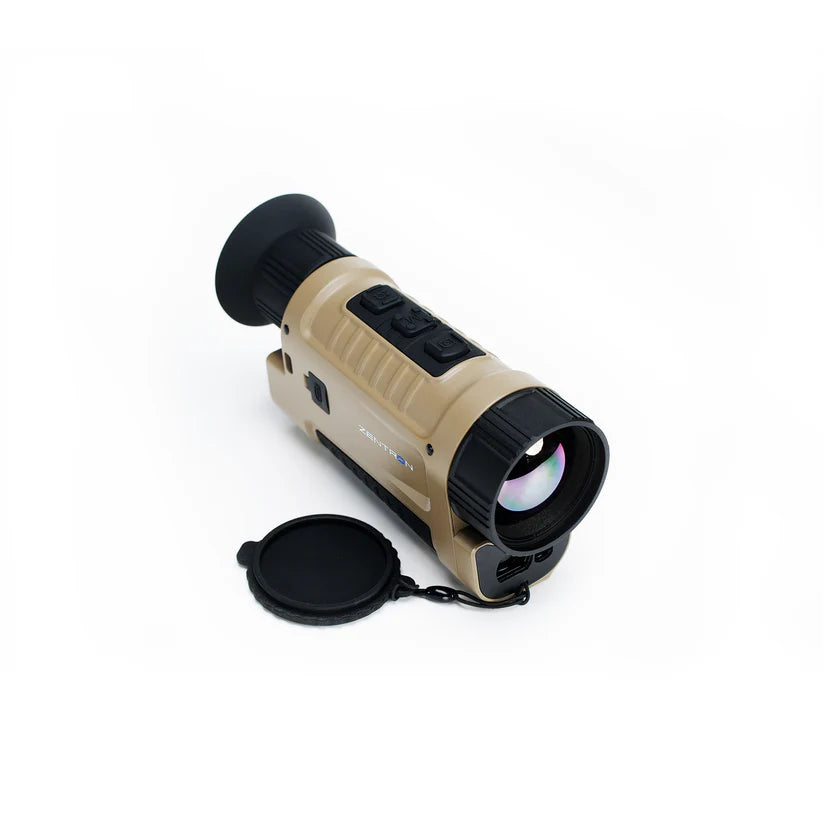
The Zentron M6 is a 640×512 handheld thermal monocular built for hunters who want a serious scanner without the extras of the Pro. You choose your lens at purchase — the 25R with a 25mm...
Who this is for
Best for
Buyers who need portable thermal scanning for spotting, scouting, and recovery work.
Not ideal for
Buyers who need a mounted shooting optic or a permanent fixed-position solution.
Quick specifications
- Category
- Thermal Handheld
- Sensor Resolution
- 640x512
- Magnification
- 1.9-15.2x
- Objective Lens
- 35
- Detection Range
- 1950
- Rangefinder
- Yes
Why buy from Thermal Bros
You get real product guidance, financing options, and trade-in or consignment help when available.
Full product description
The Zentron M6 is a 640×512 handheld thermal monocular built for hunters who want a serious scanner without the extras of the Pro. You choose your lens at purchase — the 25R with a 25mm lens for the widest scanning view, or the 35R with a 35mm lens for more reach. It is a dedicated scanner, not a rifle scope, and it does not include a rangefinder. It is for finding and identifying game before you move or set up.
Should You Choose the M6 25R or the M6 35R?
Choose the 25R if you want the widest field of view for fast scanning in brush and close cover, and the 35R if you want more reach and a tighter, more magnified image across open ground. The lens is fixed and chosen when you buy — you are picking one, not swapping between them in the field.
The 25mm lens on the 25R gives you a 31.5-meter-wide view at 100 meters, which is what you want when you are sweeping a field edge or working timber and creek bottoms. You cover ground fast and you are less likely to miss movement at the margins. Its tradeoff is reach: shorter detection and identification distances.
The 35mm lens on the 35R narrows the view to about 22 meters wide at 100 meters but pushes detection and identification farther out, which is the better fit for open pastures, crop fields, and longer calling setups. Its tradeoff is a tighter view that shows you less ground at once.
Here is how the two compare directly:
|
Spec |
M6 25R (base) |
M6 35R (larger lens) |
|---|---|---|
|
Lens |
25mm f0.9 |
35mm f0.9 |
|
Optical magnification |
1.4x |
1.9x |
|
Field of view @100m |
31.5m |
22m |
|
Detection range |
1200m |
1800m |
|
Identification range |
400m |
600m |
|
Weight |
356g / 12.55 oz |
350g / 12.34 oz |
If you mostly hunt one type of ground, pick the lens that matches it and you will be well served. If you need one device that reconfigures for both close and far — swapping lenses in the field and adding a rangefinder — that is the M6 Pro, a different product.
What's the Difference Between Detection Range and Identification Range?
Detection range is how far away the M6 can show you that something warm is present; identification range is how far away you can actually tell what it is. Detection numbers are always much larger. On the 35R, detection reaches 1800m while identification is rated at 600m — and this gap holds for every thermal device, not just this one.
Put simply: detection is a shape or a blob, enough to know the field is not empty. Identification is telling coyote from dog, hog from stump, and which way it is facing. A buyer who reads the detection number and expects to make a shot decision at that distance will be disappointed by any thermal on the market.
Use detection range to understand how far out the device will alert you that something is worth walking toward. Use identification range to understand where you can actually make a call. The 25R and 35R detection and identification figures are in the comparison table above.
What Does the M6's 640×512 Sensor Actually Do for You?
The M6's 640×512 sensor resolves enough detail to identify an animal's species and posture, not just detect that something warm is present. It is a VOx uncooled detector with a 12µm pixel pitch running at 50Hz — the resolution tier where thermal stops being "I see a heat blob" and becomes "I can see the shape of the animal and which way it's moving."
Compared to a 384×288 sensor, you are getting roughly 2.4 times the pixels on target, which is why identification distances stretch out the way they do. Thermal sensitivity is strong, which is what lets you pick an animal out of warm brush or see a body against ground that has been holding the day's heat — the marginal conditions where cheaper sensors go flat.
How Long Does the M6 Last, and How Does It Hold Up in the Field?
The M6 runs up to 7 hours on a single 18650 battery, carries an IP67 waterproof rating in a magnesium housing, and works from -20°C to 50°C (-4°F to 122°F). It is built to run a full night of scanning and take weather and rough handling while it does.
Display. The image is shown on a high-definition OLED display, so you are not losing detail at the eyepiece.
Power management. A built-in accelerometer and digital compass drive an automatic battery-saving mode: when the device tilts more than 65° up or down — which is what happens when it is hanging from your neck or sitting in your lap — the screen shuts off automatically and you get the battery back without thinking about it.
Startup. Under 5 seconds from off to image.
Storage and app. 64GB onboard. WiFi, Bluetooth, and a built-in mic. The ZEN LINK app handles photo and video transfer, live screen sharing, and remote control from your phone.
Build. Magnesium housing, IP67 sealed, rated -20°C to 50°C (-4°F to 122°F). Compact and lightweight for extended handheld scanning.
Who Should Buy the Zentron M6 — and Who Shouldn't?
The M6 is best for hunters who want a dedicated 640 handheld scanner, mostly work one type of terrain, and do not need a rangefinder or interchangeable lenses. It is not the right pick if you need ranging built in, want to swap lenses for different ground, or need an optic you can shoot through. The breakdown below covers both.
The M6 makes sense if:
You want a dedicated scanner. Scanning with a weapon-mounted optic means pointing a rifle at everything you look at. A handheld monocular separates looking from aiming, which is safer and faster.
You hunt mostly one kind of ground. Pick the lens that matches your terrain — 25R for brush and close cover, 35R for open country — and a fixed lens serves you well for less than a multi-lens setup.
You want 640 detail without the Pro's extras. You get the same 640×512 sensor as the Pro. What you give up is the interchangeable lens kit and the built-in rangefinder.
Skip it if:
You need a rangefinder. The M6 does not have one. If ranging distance at night matters to you, look at the M6 Pro, which includes a 1200m laser rangefinder.
You hunt varied terrain and want to swap lenses. The M6's lens is fixed at purchase. If you move between close brush and open ground and want one device for both, the M6 Pro ships with all three lenses and swaps in the field.
You need a weapon-mounted optic. This is not a scope and does not mount to a rifle. To shoot thermal, you need a thermal scope or a clip-on.
Does the Zentron M6 have a rangefinder?
No. The base M6 — both the 25R and 35R — does not include a rangefinder. If you want a built-in laser rangefinder, the M6 Pro has a 1200m unit with ±1m accuracy.
What is the difference between the M6 25R and the M6 35R?
They are the same monocular with a different fixed lens. The 25R has a 25mm lens with a wider field of view for scanning close cover; the 35R has a 35mm lens with more reach and magnification for open ground. You choose one at purchase — the lens is not interchangeable.
Can I change the lens on the M6 after buying it?
No. The M6's lens is fixed. You select the 25R or the 35R when you buy. If you want a device that swaps lenses in the field, that is the M6 Pro, which ships with 25mm, 35mm, and 50mm lenses.
Can the Zentron M6 be mounted on a rifle?
No. The M6 is a handheld thermal monocular for scanning, spotting, and identifying. It is not a weapon-mounted optic and has no reticle. To shoot with thermal, you need a dedicated thermal scope or a clip-on.
At what range can the M6 actually identify an animal?
Identification range depends on the lens: 400m on the 25R and 600m on the 35R. These are shorter than the detection ranges (1200m and 1800m) because detecting a heat signature and identifying what it is are two different things. Use the identification figure to judge where you can make a real decision.
How long does the battery last?
Up to 7 hours of continuous operation on a single 18650 battery. The automatic screen-off feature, which triggers when the device is tilted more than 65° up or down, helps extend that in practice.
Is the M6 waterproof?
It carries an IP67 rating, meaning it is sealed against dust and protected against temporary immersion in water. It handles rain, fog, and heavy dew without issue.
How is the M6 different from the M6 Pro?
The M6 is a fixed-lens scanner with no rangefinder — you pick the 25R or 35R lens at purchase. The M6 Pro ships with all three lenses (25mm, 35mm, 50mm) as a tool-free interchangeable kit and adds a built-in 1200m laser rangefinder. Same 640×512 sensor on both.
Thermal Bros Take
The Zentron M6 is the scanner I would point people toward if they want a dedicated 640 handheld thermal monocular with a built-in rangefinder. It is not trying to be a rifle scope. It is built for scanning, spotting, ranging, and making better decisions before the shot.
If you already have a thermal scope and want a better way to scan safely, the M6 makes a lot of sense. If you are trying to buy one optic that can both scan and shoot, look at one of the Zentron Q Series thermal scopes instead. If your goal is a dedicated handheld thermal scanner with 640 detail and rangefinding capability, the Zentron M6 is the stronger fit.
Technical Specifications
-
Sensor Resolution (px)
640x512 -
Display Resolution (px)
1920 x 1080 -
NETD Rating
18 -
Detection Range
1950 -
Refresh Rate (Hz)
50 -
Field of View
12.5
-
Weight
0.9 lb -
HZ - refresh rate
50 -
Thermal Sensor Resolution
640x512 -
Display Resolution
1920 x 1080 -
Pixel Pitch
12 -
NETD Rating
18 -
Detection Range
1950 -
Range Finder
Yes -
Clip-On
No -
Magnification Base
1.9 -
Magnification Max
15.2 -
Objective Lens
35 -
Field of View
12.5