


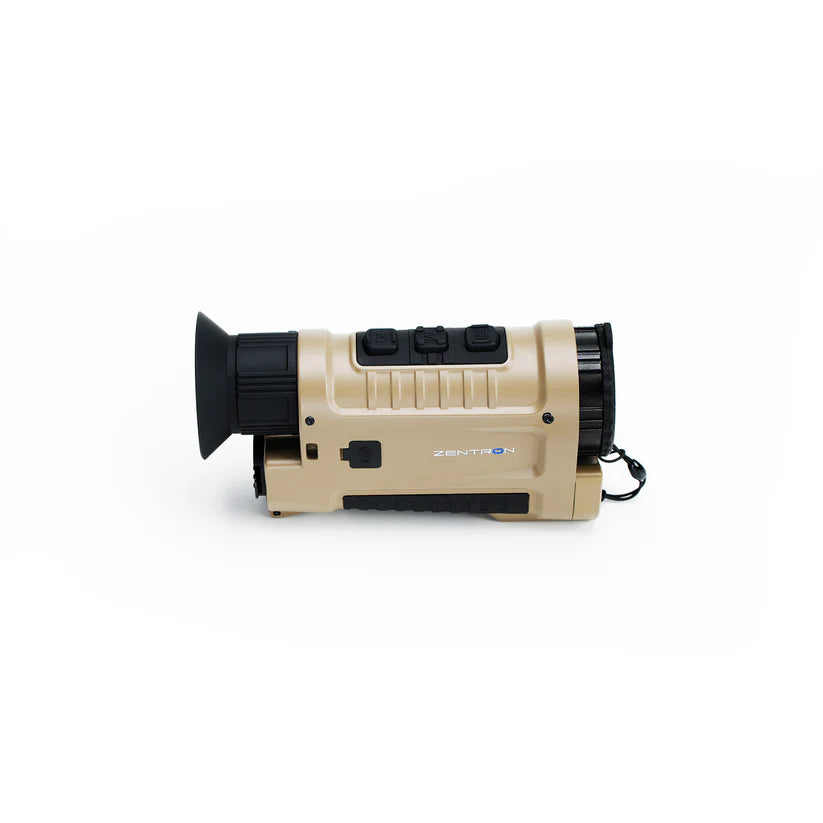


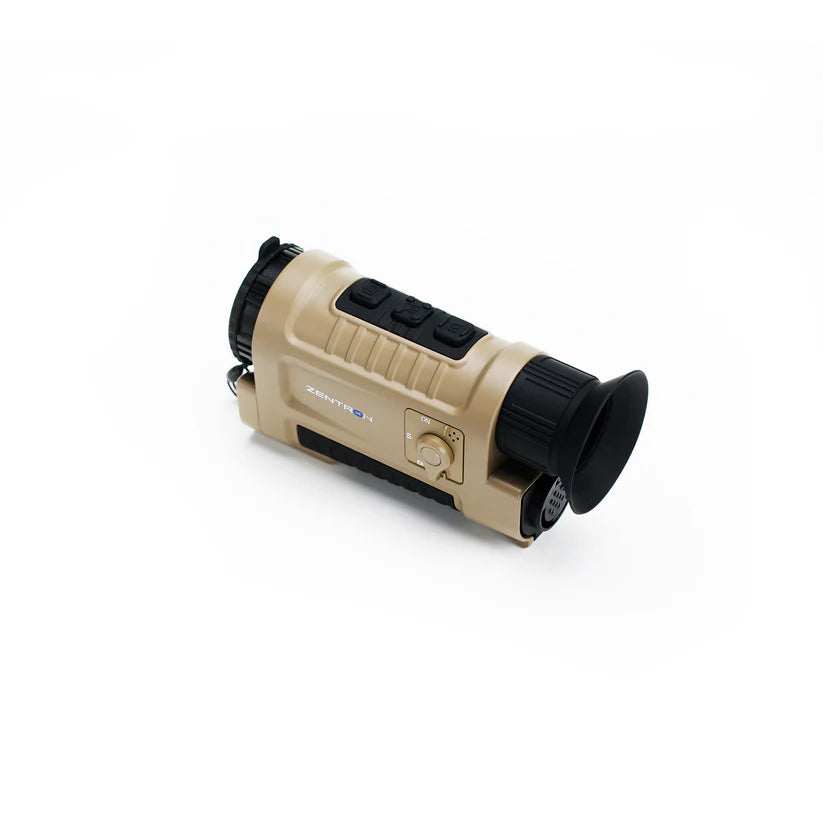
Quick answer
The Zentron M6 Pro is a 640×512 handheld thermal monocular that ships with three interchangeable lenses — 25mm, 35mm, and 50mm — and a built-in 1200-meter laser rangefinder. The 25mm is the base lens and...
Who this is for
Best for
If you want 25-50mm lens capability
Not ideal for
Buyers who need a mounted shooting optic or a permanent fixed-position solution.
Quick specifications
- Category
- Thermal Handheld
- Sensor Resolution
- 640x512
- Magnification
- 1.4-2.1x
- Objective Lens
- 50
- Detection Range
- 2800
- Rangefinder
- Yes
Why buy from Thermal Bros
You get real product guidance, financing options, and trade-in or consignment help when available.
Full product description
The Zentron M6 Pro is a 640×512 handheld thermal monocular that ships with three interchangeable lenses — 25mm, 35mm, and 50mm — and a built-in 1200-meter laser rangefinder. The 25mm is the base lens and gives you the widest field of view for scanning; the 35mm and 50mm swap in tool-free when you need more reach across open ground. It is a scanner, not a rifle scope: it is built for finding, identifying, and ranging before you ever shoulder a rifle.
How Do the M6 Pro's Interchangeable Lenses Change What You Can See?
The M6 Pro's three lenses trade field of view for reach: the 25mm shows you the widest area for fast scanning, the 50mm shows you a narrower but magnified image that holds detail farther out, and the 35mm sits between them. All three come in the box and swap without tools, so one device covers close brush and open ground both.
Most thermal monoculars lock you into one lens, which means one field of view and one effective range. The M6 Pro does not. That matters because scanning and reaching are two different jobs.
A short lens (25mm) gives you a wide field of view — 17.5° horizontal, about 31.5 meters of visible width at 100 meters. Wide views are what you want when you are sweeping a field edge or working brush, because you cover ground fast and you are less likely to miss movement at the margins.
A long lens (50mm) gives you a narrow field of view — 8.8° horizontal, about 15.5 meters wide at 100 meters. You see less at once, but what you do see is magnified and holds detail further out.
The tradeoff is real and it goes both directions. A wide lens will not let you identify an animal at distance. A long lens will make you feel like you are looking through a straw when something moves close and fast. Owning all three means you pick the right one for the ground you are actually standing on, instead of buying a second monocular.
What's the Difference Between Detection Range and Identification Range?
Detection range is how far away a thermal device can show you that something warm is present; identification range is how far away you can actually tell what it is. Detection numbers are always much larger — on the M6 Pro's 50mm lens, detection reaches 2600m while identification is rated at 700m. This gap holds true for every thermal device, not just this one, and it is the single most misread spec in the category.
Put simply: detection is a shape or a blob — enough to know the field is not empty. Identification is telling coyote from dog, hog from stump, and which way it is facing. Here is how the M6 Pro's three lenses actually break down:
|
Lens |
Detection Range |
Identification Range |
Field of View @100m |
|---|---|---|---|
|
25mm |
1200m |
400m |
31.5m |
|
35mm |
1800m |
600m |
22m |
|
50mm |
2600m |
700m |
15.5m |
A buyer who reads "2600m" and expects to make a shot decision at 2600 meters is going to be disappointed by any thermal device on the market. Use detection range to understand how far out the device will alert you that something is worth walking toward. Use identification range to understand where you can actually make a call.
How Does the M6 Pro's Built-In Rangefinder Work?
The M6 Pro's built-in Class 1 laser rangefinder measures distance out to 1200 meters with ±1 meter accuracy and displays the reading on-screen while you look through the device. You point, range, and get a number without lowering the monocular or reaching for a separate tool. It operates at 905nm with a 5-meter minimum measuring range.
Judging distance through a thermal image at night is genuinely difficult. There are no reference objects, no depth cues, and a coyote at 180 yards and a coyote at 320 yards can look surprisingly similar through a monocular. Guessing wrong changes everything downstream — whether you call, whether you move, whether the shot is one you should take at all.
A rangefinder removes the guess. You range the animal, you range the tree line behind it, and you know what you are dealing with before you commit.
Note that the rangefinder's 1200-meter maximum sits well beyond the identification range of any of the three lenses. In practice you will be ranging things you can already see clearly, which is exactly what you want.
What Does the M6 Pro's 640×512 Sensor Actually Do for You?
The M6 Pro's 640×512 sensor resolves enough detail to identify an animal's species and posture, not just detect that something warm is present. It is a VOx uncooled detector with a 12µm pixel pitch running at 50Hz — the resolution tier where thermal stops being "I see a heat blob" and becomes "I can see the shape of the animal, how it's standing, which way it's moving."
Compared to a 384×288 sensor, you are getting roughly 2.4 times the pixels on target, which is why identification distances stretch out the way they do.
The 12µm pixel pitch keeps the sensor physically compact without sacrificing the pixel count, and the 50Hz refresh rate means the image stays smooth when you pan across a field rather than smearing.
Thermal sensitivity on this unit is strong — it resolves fine temperature differences well, which is what lets you pick an animal out of warm brush or see a body against ground that has been holding the day's heat. That capability matters most in the marginal conditions where cheaper sensors go flat.
How Long Does the M6 Pro Last, and How Does It Hold Up in the Field?
The M6 Pro runs up to 7 hours on a single 18650 battery, carries an IP67 waterproof rating in a magnesium housing, and works from -20°C to 50°C (-4°F to 122°F). It is built to run a full night of scanning and take weather and rough handling while it does. The details below cover battery, display, zoom, power management, storage, and build.
Battery. One 18650 battery, up to 7 hours of continuous runtime. That covers a full night of scanning without a swap, and spares are small and easy to carry.
Display. 1280×1024 OLED. The image you look at is sharper than the sensor feeding it, which means you are not losing detail at the eyepiece.
Zoom. Digital zoom scales with the lens: 1.4–11.2x on the 25mm, 1.9–15.2x on the 35mm, and 2.1–16.8x on the 50mm.
Power management. Built-in accelerometer and digital compass. When the device tilts more than 65° up or down — which is what happens when it is hanging from your neck or sitting in your lap — the screen shuts off automatically. You get the battery back without thinking about it.
Startup. Under 5 seconds from off to image.
Storage and app. 64GB onboard. WiFi, Bluetooth, and a built-in mic. The ZEN LINK app handles photo and video transfer, live screen sharing, and remote control of the device from your phone.
Build. Magnesium housing, IP67 sealed, rated from -20°C to 50°C (-4°F to 122°F).
Weight. 336g with the 25mm lens, 330g with the 35mm, and 370g with the 50mm — 11.85 oz, 11.64 oz, and 13.05 oz respectively. All three are light enough to hold up to your eye for extended scanning without fatigue setting in.
Who Should Buy the Zentron M6 Pro — and Who Shouldn't?
The M6 Pro is best for hunters who work varied terrain and want one device that reconfigures with its lens kit and ranges targets on its own. It is not the right pick if you hunt the same ground every time, need a weapon-mounted optic you can shoot through, or only need to confirm that something is out there. The breakdown below covers both sides.
The M6 Pro makes sense if:
You hunt varied ground. If some nights are thick brush and creek bottoms and other nights are open pasture, the lens system is doing real work for you. You are effectively carrying three configurations in one device.
You want ranging built in. Not having to carry and manage a separate rangefinder is a meaningful simplification when you are working in the dark.
You want a dedicated scanner. Scanning with a weapon-mounted optic means pointing a rifle at everything you want to look at. A handheld monocular separates looking from aiming, which is both safer and faster.
Skip it if:
You hunt the same terrain every time. If you are always in the same open field or always in the same timber, you will find one lens and never touch the other two — and you are paying for flexibility you do not use. A fixed-lens monocular in the right focal length will serve you just as well for less.
You need a weapon-mounted optic. This is not a scope and does not mount to a rifle. If you need to shoot thermal, you need a thermal scope or a clip-on.
You only need to confirm something is out there. If your use is "check the pasture, see if anything's moving," a lower-resolution scanner will do that job and cost considerably less. The 640 sensor and the rangefinder are about making decisions at distance, and if you are not making those decisions, you are buying capability you will not use.
Full Specifications
Detector Type: VOx uncooled
Resolution: 640 × 512
Pixel Size: 12µm
Frame Rate: 50Hz
Spectral Range: 8–14µm
Included Lenses: 25mm f1.0, 35mm f1.0, 50mm f1.0 (interchangeable, tool-free)
Optical Magnification: 1.4x (25mm) / 1.9x (35mm) / 2.1x (50mm)
Field of View: 17.5°(H) × 14°(V) (25mm) / 12.5°(H) × 10°(V) (35mm) / 8.8°(H) × 7°(V) (50mm)
Detection Range: 1200m / 1312 yards (25mm) · 1800m / 1950 yards (35mm) · 2600m / 2800 yards (50mm)
Close-Up Range: 5m
Laser Rangefinder: Class 1, 905nm
Max Measuring Range: 1200m (1312 yards)
Min Measuring Range: 5m
Measurement Accuracy: ±1m
Display Type: OLED
Display Resolution: 1280 × 1024
Digital Zoom: 1.4–11.2x (25mm) / 1.9–15.2x (35mm) / 2.1–16.8x (50mm)
Color Palettes: White Hot, Black Hot, White Highlight, Cold Green, and additional modes
Startup Time: Under 5 seconds
Battery: 1 × 18650
Max Battery Life: 7 hours
USB Interface: Type-C
Built-In Memory: 64GB
Connectivity: WiFi, Bluetooth, built-in microphone
Sensors: Accelerometer and digital compass
Housing Material: Magnesium
Protection Level: IP67
Operating Temperature: -20°C to 50°C (-4°F to 122°F)
Storage Temperature: -40°C to 50°C (-40°F to 122°F)
Dimensions: 160 × 68 × 81mm (50mm lens) · 138.5 × 55 × 81mm (35mm lens) · 150 × 55 × 81mm (25mm lens)
Weight: 370g / 13.05 oz (50mm) · 330g / 11.64 oz (35mm) · 336g / 11.85 oz (25mm)
FAQ
Does the Zentron M6 Pro come with all three lenses?
Yes. The M6 Pro ships with the 25mm, 35mm, and 50mm lenses included. The 25mm is the base configuration, and the other two swap in without tools.
Can the Zentron M6 Pro be mounted on a rifle?
No. The M6 Pro is a handheld thermal monocular built for scanning, spotting, and ranging. It is not a weapon-mounted optic and does not have a reticle. If you need to shoot with thermal, you need a dedicated thermal scope or a clip-on.
At what range can the M6 Pro actually identify an animal?
Identification range depends on the lens: 400m with the 25mm, 600m with the 35mm, and 700m with the 50mm. These are shorter than the detection ranges (1200m, 1800m, and 2600m) because detecting a heat signature and identifying what it is are two different things. Use the identification figure to judge where you can make a real decision about an animal.
How far will the rangefinder read?
The built-in rangefinder has a maximum measuring range of 1200 meters and a minimum of 5 meters, with ±1 meter accuracy.
How long does the battery last?
Up to 7 hours of continuous operation on a single 18650 battery. The automatic screen-off feature, which triggers when the device is tilted more than 65° up or down, helps extend that in practice.
Which lens should I use?
Use the 25mm when you want the widest view for fast scanning and close, brushy ground. Use the 50mm when you are working open country and need to reach and identify at distance. The 35mm sits between the two and is a reasonable all-around choice if you only want to swap occasionally.
Is the M6 Pro waterproof?
It carries an IP67 rating, which means it is sealed against dust and protected against temporary immersion in water. It handles rain, fog, and heavy dew without issue.
How is the M6 Pro different from the M6?
The M6 Pro's defining feature is the interchangeable lens system — all three lenses in one kit — plus the built-in laser rangefinder. The standard M6 models are fixed-lens devices without a rangefinder.
Thermal Bros Take
The Zentron M6 Pro is the step-up scanner over the regular M6. The standard M6 makes sense if you want a dedicated 640 thermal monocular with a built-in rangefinder. The M6 Pro is the better fit if you want more flexibility from interchangeable 35mm and 50mm lenses, plus tracking and app support for more serious field use.
If you hunt the same type of ground most of the time, the regular M6 may be enough. If you move between timber, brush, open fields, pastures, and larger calling setups, the Zentron M6 Pro gives you more ways to match the scanner to the hunt.
Technical Specifications
-
Sensor Resolution (px)
640x512 -
Display Resolution (px)
1920 x 1080 -
NETD Rating
18 -
Detection Range
2800 -
Refresh Rate (Hz)
50
-
Weight
1 lb -
HZ - refresh rate
50 -
Thermal Sensor Resolution
640x512 -
Display Resolution
1920 x 1080 -
Pixel Pitch
12 -
NETD Rating
18 -
Detection Range
2800 -
Range Finder
Yes -
Clip-On
No -
Magnification Base
1.4 -
Magnification Max
2.1 -
Objective Lens
50