


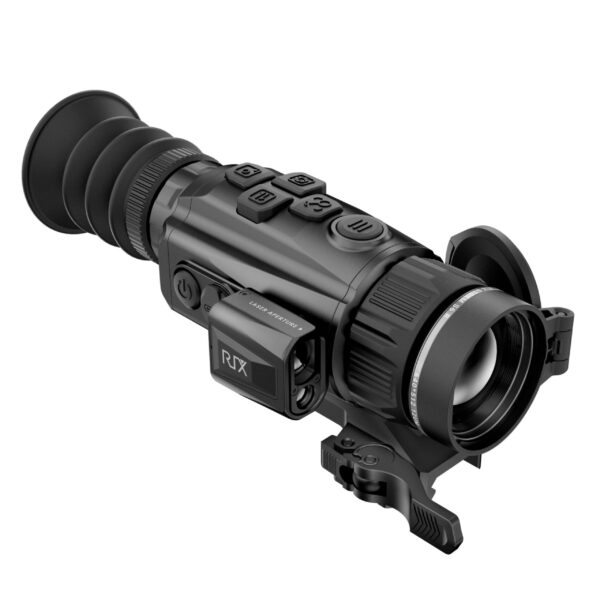
Why Choose this model
The RIX Storm S6R Thermal Rifle Scope is a compact 640x512 thermal scope built for coyote, hog, and predator hunters who want better image detail, built-in ranging, and ballistic support without putting a heavy optic...
Who this is for
Best for
Best for hog, coyote, and predator hunters who want stronger image detail than entry-level thermal without jumping straight to top-tier 1280 pricing.
Not ideal for
Not ideal for buyers who only hunt close range, mainly need a handheld scanner, or want the lowest-cost starting point.
Quick specifications
- Category
- Thermal Rifle Scopes
- Sensor Resolution
- 640x512
- Magnification
- 2-8x
- Objective Lens
- 35
- Detection Range
- 1969
- Rangefinder
- Yes
Why buy from Thermal Bros
Thermal Bros compares thermal scopes by real field use, not spec flex. We will tell you when this optic makes sense, when a different lens or sensor tier would serve you better, and what you are actually paying for.
Full product description
The RIX Storm S6R Thermal Rifle Scope is a compact 640x512 thermal scope built for coyote, hog, and predator hunters who want better image detail, built-in ranging, and ballistic support without putting a heavy optic on the rifle. Its 640x512, 12µm thermal sensor, 35mm F1.0 objective lens, 2x base magnification, and <20 mK NETD give hunters a detailed thermal image with enough field of view for scanning and enough resolution for more confident target identification at practical hunting distances.
Why the S6R zooms to 8x when the cheaper S3R reaches 14x
Put the two spec sheets side by side and the numbers look backwards. The S6R starts at 2x and tops out at 8x. The S3R starts at 3.5x and reaches 14x — for eight hundred dollars less. That reads like paying more to get less, and it is worth understanding why it is not.
Two things are going on. The S6R's 640 sensor is physically larger than the S3R's 384, and both sit behind the same 35 mm lens. A bigger sensor behind the same glass takes in a wider slice of the field, and that is what pulls the base magnification down to 2x. The wider view is an advantage while you are scanning — more ground in the frame, less swinging the rifle around to find what you heard.
The ceiling matters less than it looks, because both scopes get there the same way: digital zoom. Digital zoom does not add detail. It enlarges the pixels the sensor already captured. The S3R at 14x is showing you a 384 sensor's worth of information blown up four times over. The S6R at 8x is showing you a 640 sensor's worth blown up four times. More detail going in is what decides whether the picture holds together at the far end of the zoom range or turns to mush.
The short version: the S3R's number is bigger, the S6R's picture is better.
How the S6R compares to the S3R and S2R
All three Storm scopes share the same shape and the same core kit: a built-in laser rangefinder, ballistic support, a replaceable battery and a body under a pound and a half. What separates them is the sensor.
The S2R is the entry point, on a 256 sensor behind a 25 mm lens. It is the right call if your shooting is genuinely close and price is the deciding factor. The S3R steps up to a 384 sensor and the same 35 mm lens the S6R uses — the practical middle of the line, and enough scope for most hog work over fields and feeders. The S6R is the 640, which is where identification stops being a guess at the distances predator hunters actually shoot.
Worth knowing before you compare on price alone: the jump from the S3R to the S6R is a sensor jump, not a lens jump. Both use the same 35 mm glass. You are paying for what the sensor can resolve, not for more reach.
Rix Storm S2R LRF.
Rix Storm S3R LRF.
FAQ
What is the difference between the RIX Storm S6R and the S3R?
The sensor. The S6R uses a 640x512 sensor, the S3R a 384x288, and both sit behind the same 35 mm lens with the same rangefinder and ballistic calculator. The S6R resolves more detail, which matters most when you are trying to tell what an animal is rather than just that something is there.
Why does the RIX Storm S6R have less magnification than the cheaper S3R?
Because its sensor is larger behind the same lens, which widens the field of view and lowers the base magnification to 2x. Both scopes reach their ceiling on digital zoom, and digital zoom only enlarges pixels the sensor already captured — so the S6R at 8x is working from more detail than the S3R at 14x.
Does the RIX Storm S6R have a built-in rangefinder?
Yes, reading to 1,312 yards and feeding an onboard ballistic calculator. Note that laser reach and the distance at which you can identify an animal are different numbers on any thermal scope.
How long does the RIX Storm S6R battery last?
Up to four hours on a charge. It runs on a replaceable 18650, so the practical answer for a full night is to carry charged spares and swap them in the field rather than plan around a single charge.
Is the RIX Storm S6R light enough to leave on the rifle?
At around a pound it is one of the lighter 640-class thermal scopes available, which is much of the reason to choose it. It mounts on a Picatinny rail and does not change the balance of a hunting rifle the way heavier thermal optics do.
What is the difference between the RIX Storm S6R and the RIX Leap L6R?
Both carry a 640 sensor, but they zoom differently. The Storm S6R magnifies digitally; the Leap L6R uses continuous optical zoom, changing magnification through the glass so the image holds sharper as you push it. The Leap costs more and is built around identification at distance; the Storm is the lighter, more affordable way into 640-class thermal.
Frequently asked questions
What is this product best for?
Best for hog, coyote, and predator hunters who want stronger image detail than entry-level thermal without jumping straight to top-tier 1280 pricing.
Who should probably skip it?
Not ideal for buyers who only hunt close range, mainly need a handheld scanner, or want the lowest-cost starting point.
Does it include a rangefinder?
Yes. This product is configured with rangefinding support according to the current product data.
Why buy from Thermal Bros?
Thermal Bros compares thermal scopes by real field use, not spec flex. We will tell you when this optic makes sense, when a different lens or sensor tier would serve you better, and what you are actually paying for.
Is this a scope or a scanner?
This is a rifle-mounted optic. Use a handheld thermal monocular or binocular if your main need is scanning before the shot.
Rix Optics App
Wi-Fi integration with iOS and Android devices


Technical Specifications
-
Sensor Resolution (px)
640x512 -
Display Resolution (px)
1024x768 -
NETD Rating
25 -
Detection Range
1969 -
Refresh Rate (Hz)
50 -
Field of View
12.5
-
Weight
1 lb -
Dimensions
5.3 in 2.5 in 2.2 in -
HZ - refresh rate
50 -
Category
Thermal Rifle Scopes -
Handhelds
No -
Thermal Sensor Resolution
640x512 -
Display Resolution
1024x768 -
Pixel Pitch
12 -
NETD Rating
25 -
Detection Range
1969 -
Range Finder
Yes -
Clip-On
No -
Magnification Base
2 -
Magnification Max
8 -
Objective Lens
35 -
Field of View
12.5