

Quick answer
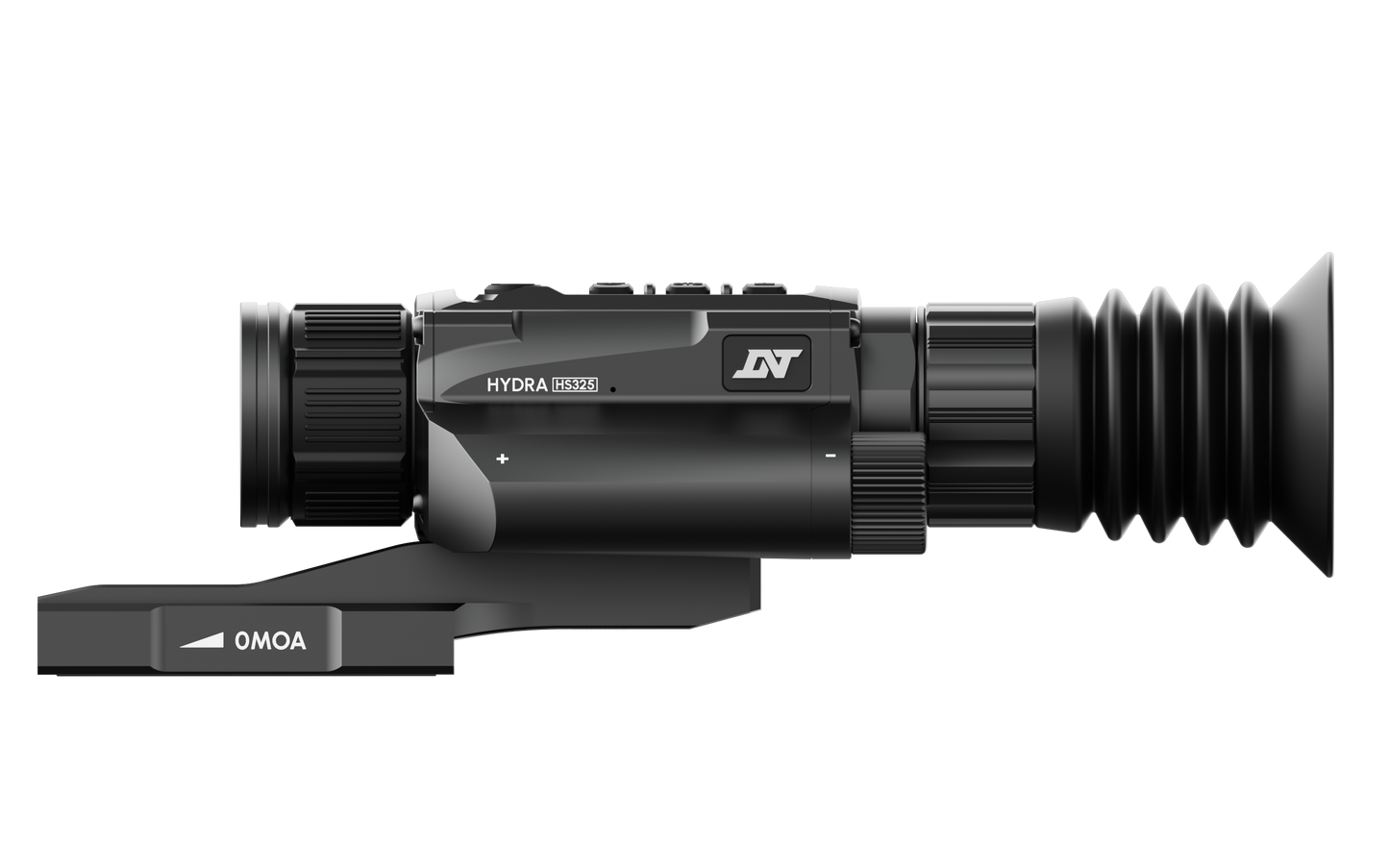
Multi-function thermal riflescope that also works as a clip-on and handheld scanner. 384 sensor, 25 mm lens, QDM150 quick detach mount included.
Who this is for
Best for
Hunters stepping up from a 256-class optic who want better target identification; coyote and hog work where deciding what a heat signature is matters before the shot; buyers who want one unit for scanning, clip-on use, and rifle-mounted shooting
Not ideal for
First-time buyers who mainly need the lowest entry cost, or hunters who want the most reach available in the series — step down to a 256-class model or up to a 640-class HYDRA
Quick specifications
- Category
- Thermal Rifle Scope
- Sensor Resolution
- 384x288
- Magnification
- 2x-8xx
- Objective Lens
- 25 mm
- Rangefinder
- No
Why buy from Thermal Bros
You get real product guidance, financing options, and trade-in or consignment help when available.
Full product description
The DNT HYDRA HS325 works as a riflescope, clip-on, and handheld scanner
One HYDRA HS325 replaces three separate thermal purchases: a dedicated riflescope, a clip-on, and a handheld scanner. Mounted alone on a Picatinny rail, the HS325 aims through its own reticle as a standalone thermal riflescope. Mounted ahead of a day optic, the HS325 feeds a thermal image into glass already zeroed on the rifle. DNT recommends pairing clip-on use with an LPVO or low-magnification prism optic, staying in the lower half of the LPVO's magnification range. Off the rifle, the unit becomes a hand-carried scanner for locating heat before shouldering the gun.
A 384×288 sensor gives the HS325 more pixels on target than the 256-class HYDRA models
A 384 sensor means a 384×288 pixel array, roughly twice the pixel count of a 256×192 array. More pixels across the same scene means finer thermal detail, which matters most when a hunter is deciding what a heat signature actually is. The HS325 pairs that sensor with a 12 μm pixel pitch and a 1024×768 Micro-OLED display, and a rapid-adjust eyepiece with 2.6 inches of eye relief keeps the sight picture forgiving under recoil.
Quick detach mounting returns the HS325 to zero after removal
A QDM150 quick detach mount ships with the HS325 at no extra cost. Removing the unit for handheld scanning and remounting it on the rifle requires no re-zero, which is what makes fast mode switching practical in the field. Mount and optic stay matched to each other, so the rifle keeps its zero between modes.
At 25 mm, the HS325 matches the HS225 lens and upgrades the sensor
Both the HS325 and the HS225 use a 25 mm objective lens, so the difference between them is sensor class rather than optics. Stepping from the 256-class HS225 to the 384-class HS325 raises image detail at the same lens size and the same general field of view. Buyers who want more reach from the same 384 sensor should look at the 35 mm HS335 instead.
Image Super Resolution sharpens digital zoom on the HS325
DNT's Image Super Resolution (ISR) processing recovers detail that digital zoom normally softens. Zoomed images on the HS325 hold edges and texture better than raw digital magnification alone. ISR is image processing rather than added sensor resolution — the HS325 remains a 384×288-class optic, and buyers weighing sensor classes should judge it as one.
Two 18650 batteries and a charger ship with the HS325
Two 18650 flat-top batteries and a charger ship with the HS325, so a field swap extends a hunt without buying accessories separately. DNT specifies flat-top cells measuring 65 mm by 18 mm, and protected cells run longer and will not fit the compartment.
Onboard 32 GB memory records footage from the HS325
Built-in 32 GB memory stores footage captured through the HS325 in the field, with no card to buy or install. Wi-Fi pairing with the DNT App adds live viewing on a smartphone, plus file management and sharing after the hunt.
Hunters stepping up from a 256-class optic get the most from the HS325
Hunters who have used a 256-class thermal and want better target identification are the core fit for the HS325. Coyote and hog work benefits from the added detail when deciding what a heat signature is before the shot. Buyers who mainly need a first thermal at the lowest cost should look at the 256-class models, and hunters who want the most reach available in the series should move to a 640-class HYDRA.
FAQ
What is the difference between the DNT HYDRA HS325 and the HS225?
Both use a 25 mm objective lens. The HS325 has a 384×288 sensor and the HS225 has a 256×192 sensor, so the difference is sensor class rather than optics. The HS325 resolves finer thermal detail at the same lens size.
Does the HS325 come with a mount?
Yes. A QDM150 quick detach mount is included, along with two 18650 batteries, a charger, an eye cup, a flip-up lens cover, two USB cables, a user manual, a quick start guide, and a lens cleaning cloth.
Can the HS325 be used as a clip-on with a day scope?
Yes. The HS325 mounts ahead of a day optic and feeds it a thermal image, using the day scope's reticle and zero. DNT recommends LPVOs or low-magnification prism optics, kept in the lower half of the LPVO's magnification range.
Is there a rangefinder version of the HS325?
No. DNT does not make an HS325R. The nearest HYDRA-LRF model with a 384 sensor is the HS335R, which pairs the same sensor class with a 35 mm lens.
Does the HS325 need a memory card?
No. The HS325 has 32 GB of built-in memory, so there is no card to buy or install.
Technical Specifications
-
Sensor Resolution (px)
384x288 -
Display Resolution (px)
1024x768
-
Weight
13.4 oz -
Thermal Sensor Resolution
384x288 -
Display Resolution
1024x768 -
Pixel Pitch
12 µm -
Range Finder
No -
Clip-On
Yes -
Magnification Base
2x -
Magnification Max
8x -
Objective Lens
25 mm