

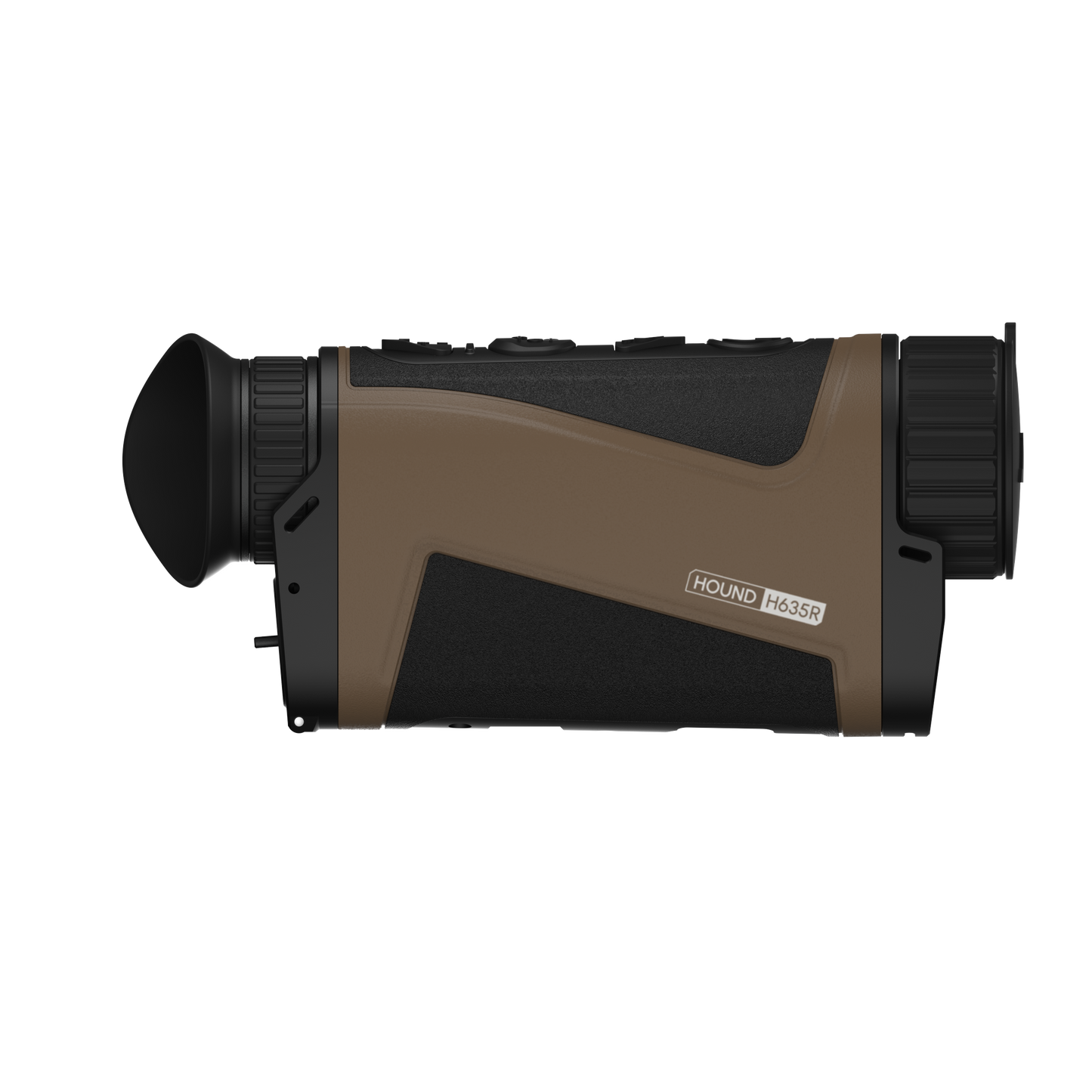
Quick answer
Handheld thermal monocular with a 640×512 sensor and 35 mm lens for identifying animals at distance. 1,200-yard laser rangefinder and ballistic calculator. 10.93 oz.
Who this is for
Best for
Coyote and hog hunters working open country where telling a coyote from a stray dog, or a hog from a calf, matters before the rifle comes up; buyers who need identification at distance rather than detection alone
Not ideal for
Hunters scanning large acreage — the wider H315R finds movement faster and costs less. Buyers chasing maximum zoom get more from the H325R, which reaches 10x against 8x here. Not rifle-mountable; the HYDRA line covers that
Quick specifications
- Category
- DNT Optics
- Sensor Resolution
- 640x512
- Magnification
- 2x-8xx
- Objective Lens
- 35 mm
- Rangefinder
- Yes
Why buy from Thermal Bros
You get real product guidance, financing options, and trade-in or consignment help when available.
Full product description
Knowing something is out there and knowing what it is are two different problems. The H635R exists for the second one: a 640×512 array reads detail at distances where a 384-class device shows a warm shape and little more. Frame width comes to 21.9 yards at 100 yards, ranging runs to 1,200, and ballistic solutions are calculated on board.
A 640×512 sensor puts the DNT HOUND H635R above both 384-class models
Resolution is the whole reason this model exists. Where a 384×288 array carries roughly 110,000 pixels, the 640×512 array here carries over 327,000, and those extra pixels land on the same scene. What that buys is not a brighter or warmer image but a more legible one — the difference between a heat blob that could be several things and a shape a hunter can put a name to.
More pixels and a 35 mm lens give the H635R a wider frame than the H325R
Something worth understanding before comparing these on price alone: a bigger sensor behind a longer lens still frames wider than a smaller sensor behind a shorter one. This model shows 21.9 by 17.6 yards at 100 yards. The 25 mm H325R shows 18.4 by 13.8. So the step up in sensor class does not cost frame width here — it gains it, while the 15 mm H315R still frames widest of the three at 30.7 yards.
Zoom on the H635R stops at 8x, short of what the 25 mm model reaches
Not every number on this model beats its cheaper siblings. Magnification starts at 2x and tops out at 8x, where the H325R starts at 2.5x and reaches 10x. A hunter whose priority is pushing magnification as far as the line allows will get more of it from the 25 mm model, and pay less. The trade being made here is sensor resolution and frame width in exchange for zoom ceiling.
ISR processing holds detail through H635R zoom
Pushing digital zoom always costs sharpness, and DNT's Image Super Resolution works against that across the 2x to 8x range. Worth being clear about what it is: processing applied to the image the sensor already captured, not extra sensor resolution. A 640×512 device stays a 640×512 device at every zoom setting, and anyone comparing sensor classes should treat it that way.
The H635R ranges to 1,200 yards like the rest of the HOUND line
Rangefinding is identical across all three HOUND models: 5 to 1,200 yards, with a ballistic calculator that converts a reading into an aiming solution once a load profile is stored. Profiles are built in the DNT App. Worth noting the laser outreaches what any thermal sensor in this line will identify at, so treat the 1,200-yard figure as terrain and confirmation reach rather than a shooting distance.
Four palettes and a 1024×768 display carry the H635R image
Output lands on a 1024×768 Micro-OLED panel refreshing at 50 Hz. White Hot, Black Hot, Red Hot and Iron Hot are selectable on the device, and each is a different way of drawing the same temperature data — a display preference rather than a capability. DNT ties the choice to varying light and terrain.
Footage from the H635R saves with overlays intact
Clips record full-screen to 32 GB of internal eMMC, ranging and ballistic overlays included, so a recording shows what the shooter actually saw rather than a stripped image. Transfers and live view run through the DNT App over Wi-Fi, and no memory card is needed or supported.
At 10.93 oz the H635R runs five hours and is the largest in the line
Both figures move the wrong way against the 384 models, and by small amounts: 10.93 oz here against 10.16 and 10.55, and five hours of runtime against five and a half. A bigger sensor and longer lens account for both. Dimensions come to 6.2 by 2.2 by 2.8 inches. Two 18650 flat-top cells and a charger are included, and the batteries must be flat-top at 65 mm by 18 mm — protected cells are longer and will not seat. Eye relief is 25 mm with fast diopter adjustment, and the body carries an IP67 rating.
Hunters who need to identify animals at distance fit the H635R
Coyote and hog hunters working open country, where telling a coyote from a stray dog or a hog from a calf matters before the rifle comes up, are the core fit for the H635R. Sensor resolution is what makes that call possible further out. Hunters scanning large acreage will still find movement faster through the wider H315R, and those chasing maximum zoom will get more from the H325R at lower cost. Buyers who want a thermal device that also mounts on a rifle should be looking at the HYDRA line rather than any HOUND.
FAQ
Is the DNT HOUND H635R worth it over the 384 models?
It depends what the monocular is for. The 640×512 sensor resolves more detail at distance, which is what identification depends on. But the H325R zooms further at 10x, and the H315R frames wider at 30.7 yards. Sensor class matters most when working out what an animal is at range.
Why does the H635R have lower magnification than the H325R?
The H635R starts at 2x and reaches 8x; the H325R starts at 2.5x and reaches 10x. Base magnification is a product of sensor size and lens length together, and the larger 640 sensor here produces a wider frame at lower magnification through the 35 mm lens.
How far does the H635R rangefinder measure?
Out to 1,200 yards from a 5-yard minimum. That describes the laser's reach, not the thermal image — identification distance is considerably shorter and depends on conditions and target size.
How long does the H635R last on one battery?
Five hours, half an hour less than the 384 models draw from the same cell. Two 18650 flat-top batteries and a charger are included. Protected cells will not fit, as they run longer than the 65 mm by 18 mm the compartment allows.
Can the H635R be mounted on a rifle?
It cannot. The HOUND platform was designed as a spotting device and provides no way to attach it to a firearm. Hunters wanting thermal on the rifle itself should be looking at HYDRA, where one unit serves as scope, clip-on, and scanner.
Will sunlight damage the H635R sensor?
Yes, permanently. Never point a thermal device at the sun or an open flame. DNT also notes that a loose battery cap or fully drained cell can leave the internal shutter open, which means the sensor can be damaged while the device is switched off — so keep the lens capped in storage.
Technical Specifications
-
Sensor Resolution (px)
640x512 -
Display Resolution (px)
1024x768 -
Refresh Rate (Hz)
50 Hz -
Field of View
21.9 yd x 17.6 yd @ 100 yd
-
Weight
10.93 oz -
HZ - refresh rate
50 Hz -
Thermal Sensor Resolution
640x512 -
Display Resolution
1024x768 -
Pixel Pitch
12 µm -
Range Finder
Yes -
Clip-On
No -
Magnification Base
2x -
Magnification Max
8x -
Objective Lens
35 mm -
Field of View
21.9 yd x 17.6 yd @ 100 yd