

Quick answer
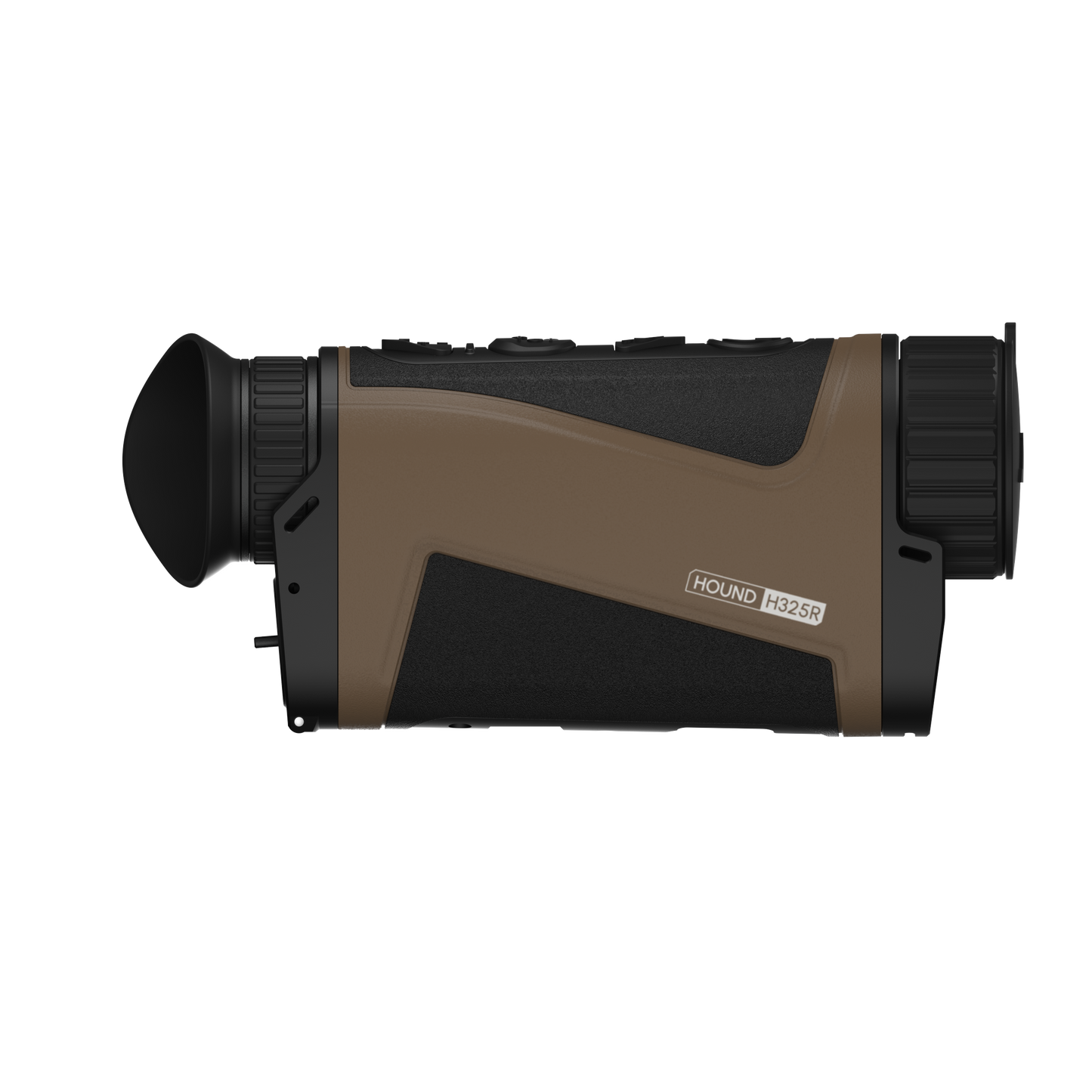
Handheld thermal monocular with a 25 mm lens, 2.5x base magnification and zoom to 10x, plus a 1,200-yard laser rangefinder and ballistic calculator. 384 sensor, 10.55 oz.
Who this is for
Best for
Coyote and hog hunters who already know roughly where animals are and need to work out what they're looking at; buyers who want magnification and zoom reach over frame width; hunters ranging and confirming from the hand before the rifle comes up
Not ideal for
Hunters covering large fields and tree lines — the wider H315R finds ground faster at a lower price. Anyone identifying animals further out should step up to the 640-class H635R. Not rifle-mountable; the HYDRA line covers that
Quick specifications
- Category
- DNT Optics
- Sensor Resolution
- 384x288
- Magnification
- 2.5x-10xx
- Objective Lens
- 25mm
- Rangefinder
- Yes
Why buy from Thermal Bros
You get real product guidance, financing options, and trade-in or consignment help when available.
Full product description
A 25 mm objective and 2.5x starting magnification put the DNT HOUND H325R at the tighter end of the HOUND range. Zoom reaches 10x, past what the wide-frame H315R offers, which suits deciding what a heat signature belongs to rather than sweeping ground to find one. Ranging and ballistic solutions are built in.
A 25 mm lens and 2.5x base magnification define the DNT HOUND H325R
Lens size is what separates the H325R from its sibling. A 25 mm objective starts the view at 2.5x against the 1.5x on the 15 mm H315R, putting more of the sensor on whatever sits at the centre of the frame. Both use the same 384×288 sensor, so this is an optical difference rather than a sensor-class step.
Tighter framing on the H325R suits confirming over searching
Field of view measures 18.4 by 13.8 yards at 100 yards, against 30.7 by 23.0 on the H315R. Less ground in frame is the direct cost of more magnification, and it is a fair trade when the work is deciding what an animal is rather than finding one. Hunters who sweep large fields will cover ground faster through the wider model.
Digital zoom carries the H325R to 10x with ISR behind it
Zoom runs from the 2.5x base out to 10x, a longer reach than the 6x ceiling on the H315R. DNT's Image Super Resolution processing recovers detail that digital zoom normally softens across that range. ISR is image processing rather than added sensor resolution — the H325R remains a 384×288-class device and should be judged as one.
The H325R shares its 384×288 sensor with the rest of the 384-class HOUND line
Magnification does not add detail that the sensor never captured. The 384×288 array in the H325R is the same one the H315R uses, so the extra reach here comes from optics rather than from a finer image. Pixel data feeds a 1024×768 Micro-OLED display at 50 fps, and how far that data holds up under zoom is the practical ceiling on this model.
A built-in rangefinder reads 1,200 yards through the H325R
Press the ranging button and the H325R returns a distance out to 1,200 yards. Feed that number to the onboard ballistic calculator with a load profile saved, and it comes back with an aiming solution. Profiles are built in the DNT App and synced to the device.
Palette choice on the H325R covers four rendering options
Four palettes ship on the H325R: White Hot, Black Hot, Red Hot, and Iron Hot. Switching between them changes how the display draws temperature, not what the sensor detects, and DNT frames the choice around changing light and terrain. No palette outperforms another.
Full-screen recording on the H325R keeps ballistic overlays
Video captured on the H325R keeps whatever ranging and ballistic overlays were showing at the time, which makes a clip useful for reviewing a shot rather than only for sharing it. Onboard eMMC storage runs to 32 GB, and the DNT App handles live view and file transfer over Wi-Fi.
At 10.55 oz the H325R matches its sibling on size and runtime
The larger objective adds four tenths of an ounce over the 15 mm model and nothing else — 10.55 oz in the same 6.1 by 1.9 by 2.8 inch body, with the same 5.5 hours from a single cell and a spare plus charger included. Eye relief runs 25 mm with a fast diopter adjustment, and the housing carries an IP67 rating. Batteries must be flat-top 18650s at 65 mm by 18 mm; protected cells measure longer and will not seat.
Hunters confirming targets more than searching for them fit the H325R
Coyote and hog hunters who already know roughly where animals are, and need to work out what they are looking at, are the core fit for the H325R. Magnification and zoom reach matter more than frame width for that job. Hunters covering large fields and tree lines will find more ground faster through the wider H315R at a lower price. Anyone needing to identify animals further out should step up to the 640-class H635R. Buyers who need one device that also goes on a rifle should be looking at the HYDRA line rather than either HOUND.
FAQ
What is the difference between the DNT HOUND H325R and the H315R?
Lens and magnification. The H325R has a 25 mm lens starting at 2.5x with zoom to 10x and an 18.4 by 13.8 yard frame at 100 yards. The H315R has a 15 mm lens starting at 1.5x with zoom to 6x and a wider 30.7 by 23.0 yard frame. Sensor, display, battery, storage, and dimensions are the same on both.
Which HOUND is better for scanning large fields?
The H315R. Its 30.7 yard frame covers more ground per sweep, which finds movement faster over open country. The H325R suits closer work where identifying what is already spotted matters more than searching.
How far does the H325R rangefinder measure?
Five to 1,200 yards. Note that this figure describes how far the laser will return a distance, not how far the thermal sensor will identify an animal — the laser reaches much further than the image does.
Can the HOUND H325R be mounted on a rifle?
No — there is no rail interface on the body and no mount supplied. For rifle-mounted thermal, the HYDRA series is the line to look at; a single HYDRA unit covers riflescope, clip-on, and handheld scanning.
Will pointing the H325R at the sun damage it?
Yes, and permanently. Thermal sensors are damaged by direct sun or open flame in the field of view. DNT adds a warning worth knowing: if the battery cap works loose or the cell fully drains, the internal shutter can stay open, meaning the sensor is exposed even with the device switched off. Cap the lens whenever the H325R is stowed.
What comes in the box with the H325R?
Two 18650 flat-top batteries and a charger, a carrying pouch, a lanyard and wrist strap, separate data and charging cables, a lens cleaning cloth, plus the user manual and quick start guide.
Technical Specifications
-
Sensor Resolution (px)
384x288 -
Display Resolution (px)
1024x768 -
Refresh Rate (Hz)
50 Hz -
Field of View
18.4 yd x 13.8 yd @ 100 yd
-
Weight
10.55 oz -
HZ - refresh rate
50 Hz -
Thermal Sensor Resolution
384x288 -
Display Resolution
1024x768 -
Pixel Pitch
12 µm -
Range Finder
Yes -
Clip-On
No -
Magnification Base
2.5x -
Magnification Max
10x -
Objective Lens
25mm -
Field of View
18.4 yd x 13.8 yd @ 100 yd