

How to choose the right Helmet Mounted Thermal & Night Vision Gear
For most hunters, the best helmet-mounted setup is not the most complicated one. Choose helmet-mounted thermal when fast heat detection and hands-free scanning matter most, night vision when walking, navigation, and terrain detail are the priority, and fusion only when you genuinely need both. Then match the optic to a comfortable helmet or headgear, a compatible mount or bridge, and the right balance and power accessories. If you want to avoid fitment guesswork, start with a complete matched system.
Need help deciding? Visit our FAQ, browse related collections, or use our contact page for one-to-one guidance.
-
 In Stock
RIX BM-01 Helmet Mount for STRIDE Series
Regular price $129.00Regular priceUnit price per -
 In Stock
RIX Tactical RNV-31 Night Vision Goggle | Gen 2+ Dual Tube Binocular
Regular price $3,999.00Regular priceUnit price per -
 Out of Stock
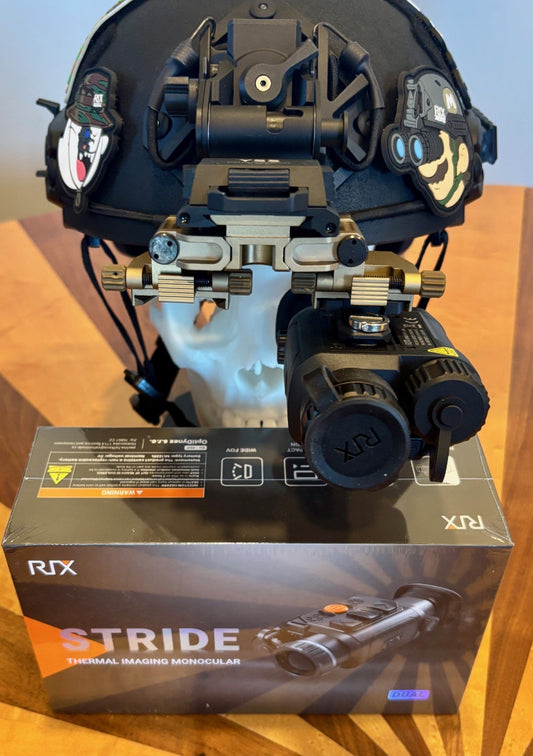
RIX Stride ST6 Lite Thermal Monocular Used
Notify Me When AvailableRegular price $1,750.00Regular priceUnit price per -
 In Stock
RIX Tactical RENV-B Enhanced Night Vision Fusion Binocular
Regular price $8,999.00Regular priceUnit price per -
 In Stock
RIX Tactical RNV-31S Dual-Tube Night Vision Goggle
Regular price $4,499.00Regular priceUnit price per -
 In Stock
AGM Soft Headgear with Mounting Plate
Regular price $150.00Regular priceUnit price per


Helmet-Mounted Thermal and Night Vision Gear
Helmet-mounted thermal and night vision gear gives hunters, ranchers, landowners, and night-use buyers a hands-free way to scan, move, observe, and work after dark. Instead of holding a monocular all night or constantly switching between devices, a properly matched helmet-mounted setup keeps the optic stable, accessible, and ready when you need it.
At Thermal Bros, the goal is not to build the most complicated rig possible. The goal is to build a system where the optic, helmet or headgear, mount, bridge or adapter, weight, balance, and intended use all make sense together.
Start With the Job First
A helmet-mounted setup can be useful, but only when the gear matches the job. Thermal, night vision, and fusion solve different problems. Before choosing a helmet, mount, bridge, or optic, decide whether you mainly need detection, movement, observation, identification, or a combination of those jobs.
Choose helmet-mounted thermal if detection is the main job
Helmet-mounted thermal is best when you need to spot heat signatures without holding a scanner in your hand. It can help when checking fields, walking into a stand, watching livestock, scanning tree lines, or moving around property after dark. Thermal is strong for detection, but it is not always the best choice for reading terrain detail.
Current helmet-capable thermal options to compare include the RIX Stride ST6 Lite Thermal Monocular and RIX Stride ST3 Lite Thermal Monocular. Both can also serve as compact handheld thermal scanners when you do not need the optic on the helmet.
Choose dual-tube night vision if movement matters
Night vision is usually the better tool when you need to walk, navigate, drive slowly, check equipment, or understand terrain detail after dark. Dual-tube night vision provides an image to both eyes and can make movement and longer observation more natural than a single-eye setup.
Current dual-tube night vision options to compare include the RIX Tactical RNV-31S Dual-Tube Night Vision Goggle and RIX Tactical RNV-31 Night Vision Goggle.
Choose fusion if you need night vision detail and thermal detection
Fusion combines night vision detail with thermal detection. That can be valuable for users who need to move, observe, and detect heat in one helmet-mounted system. It also adds cost, weight, power requirements, and complexity, so it is not necessary for every hunter or landowner.
For an integrated fusion option, compare the RIX Tactical RENV-B Enhanced Night Vision Fusion Binocular. The RENV-B combines the two technologies in one integrated device instead of requiring separate thermal and night vision optics on a bridge.
Choose the helmet or headgear around the optic
The helmet is the base of the system, but the optic should guide the setup. Weight, shroud compatibility, mount style, balance, protection, and comfort matter more than appearance.
For a structured helmet platform, compare the Combat Defense CDI Bighorn High Cut Ballistic Helmet IIIA. For a lighter head-mounted option, compare the AGM Soft Headgear with Mounting Plate.
If you would rather start with the major components matched together, review the Complete Helmet System.
Choose the mount or bridge after you choose the optic
The mounting hardware connects the helmet to the optic, and this is where many expensive compatibility mistakes happen. A good mount or bridge can still be wrong if the optic-side interface, helmet shroud, eye position, or required adapter does not match.
For a single compatible RIX STRIDE thermal, compare the RIX BM-01 Helmet Mount for STRIDE Series.
For an intentionally built dual-device thermal, night vision, or mixed configuration, compare the Universal Dual Bridge Night Vision & Thermal Helmet Mount Kit and the UNV Ultimate Helmet Mount.
Do not buy a dual bridge simply because it supports more equipment. If one optic solves the job, a simpler single-device setup is usually lighter, easier to balance, and less expensive.
Who Helmet-Mounted Setups Are Best For
- Hunters who want hands-free scanning while walking, riding, or setting up after dark.
- Ranchers and landowners checking property, livestock, gates, roads, pens, or fields at night.
- Night vision users who need a stable helmet platform for navigation and observation.
- Predator and hog hunters who want faster access to thermal or night vision without holding an optic the entire time.
- Buyers building a complete system with a helmet, mount, bridge, adapter, optic, and counterweight.
- Users who genuinely need both night vision detail and thermal detection.
- Experienced users intentionally building a compatible separate thermal and night vision configuration.
Who May Not Need Helmet-Mounted Gear
- If you mostly sit in one place and scan from a tripod, truck, or blind, a handheld thermal may be enough.
- If you only need a rifle-mounted optic for taking the shot, build around a dedicated rifle scope instead of adding an unnecessary helmet system.
- If you rarely walk or move after dark, dual-tube night vision may be more setup than you need.
- If budget is the main concern, a simple handheld scanner may provide more useful capability per dollar than a complete helmet system.
- If you do not know your mount, bridge, optic, or helmet compatibility, do not guess. Confirm the full connection chain first.
- If you only intend to use one optic, do not assume a dual bridge is an upgrade.
Popular Helmet-Mounted Product Lanes
RIX STRIDE helmet-capable thermal monoculars
The RIX Stride ST6 Lite and RIX Stride ST3 Lite are compact thermal monocular options for buyers who want heat detection, quick scanning, and a relatively light thermal setup.
They are detection and observation tools first. If you only need to find heat and do not need the optic on your head, they can also be used as handheld thermal scanners.
RIX Tactical dual-tube night vision goggles
The RIX Tactical RNV-31S and RIX Tactical RNV-31 are dual-tube night vision options for buyers who need hands-free movement, depth perception, terrain awareness, and longer observation after dark.
These make more sense for navigation and environmental detail than for pure heat detection.
RIX Tactical integrated fusion
The RIX Tactical RENV-B Enhanced Night Vision Fusion Binocular is for buyers who want night vision and thermal detection integrated into a single helmet-mounted system.
It is a more advanced and expensive solution. Buy it when the combined capability solves a recurring need, not simply because it provides more technology.
Helmets and headgear
The Combat Defense CDI Bighorn High Cut Ballistic Helmet IIIA and AGM Soft Headgear with Mounting Plate represent two different approaches to supporting the optic.
The Bighorn makes more sense when you need a structured helmet platform and ballistic protection is genuinely part of the requirement. The AGM soft headgear makes more sense when a lighter and simpler mounting platform will support the intended optic comfortably.
Single-device mounting
For a compatible single RIX STRIDE thermal, compare the RIX BM-01 Helmet Mount for STRIDE Series. A dedicated single-device mounting solution is often the better choice when you do not need a second optic.
Dual-device bridges and mounts
For buyers intentionally building a compatible two-device helmet setup, compare the Universal Dual Bridge Night Vision & Thermal Helmet Mount Kit and UNV Ultimate Helmet Mount.
A dual-device setup may support night vision, thermal, or a compatible mixed configuration, but the exact optic interfaces, positioning, eye alignment, total weight, and balance still need to be confirmed before ordering.
Complete helmet system
The Complete Helmet System is the better starting point for buyers who want help matching the major pieces instead of selecting the helmet, mount, optic, and related equipment independently.
What You Need for a Helmet-Mounted System
- Helmet or headgear: The base of the system. Fit, comfort, shroud compatibility, protection requirements, and weight matter.
- Helmet mount: Connects the helmet shroud to the optic-side mounting hardware.
- Arm, bridge, or adapter: Connects compatible optics to the mount. This is one of the most common places for compatibility mistakes.
- Thermal or night vision optic: Choose thermal for detection, night vision for movement, and fusion when you genuinely need both.
- Counterweight or battery support: Can help balance heavier setups and reduce front-heavy strain during longer use.
- IR support if needed: Some night vision environments require additional infrared illumination.
A single STRIDE setup may only require the compatible optic and RIX BM-01 mounting hardware. A dual-device setup may instead require a product such as the Universal Dual Bridge or UNV Ultimate Helmet Mount.
If you do not want to determine every component independently, compare the Complete Helmet System.
Thermal vs. Night Vision on a Helmet
Helmet-mounted thermal
Thermal is best for detecting heat signatures. It helps you spot animals, people, livestock, and movement in darkness, brush, or open fields. Thermal is especially useful for scanning and detection, but it is not always the best tool for navigation or reading terrain detail.
Helmet-mounted night vision
Night vision is generally better for movement, navigation, depth perception, and seeing natural environmental detail in low-light conditions. It often makes more sense if you need to walk, drive slowly, work around equipment, or understand your surroundings after dark.
Integrated fusion
Integrated fusion combines thermal detection and night vision in one purpose-built device. The RIX Tactical RENV-B is the relevant option when you want both technologies in a single device instead of managing separate optics.
Separate thermal and night vision on a bridge
A separate dual-device setup uses independent compatible optics rather than integrating both technologies into one housing. This can provide flexibility, but it also creates more mounting, alignment, weight, and balance decisions.
For this type of configuration, compare the Universal Dual Bridge Night Vision & Thermal Helmet Mount Kit and UNV Ultimate Helmet Mount.
How to Choose the Right Helmet-Mounted Setup
- Start with the job: Decide whether you mainly need scanning, navigation, detection, property work, or a combination of uses.
- Choose the optic first: The optic determines much of the mounting hardware and helmet configuration.
- Check every interface: Confirm the helmet shroud, mount, arm or bridge, adapter, and optic-side connection.
- Decide whether one optic is enough: Do not add a dual bridge unless a second device solves a specific problem.
- Watch total weight: Helmet-mounted gear gets heavy quickly. Lighter and simpler often works better for longer use.
- Think about balance: A counterweight or rear battery system may improve a front-heavy setup, but unnecessary rear weight creates its own problems.
- Plan the power system: Consider batteries, external packs, cables, expected runtime, and how power equipment affects balance.
- Avoid overbuilding: The most expensive or complicated setup is not automatically the best one.
Common Helmet-Mounted Gear Mistakes
- Buying a mount before confirming optic compatibility.
- Buying a bridge because it is labeled universal without confirming the optic interfaces.
- Building a dual-device setup when one optic would solve the job.
- Building a system that is too heavy for long use.
- Choosing thermal when night vision would work better for navigation.
- Choosing night vision when thermal detection is the real priority.
- Ignoring helmet balance and counterweight needs.
- Assuming every pictured component is included with the product.
- Buying integrated fusion when a simpler dedicated thermal or night vision device would solve the problem.
- Spending more on complexity instead of solving the actual field need.
Helmet-Mounted Thermal and Night Vision FAQ
Can thermal optics be helmet mounted?
Some thermal optics are designed for helmet mounting, but compatibility depends on the optic, mount, bridge or arm, adapter, and helmet.
For current helmet-capable thermal options, compare the RIX Stride ST3 Lite and RIX Stride ST6 Lite. For a compatible single STRIDE mounting solution, review the RIX BM-01 Helmet Mount.
Is thermal or night vision better on a helmet?
It depends on the job. Thermal is better for detecting heat signatures and spotting animals. Night vision is generally better for navigation, movement, depth perception, and understanding terrain after dark.
For thermal, compare the RIX Stride ST3 Lite and ST6 Lite. For dual-tube night vision, compare the RIX Tactical RNV-31 and RNV-31S. Choose around what you actually need to accomplish after dark.
Do I need a bridge for a helmet-mounted setup?
Not always. Many single-device setups do not need a dual bridge. If you are running one compatible RIX STRIDE thermal, the RIX BM-01 may be the simpler route.
If you intentionally need two compatible devices, compare the Universal Dual Bridge Night Vision & Thermal Helmet Mount Kit and UNV Ultimate Helmet Mount.
Can I run thermal and night vision together?
Potentially. A compatible dual-device bridge can support more complex thermal and night vision configurations, but a bridge does not automatically make any two optics work together.
Confirm the exact optic interfaces, positioning, spacing, adapters, total weight, and helmet balance before building the system.
What is the difference between fusion and a dual bridge?
Integrated fusion combines thermal and night vision within one purpose-built device. The RIX Tactical RENV-B is an example of this approach.
A dual bridge supports separate compatible devices. The Universal Dual Bridge and UNV Ultimate Helmet Mount belong in this separate-device lane.
Are dual-tube night vision goggles worth it?
Dual-tube goggles can be worth it if you regularly need hands-free movement, longer observation, depth perception, and terrain awareness after dark. Compare the RIX Tactical RNV-31 and RIX Tactical RNV-31S if those are your priorities.
If you only need occasional heat detection from one position, a compact thermal scanner may be the better first purchase.
Is fusion worth it on a helmet?
Fusion can be worth it when you repeatedly need both night vision detail and thermal detection in one system. It is not necessary for every buyer.
If your main goal is only finding heat, a thermal monocular may be enough. If your main goal is movement and terrain awareness, dual-tube night vision may be the better fit. If you genuinely need both capabilities integrated together, compare the RIX Tactical RENV-B.
Should I build the system myself or buy a complete setup?
Building the system yourself makes sense when you already know the exact optic, helmet, mount, bridge or arm, and interfaces you need.
If you are still trying to determine how those major components fit together, start with the Complete Helmet System or contact Thermal Bros before ordering individual pieces.
Can Thermal Bros help me choose compatible parts?
Yes. Helmet-mounted systems are easy to mismatch. If you are unsure which helmet, mount, bridge, adapter, or optic fits your setup, contact Thermal Bros with the exact equipment you own or plan to buy. We can help confirm the connection chain before you waste money on parts that do not work together.
Why Buy Helmet-Mounted Gear from Thermal Bros?
Thermal Bros helps buyers build helmet-mounted thermal and night vision systems around real use rather than unnecessary complexity. We look at detection, navigation, optic compatibility, helmet fit, mounting hardware, weight, balance, comfort, and total cost as one system.
For helmet-mounted thermal, compare the RIX Stride ST3 Lite and RIX Stride ST6 Lite. For dedicated dual-tube night vision, compare the RIX Tactical RNV-31 and RIX Tactical RNV-31S. For integrated fusion, compare the RIX Tactical RENV-B.
For mounting hardware, use the RIX BM-01 when it matches the intended single STRIDE setup, or compare the Universal Dual Bridge and UNV Ultimate Helmet Mount when you genuinely need a compatible dual-device configuration.
If you want the major components matched before you order, start with the Complete Helmet System.
The right helmet-mounted system is the one that solves the job without unnecessary weight, cost, or complexity.