


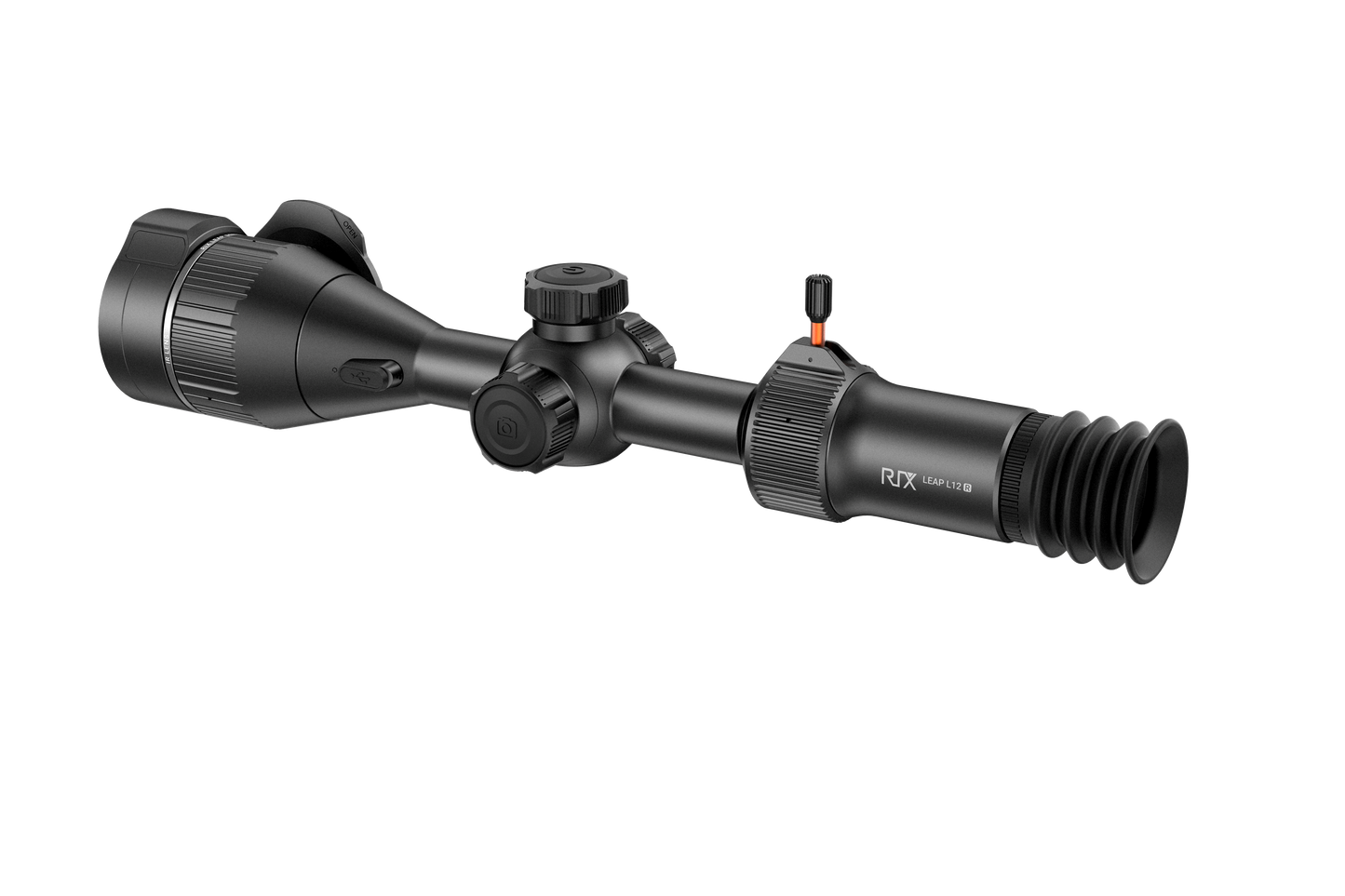
Why Choose this model
The Rix Leap L12R LRF is the flagship of Rix's three-scope Leap lineup the only Leap built on a 1280 — 1024 thermal sensor and the only one with a 60mm objective lens. At $6,899,...
Who this is for
Best for
Best for experienced hunters or professionals who know they need premium image detail, longer identification confidence, and a rifle-mounted thermal optic.
Not ideal for
Not ideal for first-time buyers, short-range hunters, or anyone trying to keep the setup simple and budget-conscious.
Quick specifications
- Category
- Thermal Rifle Scopes
- Sensor Resolution
- 1280x1024
- Magnification
- 2-6x
- Objective Lens
- 60
- Detection Range
- 3400
- Rangefinder
- Yes
Why buy from Thermal Bros
With premium thermal scopes, the expensive mistake is buying the wrong fit. Thermal Bros helps you compare sensor tier, lens size, and rangefinding value in plain English so you end up with the right optic, not just the most expensive one.
Full product description
The Rix Leap L12R LRF is the flagship of Rix's three-scope Leap lineup the only Leap built on a 1280 — 1024 thermal sensor and the only one with a 60mm objective lens. At $6,899, it's the top-tier option for hunters who treat image quality as the deciding spec, not just a feature on a list. If you've outgrown 640-sensor optics and you want the sharpest thermal image Rix builds, this is the scope.
The Leap series gives shoppers a clean three-tier decision: the Rix Leap L3R LRF at $2,599 for the entry-tier 384 sensor, the Rix Leap L6R LRF at $4,499 for the 640-sensor mid-tier, and this scope at the top with the 1280 sensor. The L12R sits $2,400 above the L6R a meaningful step, and one that only makes sense for hunters who actually use the resolution.
What the 1280 Sensor Actually Buys You
The 1280 — 1024 sensor is the defining feature of the L12R LRF, and understanding what it does is the difference between a justified purchase and an over-spec'd one.
A 1280 sensor has roughly four times the pixel count of a 640 sensor on the same field of view. In practical terms, that translates to three things:
Longer practical identification range
On a 640 sensor, species confirmation gets unreliable past 600–800 yards because pixel density on a coyote-sized target drops below what's needed to distinguish features. On the 1280 sensor, that practical ID window pushes well beyond 1,000 yards in good conditions into ranges most hunters won't take shots at, but where confident detection and tracking still matters.
True optical zoom that holds image quality
The L12R LRF uses 2–6x optical zoom rather than relying on digital magnification stacked on a smaller sensor. With the 1280 sensor backing it, the image stays clean across the entire zoom range no smearing, no resolution drop when you push to the high end.
More margin in marginal conditions
Fog, light rain, humidity, and temperature swings reduce contrast on any thermal image. The 1280 sensor's pixel density gives you more usable image to work with when conditions aren't ideal.
The tradeoff is price. At $6,899, the L12R LRF costs more than double the L3R LRF and meaningfully more than the L6R LRF. If your shots stay inside 500 yards in good conditions, you won't see the full value of the 1280 sensor and the L6R LRF delivers a strong image for $2,400 less. If you regularly push past 600 yards, hunt at the edge of what a 640 can resolve, or simply want the best image Rix builds, the L12R is where the spend justifies itself.
Why the 60mm Objective Matters
A larger objective lens gathers more thermal energy, which directly translates to longer detection range and better separation between a target and the background at the edge of your range. The L12R LRF's 60mm objective is the largest in the Leap lineup the L6R uses a 35mm objective and the L3R uses a 25mm objective. Pair the 60mm objective with the 1280 sensor and you get the longest practical detection-to-identification chain Rix offers in this series.
The tradeoff is weight and length a 60mm front end is physically larger than the smaller objectives on the L6R and L3R. If you're running a precision rifle setup where size at the front of the scope matters, that's worth knowing. For most stand-based and stalking hunters, the size is offset by the image quality gain.
What the Onboard LRF Adds
Every Leap-series scope ships with an integrated laser rangefinder, and the L12R LRF is no exception. The rangefinder reads distance directly inside the scope's display and feeds Rix's onboard ballistic calculator, which converts the range into a holdover solution without breaking shooting position.
On a flagship scope like the L12R LRF, the LRF and ballistic calculator are doing more work than they do on the entry-tier scopes because you're more likely to take shots at distances where holdover actually matters. A 600-yard coyote shot is a guess without a rangefinder; with the L12R's integrated LRF and ballistic calculator, it's a calculated shot with confirmed distance.
Key Specs
- Thermal sensor: 1280 — 1024 px
- Objective lens: 60mm
- Optical magnification: 2x – 6x
- Laser rangefinder: Integrated
- Onboard ballistic calculator: Yes
- Price: $6,899.00
Who This Scope Is For
- Long-range predator hunters taking shots past 500 yards where pixel density on target matters for ethical species ID
- Open-country coyote and hog hunters working large acreage where targets appear at varied distances and the extra magnification range gets used
- Hunters who shoot in marginal conditions fog, humidity, temperature swings where the extra sensor resolution preserves image clarity
- Hunters upgrading from a 640-sensor scope who've hit the resolution ceiling and want more image to work with at distance
- Flagship buyers who want the best thermal sensor available in this category and aren't willing to compromise on image quality
If your shots stay inside 500 yards or you don't want to pay flagship pricing, the Rix Leap L6R LRF delivers strong 640-sensor performance for $2,400 less. If you're stepping into thermal for the first time or working tighter distances, the Rix Leap L3R LRF is the entry point into the Leap platform at $2,599.
How It Compares in the Leap Lineup
The L12R LRF is the top of Rix's three-scope Leap series. Step down to the Rix Leap L6R LRF for a 640-sensor option with a 35mm objective at $4,499 strong performance for hunters working inside 500 yards. Step down further to the Rix Leap L3R LRF at $2,599 for the 384-sensor entry point into the Leap platform. The L12R LRF is the right pick when image quality drives the buying decision and the shots you take justify the spend.
Frequently Asked Questions
What's the difference between the Rix Leap L12R LRF, L6R LRF, and L3R LRF? Same Leap platform, same onboard LRF, same ballistic calculator. The difference is sensor resolution and objective lens size and the price reflects it. The L3R LRF runs a 384 sensor at $2,599. The L6R LRF runs a 640 sensor with a 35mm objective at $4,499. The L12R LRF runs a 1280 sensor with a 60mm objective at $6,899. Pick the L3R if you're stepping into thermal or working under 200 yards, the L6R if you need 640-class image quality at typical hunting distances, and the L12R if you're pushing past 500 yards or want the sharpest image Rix builds.
Is the Rix Leap L12R LRF worth the $2,400 over the L6R LRF? It depends on the shots you actually take. If most of your work is inside 500 yards in good conditions, you won't see the full value of the 1280 sensor and the L6R LRF will serve you well. If you regularly identify targets past 500 yards, push optical zoom toward the high end, or hunt in fog, humidity, or temperature swings, the L12R LRF delivers a meaningfully better image where it matters and the $2,400 spread is justified.
Is the Rix Leap L12R LRF good for long-range coyote hunting? Yes it's one of the best-equipped scopes in this category for it. The 1280 sensor gives you pixel density to support confident species ID well past where most predator hunters take shots. The 60mm objective and 2–6x optical zoom keep the image clean at distance. The onboard LRF and ballistic calculator give you confirmed range and holdover for precision shot placement.
Does the L12R LRF use optical zoom or digital zoom? The 2–6x magnification on the L12R LRF is true optical zoom, not digital. That matters because optical zoom preserves image quality across the magnification range, while digital zoom degrades it by enlarging pixels. Combined with the 1280 sensor backing it, the L12R LRF holds image quality across the full zoom range.
Does the onboard ballistic calculator require an app or subscription? The ballistic calculator runs directly on the scope. No subscription is required to use it.
Frequently asked questions
What is this product best for?
Best for experienced hunters or professionals who know they need premium image detail, longer identification confidence, and a rifle-mounted thermal optic.
Who should probably skip it?
Not ideal for first-time buyers, short-range hunters, or anyone trying to keep the setup simple and budget-conscious.
Does it include a rangefinder?
Yes. This product is configured with rangefinding support according to the current product data.
Why buy from Thermal Bros?
With premium thermal scopes, the expensive mistake is buying the wrong fit. Thermal Bros helps you compare sensor tier, lens size, and rangefinding value in plain English so you end up with the right optic, not just the most expensive one.
Is this a scope or a scanner?
This is a rifle-mounted optic. Use a handheld thermal monocular or binocular if your main need is scanning before the shot.
Rix Optics App
Wi-Fi integration with iOS and Android devices


Technical Specifications
-
Sensor Resolution (px)
1280x1024 -
Display Resolution (px)
2560x2560 -
NETD Rating
15 -
Detection Range
3400 -
Refresh Rate (Hz)
60 -
Field of View
14.6
-
Weight
2.8 lb -
Dimensions
15.5 in 3.8 in 3.3 in -
HZ - refresh rate
60 -
Category
Thermal Rifle Scopes -
Handhelds
No -
Thermal Sensor Resolution
1280x1024 -
Display Resolution
2560x2560 -
Pixel Pitch
12 -
NETD Rating
15 -
Detection Range
3400 -
Range Finder
Yes -
Clip-On
No -
Magnification Base
2 -
Magnification Max
6 -
Objective Lens
60 -
Field of View
14.6