

Quick answer
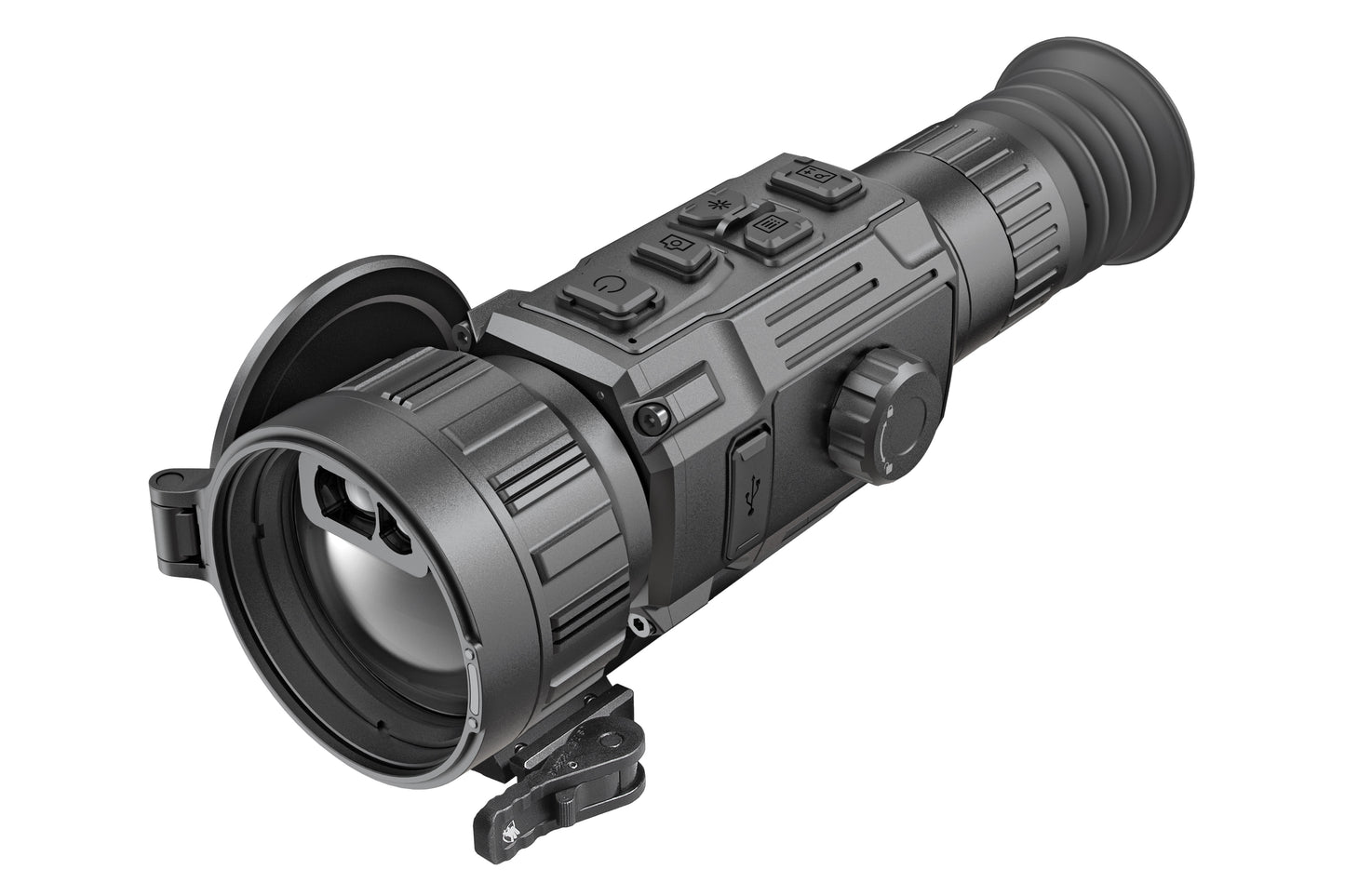
The AGM Rattler V3 LRF 50-640 is the long-range flagship of AGM's third-generation Rattler lineup. It pairs a sub-15 mK 640 thermal sensor with a 50mm objective lens, an in-lens laser rangefinder, and a 2.2-mile...
Who this is for
Best for
Best for hog, coyote, and predator hunters who want stronger image detail than entry-level thermal without jumping straight to top-tier 1280 pricing.
Not ideal for
Not ideal for buyers who only hunt close range, mainly need a handheld scanner, or want the lowest-cost starting point.
Quick specifications
- Category
- Thermal Rifle Scopes
- Sensor Resolution
- 640x512
- Magnification
- 3.5-28x
- Objective Lens
- 50
- Detection Range
- 3800
- Rangefinder
- Yes
Why buy from Thermal Bros
With premium thermal scopes, the expensive mistake is buying the wrong fit. Thermal Bros helps you compare sensor tier, lens size, and rangefinding value in plain English so you end up with the right optic, not just the most expensive one.
Full product description
The AGM Rattler V3 LRF 50-640 is the long-range flagship of AGM's third-generation Rattler lineup. It pairs a sub-15 mK 640 thermal sensor with a 50mm objective lens, an in-lens laser rangefinder, and a 2.2-mile detection range making it the Rattler built for predator hunters working wide-open terrain where shots happen at distance.
The Rattler line has come a long way. What launched five years ago as an entry-level thermal competitor has, through the V2 generation and now V3, become one of the more technically advanced thermal platforms available. The V3 LRF generation is the clearest proof of that: in-lens LRF technology, a high-resolution 2560 — 2560 display, shutterless NUC, and AGM's Image Boost 2.0 processing all arrive together in a compact Rattler body. The 50-640 is the top of that four-scope V3 lineup.
How the AGM Rattler V3 LRF Lineup Works
Before getting into what makes the 50-640 specific, it helps to understand the lineup, because AGM's model naming tells you exactly what you're getting. Every Rattler V3 LRF model is named by two numbers: objective lens size, then sensor resolution.
- AGM Rattler V3 LRF 50-640 50mm lens, 640 sensor. The long-range flagship. $4,895.
- AGM Rattler V3 LRF 35-640 35mm lens, 640 sensor. Same high-resolution sensor, more compact lens. $4,295.
- AGM Rattler V3 LRF 35-384 35mm lens, 384 sensor. The mid-tier balance of capability and price. $2,995.
- AGM Rattler V3 25-384 25mm lens, 384 sensor. The compact entry point into the V3 platform. $2,395.
All four share the same V3 platform features in-lens LRF, the 2560 — 2560 display, shutterless NUC, the adjustable display shape, and Image Boost 2.0. What changes across the lineup is the sensor resolution (640 vs. 384) and the objective lens size (which drives magnification and detection range). The 50-640 is the model for hunters who want the highest-resolution sensor AGM puts in a Rattler, paired with the largest objective for the longest reach.
What Makes the 50-640 Specific
Two specs define this model within the lineup: the 640 sensor and the 50mm lens.
The 640 sensor carries roughly four times the pixel count of a 384 sensor. More pixels on target means longer practical identification range the distance at which you can confirm what a heat signature actually is, not just detect that it's there and a cleaner image as magnification climbs. The 50-640 and the 35-640 share this sensor; the 35-384 and 25-384 step down to the 384.
The 50mm objective lens is the largest in the V3 LRF lineup. A larger objective gathers more thermal energy, which extends detection range and improves target separation at distance. It also raises the base magnification the V3 LRF 50-640 starts at 3.5x, up from 2.5x on the previous-generation V2 50-640. That higher base magnification makes the 50-640 better suited to open-country engagements, where you're identifying and ranging targets across distance rather than scanning tight cover up close.
Together, the 640 sensor and the 50mm lens produce the 2.2-mile (roughly 3,800-yard) detection range that headlines this scope.
The V3 LRF Platform Features
Every Rattler V3 LRF model, including the 50-640, brings a set of upgrades over the V2 generation:
In-lens laser rangefinder. The V3 LRF generation brings AGM's in-lens LRF technology to the compact Rattler series. The rangefinder confirms target distance directly through the optic, feeding accurate range data without a separate handheld device.
2560 — 2560 high-resolution display. Paired with the sub-15 mK thermal sensor, the high-resolution display is what AGM credits for the sharpest 640 image the Rattler line has produced.
Sub-15 mK thermal sensor. NETD measures how small a temperature difference the sensor can resolve lower is better. A sub-15 mK rating puts the V3 LRF among the more sensitive thermal sensors available, which preserves image contrast in rain, fog, and humidity.
Shutterless NUC. The 50-640 is the first Rattler generation with shutterless non-uniformity correction the image calibration that keeps a thermal picture clean happens without the periodic shutter "click" and momentary image freeze that traditional NUC requires. You stay on a live image continuously.
Adjustable display shape. A first for the Rattler line users can switch the display between a traditional rectangular format and a semi-circular format based on preference.
Image Boost 2.0. AGM's image processing mode, toggled in the menu, sharpens detail and contrast for a clearer picture.
Key Specs
- Thermal sensor: 640 resolution, sub-15 mK NETD
- Objective lens: 50mm
- Base magnification: 3.5x
- Display: 2560 — 2560 high-resolution
- Detection range: 2.2 miles (approx. 3,800 yards)
- Laser rangefinder: In-lens LRF
- NUC: Shutterless
- Display shape: Adjustable (rectangular or semi-circular)
- Image processing: Image Boost 2.0
- Price: $4,895.00
Who This Scope Is For
- Open-country predator hunters working coyotes and other predators across wide terrain where shots happen at distance
- Long-range thermal shooters who want the highest-resolution Rattler sensor paired with the longest detection range in the lineup
- Hunters who want in-lens ranging without carrying a separate handheld rangefinder
- Hunters upgrading from a Rattler V2 who want the V3 platform's in-lens LRF, shutterless NUC, and improved display
- Buyers who prioritize image quality and reach over a compact, lightweight package
When This Scope Is More Than You Need
The 50-640 is the top of the V3 LRF lineup, and it isn't the right pick for every hunter. Consider another Rattler V3 LRF model if:
- Your shots are closer-range. If you hunt tighter cover inside 200 yards, the 50mm lens and 3.5x base magnification are more reach than you need. The AGM Rattler V3 LRF 35-640 keeps the same 640 sensor in a more compact 35mm package, or the 35-384 steps down to the 384 sensor for less.
- You want the lightest, most compact setup. The 50mm objective makes the 50-640 the largest scope in the lineup. The AGM Rattler V3 25-384 is the compact entry point.
- Budget is the priority. At $4,895, the 50-640 is the most expensive V3 LRF model. The 384-sensor models 35-384 at $2,995 and 25-384 at $2,395 deliver the full V3 platform for considerably less.
Frequently Asked Questions
What's the difference between the AGM Rattler V3 LRF 50-640 and the 35-640? Both use the same 640 thermal sensor and the same V3 LRF platform features. The difference is the objective lens: the 50-640 has a 50mm lens with a 3.5x base magnification and a 2.2-mile detection range, while the 35-640 has a more compact 35mm lens with a lower base magnification and shorter detection range. The 50-640 is built for open-country, longer-range hunting; the 35-640 is the more compact option for hunters who want the 640 sensor without the larger objective.
What's the difference between the 640 and 384 models in the Rattler V3 LRF lineup? The 640 models (50-640 and 35-640) use a higher-resolution sensor with roughly four times the pixel count of the 384 models (35-384 and 25-384). More pixels means longer practical identification range and a cleaner image at higher magnification. The 384 models cost less and remain capable for typical hunting distances. If your shots happen at distance or you want maximum image detail, the 640 is worth the step up; if you hunt closer range, the 384 models deliver the full V3 platform for less.
What is in-lens LRF technology? In-lens LRF integrates the laser rangefinder directly into the optic, so you confirm target distance through the scope itself rather than using a separate handheld rangefinder. The V3 LRF generation is the first to bring this technology to the compact Rattler series.
What is shutterless NUC, and why does it matter? NUC (non-uniformity correction) is the calibration process that keeps a thermal image clean and accurate. Traditional thermal optics use a mechanical shutter that briefly closes to recalibrate, causing a short "click" and image freeze. Shutterless NUC performs that calibration without the shutter, so you keep a continuous live image. The Rattler V3 LRF 50-640 is the first Rattler to feature it.
Is the AGM Rattler V3 LRF 50-640 good for coyote hunting? Yes it's specifically suited to open-country predator hunting. The 640 sensor provides the resolution to confidently identify a coyote at distance, the 3.5x base magnification suits wide-terrain engagements, and the in-lens LRF confirms range before the shot. For predator hunting in tighter cover at closer distances, a smaller-objective Rattler V3 LRF model may be a better fit.
How does the V3 LRF compare to the previous Rattler V2 generation? The V3 LRF generation adds in-lens LRF technology, a higher-resolution 2560 — 2560 display, shutterless NUC, an adjustable display shape, and Image Boost 2.0 processing. On the 50-640 specifically, the base magnification was raised from 2.5x on the V2 to 3.5x on the V3.
AGM Connect
Wi-Fi integration with iOS and Android devices


Technical Specifications
-
Sensor Resolution (px)
640x512 -
Display Resolution (px)
2560x2560 -
NETD Rating
15 -
Detection Range
3800 -
Refresh Rate (Hz)
50 -
Field of View
8.7
-
Weight
1.3 lb -
Dimensions
9.1 in 3.3 in 2.8 in -
HZ - refresh rate
50 -
Category
Thermal Rifle Scopes -
Handhelds
No -
Thermal Sensor Resolution
640x512 -
Display Resolution
2560x2560 -
Pixel Pitch
12 -
NETD Rating
15 -
Detection Range
3800 -
Range Finder
Yes -
Clip-On
No -
Magnification Base
3.5 -
Magnification Max
28 -
Objective Lens
50 -
Field of View
8.7