

Quick answer
Multi-function scope with a 256×192 thermal channel and a Sony STARVIS 2 digital day and night channel, picture-in-picture, and a 1,200-yard rangefinder. 22.8 oz.
Who this is for
Best for
Hunters working small acreage, barns, and field edges where thermal finds the animal and the digital channel confirms it inside 150 yards; coyote and hog control on that kind of ground; buyers who want thermal and night vision in one scope instead of two devices
Not ideal for
Hunters shooting past a couple hundred yards — identification, not magnification, is the limit here, so a longer-range thermal fits better. Buyers who want thermal only, lighter and cheaper, are better served by a dedicated thermal scope. Eye relief is 1.8 inches, short for hard-recoiling rifles
Quick specifications
- Category
- DNT Optics
- Sensor Resolution
- 256x192
- Magnification
- Thermal 3x · Digital 5x- Thermal 12x · Digital 20xx
- Objective Lens
- Thermal 25 mm · Digital 52 mm
- Rangefinder
- Yes
Why buy from Thermal Bros
You get real product guidance, financing options, and trade-in or consignment help when available.
Full product description
The DNT ThermNight TNC225R carries two complete imaging systems in one scope: a 256×192 thermal channel and a Sony STARVIS 2 digital day and night channel. Either one can fill the screen, or both can run at once through picture-in-picture. A built-in rangefinder reaches 1,200 yards and feeds a ballistic engine that puts the corrected hold in view.
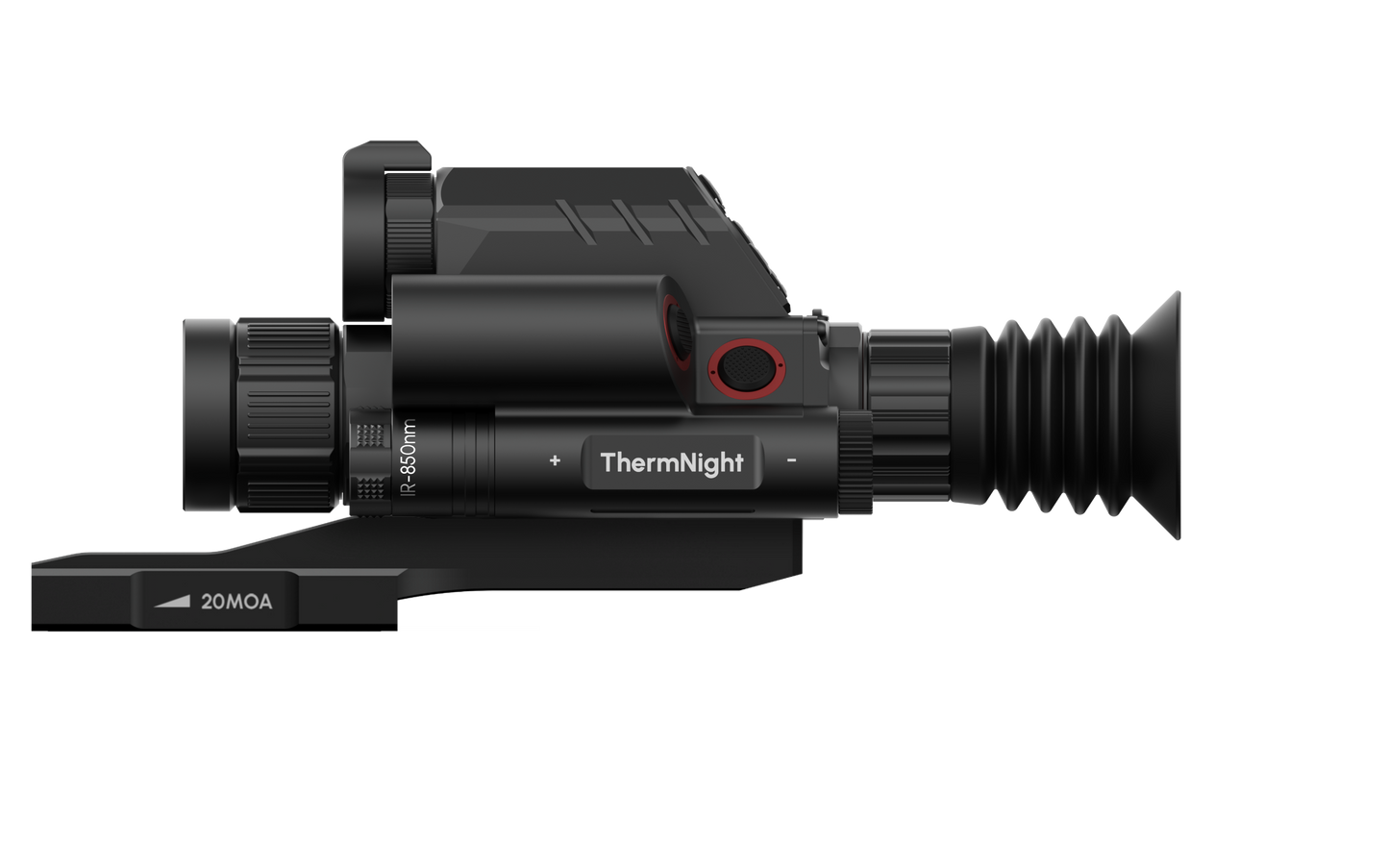
The DNT ThermNight TNC225R runs thermal and digital night vision in one housing
Two separate sensors sit inside the TNC225R. A 256×192 uncooled thermal detector behind a 25 mm lens reads heat. A Sony STARVIS 2 sensor behind a 52 mm lens handles daylight and, with its IR illuminator, darkness. Each channel has its own magnification range, its own field of view, and its own reticle zero. A button press switches which one is on screen.
Picture-in-picture puts both TNC225R channels on screen at once
Running one channel full-screen with the other in a smaller window is what separates the TNC225R from carrying two devices. Thermal in the main window and digital in the inset, or the reverse, switched with a single button. The inset window can sit upper left, center, or upper right, and defaults to about a tenth of the screen.
Thermal finds the heat and the digital channel confirms what it is
Each sensor is good at a different job. Thermal picks a warm body out of brush, shadow, and darkness at distances where nothing else registers, but a heat blob does not always say what animal it belongs to. The digital channel resolves detail, and that is what turns a heat signature into a confirmed identification. Using them together is the point of the design.
Identification range on the TNC225R runs to roughly 150 yards
DNT publishes the working numbers for this scope, and they set clear expectations. Both channels together give clear target identification at around 150 yards. Night vision with the IR illuminator alone extends visibility to approximately 450 yards, though seeing something is not the same as identifying it. That makes the TNC225R a close-range optic suited to small acreage, pest control, and hunting inside a few hundred yards. Anyone shooting past that should look at a longer-range unit.
Both TNC225R channels zero independently, one shot each
Two sensors means two reticles, and each one needs its own zero. One-shot zeroing handles each channel: fire a round, freeze the image, move the reticle to the point of impact, and save. Zeroing the digital channel first and matching the thermal reticle to the same point of impact is the faster order. A screen shifting adjustment in the system menu then aligns the two channels so both point where the rifle shoots. Five zeroing profiles store different rifles.
A detachable 850 nm IR illuminator ships with the TNC225R
Digital night vision needs light to work with, and the TNC225R includes a removable 850 nm IR illuminator to supply it. Swapping to a 940 nm unit gives a beam that is much harder to spot, at the cost of some reach; that module is a separate purchase. Both are Class 3R eye safe. The thermal channel needs no illumination at all and works in complete darkness.
Built-in ranging reaches 1,200 yards and feeds the TNC225R ballistic engine
The rangefinder in the TNC225R measures from 5 to 1,200 yards, well past the distance at which either channel can identify a target, which makes it useful for terrain and confirmation as much as for shot solutions. Measured range feeds the DNT Ballistic Engine, and the corrected aim point appears as either a dial-in reticle shift or a holdover mark. A preloaded bullet database speeds up building a profile, and profiles sync over Bluetooth through the DNT App.
At 22.8 oz and 6.7 inches, the TNC225R stays compact for a dual-sensor scope
Carrying two imaging systems usually costs size, and the TNC225R keeps it to 22.8 oz across 6.7 by 3.3 by 3.1 inches. A PMS Picatinny 0 MOA Short mount ships in the box along with two 18650 batteries and a charger, and runtime reaches 5 hours per battery. Eye relief measures 45 mm, or 1.8 inches, which is shorter than most riflescopes and worth accounting for in mount position and stock fit on hard-recoiling rifles.
Close-range hunters and pest control work fit the TNC225R best
Hunters working small acreage, barns, and field edges are the core fit for the TNC225R, where thermal finds the animal and the digital channel confirms it inside 150 yards. Coyote and hog control on that kind of ground is exactly what the design serves. Hunters shooting past a couple hundred yards should look at a longer-range thermal instead, since identification is the limit here rather than magnification. Buyers who want only thermal, and want it lighter and cheaper, are better served by a dedicated thermal scope.
FAQ
Is the DNT ThermNight TNC225R thermal or night vision?
Both. The TNC225R has a 256×192 thermal sensor and a separate Sony STARVIS 2 digital day and night sensor. Either can run full screen, or both at once through picture-in-picture.
How far can the TNC225R identify a target?
Around 150 yards with both channels working together, per DNT. Night vision with the IR illuminator extends visibility to roughly 450 yards, though identification is the shorter of the two figures and the one that matters for a shot.
How far does the TNC225R rangefinder measure?
From 5 to 1,200 yards. That reaches well beyond the distance at which either channel identifies a target, so it is as useful for reading terrain as for shot solutions.
Does the TNC225R need two separate zeros?
Yes. Each channel has its own reticle and its own zero, and each uses one-shot zeroing. A screen shifting adjustment in the system menu aligns the two so both point to the same impact. Five profiles store different rifles.
What comes in the box with the TNC225R?
A PMS Picatinny 0 MOA Short mount, a detachable 850 nm IR illuminator, an eye cup, a flip-up lens cover, two 18650 flat-top batteries, a charger, two USB cables, a user manual, and a lens cleaning cloth.
What is the eye relief on the TNC225R?
45 mm, or 1.8 inches. That is shorter than a typical riflescope, so mount position and stock fit deserve attention on hard-recoiling rifles.
Technical Specifications
-
Sensor Resolution (px)
256x192 -
Display Resolution (px)
1024x768 -
Refresh Rate (Hz)
50 fps display / 50 fps thermal / 60 fps digital -
Field of View
Thermal 7.03° x 5.28° · Digital 6.13° x 3.45°
-
Weight
22.8 oz -
HZ - refresh rate
50 fps display / 50 fps thermal / 60 fps digital -
Thermal Sensor Resolution
256x192 -
Display Resolution
1024x768 -
Pixel Pitch
12 µm -
Range Finder
Yes -
Clip-On
No -
Magnification Base
Thermal 3x · Digital 5x -
Magnification Max
Thermal 12x · Digital 20x -
Objective Lens
Thermal 25 mm · Digital 52 mm -
Field of View
Thermal 7.03° x 5.28° · Digital 6.13° x 3.45°