

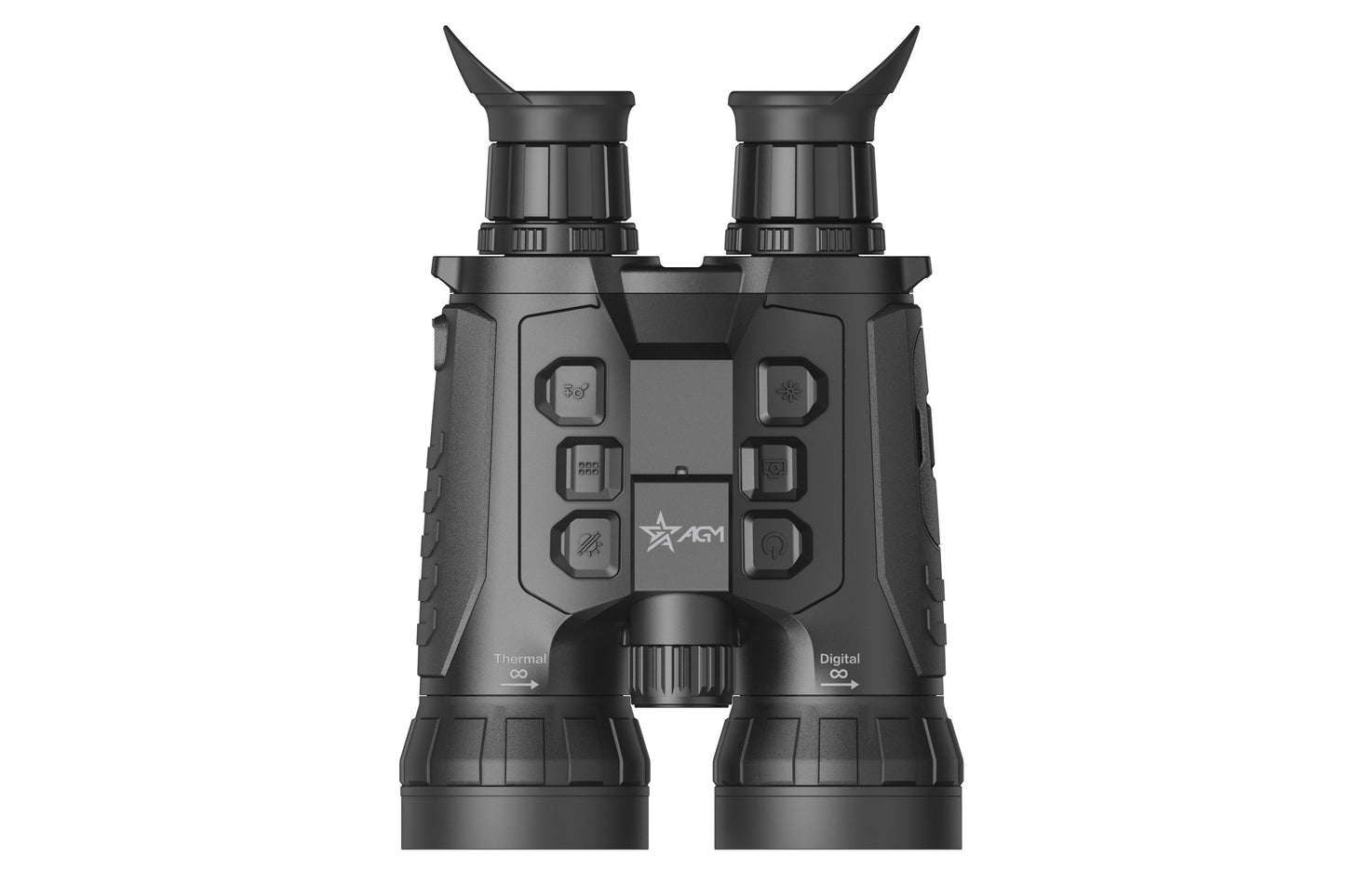
Full product description
The AGM ObservIR LRF 50-640 is a dual-spectrum thermal and digital day/night observation binocular — a handheld, dual-eye device that combines three capabilities most optics keep separate: a thermal imaging channel for detecting heat, a digital low-light optical channel for recognizing and identifying what the thermal channel finds, and a laser rangefinder for measuring exactly how far away it is.
The thermal channel is the primary engine. It pairs a 640×512 thermal sensor — built on a 12 μm pixel pitch with NETD rated at less than 15 mK at 25°C — to a 50 mm F/1.0 lens, running 4.5×–20× magnification with 2,600 m (about 2,844 yards) detection on a 6-foot object. The larger 50 mm thermal objective is what gives this model its reach. Alongside it, a digital day/night channel runs a 3840×2160 (4K) 1/1.8" CMOS sensor behind a 60 mm F/2.2 lens with a built-in 850 nm IR illuminator, so the same device that detected a heat signature can switch to an optical view to help confirm what it is. A built-in eye-safe laser rangefinder reads distance to 1,000 m. Both channels display on a 1920×1080 0.49-inch OLED at 50 Hz, processed through AGM's Image Boost 3.0 algorithm, and the binocular adds a GPS module and a digital magnetic compass for navigation and position reference in the field.
The ObservIR LRF lineup at Thermal Bros — how the 50-640 fits
Thermal Bros carries three binoculars from the AGM ObservIR LRF family. They share the same dual-spectrum concept — thermal channel, digital day/night channel, laser rangefinder, GPS, compass, and IR illuminator — and differ in thermal sensor resolution, lens size, and some generational hardware details. The naming code reads as objective lens size in millimeters followed by thermal sensor resolution.
- AGM ObservIR LRF 35-640 — 35 mm thermal lens, 640×512 thermal sensor, <15 mK NETD, 3×–22× thermal magnification, 1,800 m detection range. The wider-field, more compact option, running four 18650 batteries.
- AGM ObservIR LRF 50-640 — 50 mm thermal lens, 640×512 thermal sensor, <15 mK NETD, 4.5×–20× thermal magnification, 2,600 m detection range. The longer-reach 640-tier option, running NE-7255 battery packs with Image Boost 3.0 processing.
- AGM ObservIR LRF 60-1280 — 60 mm thermal lens, 1280×1024 thermal sensor. The flagship: the highest thermal resolution in the lineup paired with the largest objective lens.
The three share the platform concept — the digital day/night channel, the 1,000 m laser rangefinder, GPS, digital magnetic compass, 850 nm IR illuminator, 64 GB storage, and Wi-Fi hotspot. Thermal sensor resolution, lens size, and generational hardware (battery system, processing) are the differentiators.
Step up to the 50-640 from the 35-640 when the longer 2,600 m thermal detection range and the larger 50 mm objective matter more than the 35-640's wider field of view and lighter, more compact package. Step up to the 60-1280 when the highest available thermal resolution is the priority.
Why a dual-spectrum binocular is different
Most thermal devices do one thing: they show heat. A thermal image is excellent at detection — a warm body stands out instantly against a cooler background, even in total darkness or through light fog — but thermal imagery can be ambiguous at the moment of identification. A warm blob is clearly something, but telling a coyote from a dog, or a person from a deer, can be harder on thermal alone.
The ObservIR LRF addresses that with a second, separate optical channel. The thermal channel detects the heat signature; the digital day/night channel — a 4K low-light CMOS sensor with its own 60 mm lens and IR illuminator — provides an optical image to help recognize and confirm what was detected. The two channels work together: thermal finds it, the optical channel helps identify it, and the laser rangefinder measures the distance to it. That detect-recognize-range workflow in a single device is what sets the ObservIR LRF apart from a thermal-only binocular.
Why the 50 mm thermal lens earns its place
The 50-640's defining hardware difference from the 35-640 is its larger 50 mm F/1.0 thermal objective. A larger objective gathers more thermal signal, which is what extends the thermal detection range to 2,600 m (about 2,844 yards) on a 6-foot object — meaningfully farther than the 35 mm model's 1,800 m.
The trade-off is field of view: the 50-640's thermal channel sees 8.8° × 5.3°, and it starts at a higher 4.5× base magnification. The larger lens and higher base magnification favor reach and on-target detail at distance over wide-area scanning. For observation work where targets appear at longer ranges and the priority is seeing them clearly far out, the 50 mm objective is the right trade.
Why the <15 mK NETD thermal sensor matters
NETD (Noise Equivalent Temperature Difference) measures the smallest temperature difference the thermal sensor can resolve before electronic noise washes it out. Lower is better. The ObservIR LRF 50-640's thermal channel is rated at less than 15 mK at 25°C — a sensitive rating that resolves fine temperature differences cleanly.
In the field, that sensitivity translates to cleaner separation of warm targets from background heat, better image detail in marginal conditions like fog and light rain, and a more usable image when the target-to-background temperature differential is small — early morning, late evening, or after a hot day when terrain is still radiating warmth. Paired with the 640×512 sensor resolution (327,680 pixels) and AGM's Image Boost 3.0 processing algorithm, the thermal channel delivers a detailed, low-noise image for detection and observation.
Why the digital day/night channel and IR illuminator matter
The ObservIR LRF's second channel is a 3840×2160 (4K) ultra-low-light CMOS sensor behind a 60 mm F/2.2 lens. In daylight and twilight it works as a high-resolution digital optical channel. In full darkness, the built-in 850 nm smart IR illuminator — with adjustable power and beam angle — provides the light the CMOS sensor needs to produce a usable image.
This is the recognition tool. Where the thermal channel excels at picking a warm target out of a scene, the digital channel provides the kind of detailed optical image that helps confirm species, count animals, read terrain, or identify a person during a search. Having both channels in one binocular means a user can detect on thermal and immediately cross-reference on the optical channel without picking up a second device.
Why the laser rangefinder matters
The built-in laser rangefinder reads distance to 1,000 m with ±1 m accuracy and is eye-safe (Class 1). For an observation tool, accurate ranging turns "there's something out there" into actionable information — knowing a target sits at 250 m versus 600 m changes how a hunter, rancher, or observer responds. Integrated ranging also means no separate rangefinder to carry or fumble for in the dark; the distance reads directly in the display alongside the thermal or optical image.
Why GPS and the digital compass matter
The ObservIR LRF includes a built-in GPS module and a digital magnetic compass. For field use — particularly observation, search, and property or land management work — those provide position reference and bearing directly in the device. A detected target or point of interest can be located by direction and the user's own position fixed without a separate handheld GPS.
What you get with the ObservIR LRF 50-640
- Dual-spectrum design: separate thermal and digital day/night channels in one binocular.
- Thermal channel: 640 × 512 sensor with 12 μm pixel pitch. 640-tier thermal resolution for detailed detection and observation.
- Thermal NETD <15 mK (25°C, F#=1.0). A sensitive rating that holds image quality in marginal heat differentials and adverse weather.
- Thermal lens: 50 mm F/1.0. The larger thermal objective for extended detection range.
- Thermal magnification: 4.5×–20×.
- Thermal detection range: 2,600 m (about 2,844 yards) on a 6-foot object.
- Image Boost 3.0 processing algorithm.
- Digital channel: 3840 × 2160 (4K) 1/1.8" progressive-scan CMOS sensor.
- Digital lens: 60 mm F/2.2.
- Digital magnification: 5.5×–22×.
- Built-in 850 nm smart IR illuminator with adjustable power and beam angle.
- Eye-safe (Class 1) laser rangefinder: up to 1,000 m, ±1 m accuracy.
- 1920 × 1080 0.49-inch OLED display at 50 Hz.
- Color palettes: Black Hot, White Hot, Red Hot, Fusion, Red Monochrome, Green Monochrome.
- Image modes: Day, Night, Green, Yellow, Auto.
- Scene modes: Jungle, Recognition.
- Picture-in-Picture mode.
- Highest-temperature spot tracking.
- Flat field correction: Auto, Manual, External Correction.
- Built-in GPS module.
- Digital magnetic compass.
- Video and audio recording; snapshot capture.
- 64 GB EMMC built-in storage.
- Wi-Fi hotspot with smartphone streaming and file transfer.
- Interpupillary distance adjustment: 60 mm to 74 mm.
- Diopter adjustment: -5 to +3.
- Two removable rechargeable NE-7255 Li-ion battery packs (7.18 V / 5400 mAh; two included); up to 8.5 hours continuous runtime.
- External power supply capability via USB Type-C; fast charging via USB-C to USB-C.
- Standby mode and auto screen-off to conserve energy.
- IP67-rated waterproof and dustproof construction.
- Operating temperature range -20°C to +55°C (-4°F to 131°F).
- AGM 5-year transferable warranty.
Who the ObservIR LRF 50-640 is built for
- Hunters who want a dual-eye observation binocular that detects on thermal, confirms on the optical channel, and ranges targets — with the longer reach of the 50 mm thermal objective
- Ranchers and property managers monitoring land, livestock, and predators at night over larger or more open areas
- Observation and surveillance professionals who need detection, recognition, and ranging at extended distance in a single handheld unit
- Users who want dual-eye viewing for comfortable extended observation sessions rather than a single-eye monocular
- Buyers who want the longer-range 640-tier option in the ObservIR LRF lineup, accepting a narrower field of view and higher base magnification than the 35-640
- Users who want integrated GPS and a digital compass for navigation and position reference alongside their optics
The ObservIR LRF 50-640 is a handheld observation binocular, not a weapon sight — it has no reticle and is not designed to be rifle-mounted. Users who prioritize a wider field of view and a more compact, lighter package may prefer the 35-640; users who want the highest available thermal resolution may prefer the flagship 60-1280.
Full specifications
Thermal channel
- Thermal sensor: 640 × 512, 12 μm pixel pitch
- Sensor architecture: 12 μm VOx uncooled focal plane array
- NETD: <15 mK (25°C, F# = 1.0)
- Thermal lens: 50 mm F/1.0
- Thermal magnification: 4.5×–20×
- Thermal field of view: 8.8° × 5.3°
- Detection range: 2,600 m (about 2,844 yards) on a 6-foot object
- Processing: Image Boost 3.0
- Refresh rate: 50 Hz
- Color palettes: Black Hot, White Hot, Red Hot, Fusion, Red Monochrome, Green Monochrome
- Scene modes: Jungle, Recognition
- Flat field correction: Auto, Manual, External Correction
- Highest-temperature spot tracking: yes
Digital day/night channel
- Digital sensor: 3840 × 2160 (4K), 1/1.8" progressive-scan CMOS
- Digital lens: 60 mm F/2.2
- Digital magnification: 5.5×–22×
- Digital field of view: 7.3° × 4.1°
- IR illuminator: built-in 850 nm smart IR, adjustable power and beam angle
- Image modes: Day, Night, Green, Yellow, Auto
Laser rangefinder
- Range: up to 1,000 m, ±1 m accuracy
- Safety class: Class 1 (eye-safe)
- Laser wavelength: 905 nm
Shared system
- Display: 1920 × 1080, 0.49-inch OLED, 50 FPS
- Picture-in-Picture: yes
- GPS module: built-in
- Digital magnetic compass: yes
- Video/audio recording: yes
- Snapshot: yes
- Storage: 64 GB EMMC
- Wi-Fi hotspot: yes (AGM Connect app)
- Interpupillary distance: 60 mm to 74 mm
- Diopter adjustment: -5 to +3
- Standby mode: yes
- Battery: one replaceable rechargeable NE-7255 Li-ion battery pack, 7.18 V / 5400 mAh (two included)
- Battery life: up to 8.5 hours continuous
- Power supply: 5 VDC / 2 A, USB Type-C; supports external power; fast charging via USB-C to USB-C
- Operating temperature: -20°C to +55°C (-4°F to 131°F)
- Construction: IP67 waterproof and dustproof, rubber overmolding
- Dimensions: 9.0 × 5.8 × 3.1 in (229 × 148 × 80 mm)
- Weight: 1.82 lb (0.83 kg)
- Warranty: AGM 5-year transferable manufacturer warranty
In the box: thermal & digital binocular, two NE-7255 Li-ion battery packs (7.18 V / 5400 mAh), NE-7255 battery charger, USB-C to USB-C cable (fast charging), USB-A to USB-C cable, power adapter, tripod adapter, neck strap, lens cloth, quick start guide, owner's manual.
Frequently asked questions
Where does the 50-640 fit in Thermal Bros' ObservIR LRF lineup?
Thermal Bros carries three ObservIR LRF binoculars. The 35-640 is the wider-field, more compact option — a 640×512 thermal sensor on a 35 mm lens, 3×–22× magnification, 1,800 m detection. The 50-640 is the longer-reach 640-tier option — same 640 sensor, but on a 50 mm lens with 4.5×–20× magnification and 2,600 m detection. The 60-1280 is the flagship, with a 1280×1024 thermal sensor and a 60 mm lens. Step up to the 50-640 from the 35-640 when longer thermal reach matters more than the 35-640's wider field of view; step up to the 60-1280 when the highest thermal resolution is the priority.
How is the 50-640 different from the 35-640?
The two share the 640×512 thermal sensor, <15 mK NETD, the digital day/night channel, the 1,000 m laser rangefinder, GPS, and compass. The differences: the 50-640 has a larger 50 mm thermal lens (vs. 35 mm) for longer reach — 2,600 m detection vs. 1,800 m — with a narrower thermal field of view (8.8° × 5.3°) and a higher 4.5× base magnification. The 50-640 also uses a different power system: rechargeable NE-7255 battery packs (two included) rather than the 35-640's four 18650 cells, and it adds AGM's Image Boost 3.0 processing and an expanded palette/image-mode set. It runs up to 8.5 hours of continuous runtime and weighs 1.82 lb.
How far can the thermal channel detect?
AGM publishes a thermal detection range of 2,600 m — about 2,844 yards — on a 6-foot object. Detection is the distance at which the thermal sensor can register that something warm is present; it is not the same as identification distance, which is closer. The digital day/night channel and the rangefinder help turn a detection into a confirmed, ranged target.
How far does the laser rangefinder reach?
AGM publishes the laser rangefinder range as up to 1,000 m (about 1,094 yards) with ±1 m accuracy. It's eye-safe, rated Class 1.
What's the battery situation?
The ObservIR LRF 50-640 uses a removable, rechargeable NE-7255 Li-ion battery pack (7.18 V / 5400 mAh), and two packs are included — so a charged spare can be swapped in to extend a session. AGM rates runtime at up to 8.5 hours of continuous operation. The binocular fast-charges via USB-C to USB-C and can run on external power through the USB Type-C port. Note this is a different battery system from the ObservIR LRF 35-640, which uses 18650 cells — the two models' batteries are not interchangeable.
Does it have GPS?
Yes. The ObservIR LRF 50-640 has a built-in GPS module and a digital magnetic compass for position reference and bearing in the field.
Can I record what I see?
Yes. Video and audio recording and snapshot capture are built in, saving to 64 GB of internal EMMC storage. Files transfer over Wi-Fi via the AGM Connect app or via USB Type-C.
Is the ObservIR LRF 50-640 waterproof?
Yes. It carries an IP67 rating — sealed against dust ingress and rated for water immersion up to one meter for 30 minutes — and is built with rugged rubber overmolding.
What's the warranty?
AGM backs the ObservIR LRF 50-640 with their 5-year transferable manufacturer warranty.
Who this is for
Best for
Best for serious hunters and landowners who want thermal binoculars with laser rangefinding for extended scanning, better comfort, and faster distance checks in the field.
Not ideal for
Not ideal for buyers who want the lightest handheld scanner, need a rifle-mounted optic, or only plan to use thermal a few times a year.
Why buy from Thermal Bros
Thermal Bros helps you decide when thermal binoculars are worth the jump over a monocular. We will tell you when the extra comfort and feature set matter, and when a smaller handheld scanner would do the job for less.
Quick specifications
- Category
- Thermal Handheld
- Sensor Resolution
- 1280x1040
- Magnification
- 2.5-20x
- Objective Lens
- 60
- Detection Range
- 3500
- Rangefinder
- Yes
AGM Connect
Wi-Fi integration with iOS and Android devices


Technical Specifications
-
Sensor Resolution (px)
1280x1040 -
Display Resolution (px)
1920x1080 -
NETD Rating
18 -
Detection Range
3500 -
Refresh Rate (Hz)
25 -
Field of View
14.6
-
Weight
1.9 lb -
Dimensions
9 in 5.8 in 3.1 in -
HZ - refresh rate
25 -
Category
Thermal Handheld -
Handhelds
Yes -
Thermal Sensor Resolution
1280x1040 -
Display Resolution
1920x1080 -
Pixel Pitch
12 -
NETD Rating
18 -
Detection Range
3500 -
Range Finder
Yes -
Clip-On
No -
Magnification Base
2.5 -
Magnification Max
20 -
Objective Lens
60 -
Field of View
14.6
