


Quick answer
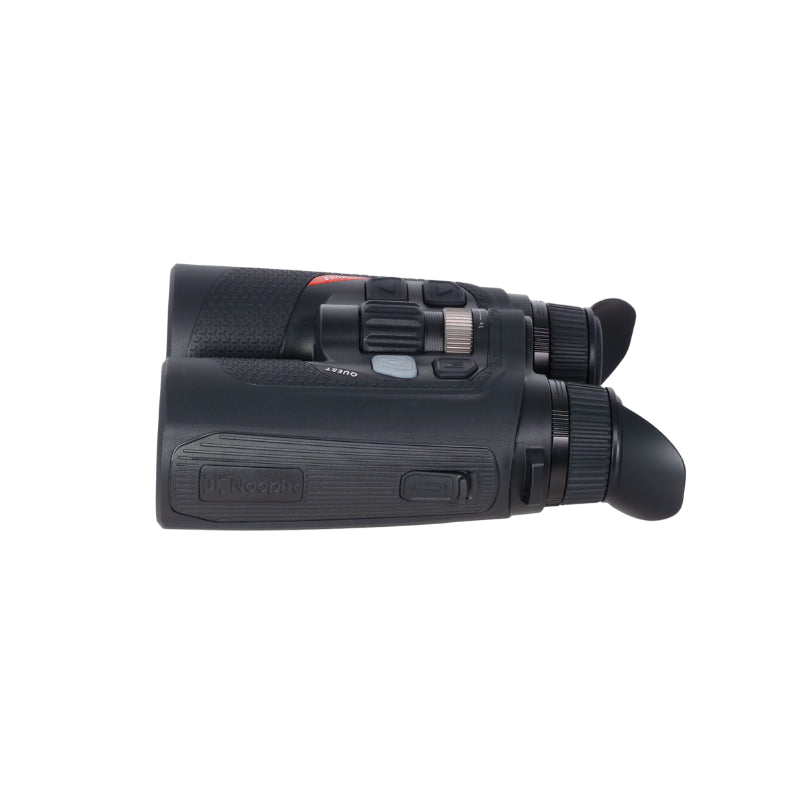
The Nocpix Quest S50R LRF is the flagship of Nocpix's Quest thermal binocular family — a true 1280-class thermal binocular with a 1280×1024 self-developed sensor, 50 mm F/1.1 germanium lens, 1,000-yard concealed laser rangefinder, and dual 1,920 × 1,200 AMOLED displays (one per eye). NETD ≤15 mK, 60 Hz refresh, 2× to 16× magnification, wide 17.5° × 14° field of view, 2,850-yard detection range, Electronic Image Stabilization, Reality+ image processing, Picture-in-Picture, onboard photo/video/audio recording with Wi-Fi, hot-swappable dual battery system, IP67 rubber-coated build, and a fully adjustable binocular harness included. Built for predator hunters, big-game spotters, ranchers, and wildlife managers who need 1280-class image quality and dual-eye comfort for serious long-distance observation.
Who this is for
Best for
Best for serious hunters, landowners, and wildlife observers who want 1280-class image detail, dual-eye viewing comfort, and integrated laser ranging for extended thermal scanning
Not ideal for
Not ideal for buyers who want a dedicated rifle-mounted thermal scope, need two-eye viewing comfort for long sits, or only want the cheapest way to try thermal.
Quick specifications
- Category
- Thermal Handheld
- Sensor Resolution
- 1280x1024
- Magnification
- 2-16x
- Objective Lens
- 50
- Detection Range
- 2850
- Rangefinder
- Yes
Why buy from Thermal Bros
Thermal Bros helps buyers choose the right scanner before they overspend on the wrong one. We will tell you when a handheld thermal monocular is enough, when a binocular makes more sense, and when you should skip straight to a rifle-mounted setup.
Full product description
The Nocpix Quest S50R LRF is the flagship of Nocpix's Quest thermal binocular family — a true 1280-class thermal binocular that brings the highest-available thermal sensor resolution to the most comfortable observation platform Nocpix builds. New for 2026, the S50R sits at the top of the Quest lineup with a 1280×1024 Nocpix self-developed thermal sensor, a 50 mm F/1.1 germanium objective lens, and the full Quest platform: dual 1,920 × 1,200 AMOLED displays (one per eye), a 1,000-yard concealed laser rangefinder, Reality+ image processing with Electronic Image Stabilization, a hot-swappable dual-battery system, and a fully adjustable binocular harness.
For the hunter who wants the most capable Quest — and the most refined dual-eye thermal experience available — this is it. The 1280 sensor delivers roughly four times the pixel count of a 640. The 50 mm F/1.1 lens gathers the thermal signal that resolution needs to be useful. And the binocular form factor lets you use that image quality across hours of scanning without the fatigue a thermal monocular forces. For predator hunters scanning big country, western big-game spotters working open terrain, or anyone who's experienced the limits of a 640-sensor binocular and wants to step up — the S50R is what was missing.
The Quest family — how the S50R fits
The Quest series is a tiered family on a shared platform. Same dual 1,920 × 1,200 AMOLED displays, same 1,000-yard concealed LRF, same Reality+ image processing with Electronic Image Stabilization, same hot-swappable dual-battery system, same fully adjustable binocular harness. What changes between tiers is sensor resolution and lens size.
- Quest H35R — 640×512 sensor, 35 mm lens. Wide-field 640 for close-to-mid range work.
- Quest H50R — 640×512 sensor, 50 mm lens. The long-reach 640 for greater detection distance.
- Quest S50R — 1280×1024 sensor, 50 mm lens. The flagship.
Step up from the H50R to the S50R when 1280-resolution image quality is what your observation demands — when positive target identification on small, distant, or partially obscured animals matters as much as detection distance.
Why a 1280 sensor matters in a binocular
A 1280×1024 sensor has roughly four times the total pixel count of a 640×512 sensor. More pixels collecting thermal data across the same scene means finer resolution at distance, cleaner edge definition on warm bodies against cooler backgrounds, and easier positive identification when a target is small, far, or partially obscured by brush or terrain.
That resolution gain matters specifically in a binocular context. A thermal monocular is built for short scans — you raise it, identify the heat signature, drop it back down. A binocular is built for serious looking. When you'll spend 30 minutes glassing a far hillside or watching a treeline for movement, image resolution at distance is what makes that observation productive instead of frustrating. The S50R puts the highest-resolution thermal sensor available into the most comfortable platform Nocpix builds — and that combination is genuinely new in the thermal binocular market.
Why a binocular vs. a monocular
If you've spent a long evening scanning a property with a thermal monocular, you already know what binoculars solve. One-eye observation creates fatigue quickly — your scanning eye tires, the other eye fights to stay open, and after a couple hours of serious looking, your effectiveness drops sharply. The Quest S50R uses dual 1,920 × 1,200 AMOLED displays, one per eye, with independent diopter adjustment on each side. Both eyes see the thermal image. Both hands hold the device. Weight distributes naturally across both wrists rather than loading one shoulder.
For the long-haul observation work the S50R is built for — western big-game spotting at dawn and dusk, all-night predator scanning, ranch security patrols, wildlife monitoring sessions — that ergonomic difference is what makes the optic actually usable across the time horizons your hunting demands.
What you get with the Quest S50R
- 1280 × 1024 thermal sensor with 12 μm pixel pitch, 60 Hz refresh rate. Nocpix's self-developed industry-leading sensor — the top sensor tier across the Nocpix lineup.
- NETD ≤15 mK. Sharp thermal contrast and clean edge definition in difficult conditions — fog, light rain, low ambient temperatures, marginal heat differentials.
- 50 mm F/1.1 germanium objective lens. Sized for reach and signal gathering.
- 2× base magnification, 2× to 16× total range with digital zoom.
- Detection range up to 2,850 yards.
- Wide 17.5° × 14° angular field of view — broader than the H50R for faster scanning and large-area search.
- Dual 1,920 × 1,200 AMOLED displays — full resolution per eyepiece. Independent diopter adjustment on each eye.
- Independent interpupillary adjustment — fully customizable to your eye spacing.
- Reality+ image processing with R+ image enhancement algorithm.
- Electronic Image Stabilization (EIS) — stabilizes the thermal image against handheld motion for cleaner viewing during extended observation.
- Built-in 1,000-yard concealed laser rangefinder. Single-firing or continuous modes; ranged distance displays on-screen.
- Multiple color palettes including hunter-friendly options.
- Picture-in-Picture mode for keeping a zoomed target view alongside the wider field.
- Onboard photo, video, and audio recording with internal storage.
- Wi-Fi connectivity for transferring footage to phone or other devices.
- Hot-swappable dual battery system: internal USB-C-charged battery plus an auxiliary 18650-style battery — swap the external while the internal keeps the device running for indefinite runtime.
- IP67-rated waterproof and dustproof construction with full rubber coating.
- Fully adjustable forward-opening binocular harness included.
- Smooth-turning ergonomic focus and zoom dials.
- Manufacturer warranty (Nocpix).
Who the Quest S50R is built for
- Western big-game spotters working open terrain where reach and resolution both matter
- Predator and coyote hunters scanning big country who need positive target identification at distance
- Hunters and ranchers who do significant long-distance observation across pastureland, cut fields, and open ranch country
- Buyers stepping up from a 640-sensor binocular who've hit the limits of what 640 can resolve
- Wildlife managers and biologists doing precision observation work at extended range
- Security and surveillance professionals who need 1280-class image quality in a comfortable, all-night platform
- Anyone who wants the most refined dual-eye thermal experience available
The trade-off versus the H50R is price, plus a small base magnification step (2× vs. 4×) — the S50R uses its 1280 sensor's pixel density to spread across a wider field of view and zoom in digitally without losing detail, while the H50R starts higher and zooms further. If you've reached the limits of a 640 binocular and want more image to work with, the S50R is the answer.
Full specifications
- Thermal sensor: 1280 × 1024, 12 μm pixel pitch
- Sensor architecture: Nocpix self-developed, industry-leading
- NETD: ≤15 mK
- Objective lens: 50 mm F/1.1 germanium
- Base magnification: 2×
- Magnification range: 2× to 16× (digital zoom)
- Detection range: up to 2,850 yards
- Field of view: 17.5° × 14° angular
- Refresh rate: 60 Hz
- Display: dual 1,920 × 1,200 AMOLED (one per eyepiece)
- Diopter adjustment: independent, each eye
- Interpupillary adjustment: yes
- Image processing: Reality+ with R+ enhancement algorithm
- Image stabilization: Electronic Image Stabilization (EIS)
- Laser rangefinder: built-in concealed, 1,000 yd (single-firing and continuous modes)
- Color palettes: multiple including hunter-optimized options
- Picture-in-Picture: yes
- Recording: photo, video, audio
- Connectivity: Wi-Fi
- Battery system: internal USB-C rechargeable + auxiliary 18650-style; hot-swappable for indefinite runtime
- Charging: USB Type-C
- Construction: rubber-coated, IP67-rated
- Included accessories: fully adjustable forward-opening binocular harness
- Warranty: manufacturer warranty (Nocpix)
Frequently asked questions
Where does the S50R fit in the Quest family?
The S50R is the flagship of the three-model Quest series. The "S" signals the 1280 sensor tier; the "50" is the 50 mm objective lens; the "R" indicates the integrated laser rangefinder. Below it sit the H35R (640 with 35 mm lens for wide FOV) and the H50R (640 with 50 mm lens for added reach).
What's the difference between the S50R and the H50R?
Same Quest platform — same dual AMOLED displays, same 1,000-yard LRF, same hot-swap battery system, same harness. Same 50 mm F/1.1 lens. The H50R uses a 640×512 sensor; the S50R steps up to a 1280×1024 sensor — roughly four times the pixel count for finer detail at distance. The S50R also has a wider 17.5° × 14° field of view than the H50R's 8.8 × 7° at the same lens size, because the 1280 sensor's pixel density lets it cover more ground at base magnification. Step up to the S50R when 1280 image quality is the deciding factor.
Is a 1280 sensor worth the upgrade from a 640?
For hunters who need positive target identification at extreme range, work in marginal heat conditions, or want to make confident calls on small or partially obscured animals — yes. The 1280 gives you roughly four times the pixel count of a 640, which translates into finer detail and easier identification at distance. If your observation happens at distances where a 640 is making positive ID confidently, the upgrade may not pay off. If you're hitting the limits of a 640's resolution, the 1280 is what solves that.
Why is the base magnification only 2× on the flagship?
This is deliberate. The 1280 sensor's extra pixel count means digital zoom doesn't soften the image the way it does on lower-resolution scopes — so Nocpix started the base low to give the S50R a wider field of view, easier to find and track moving targets, and let the 1280 sensor handle the magnification work in software up to 16×. The result is a flagship that scans like a wide-field binocular and resolves like a precision optic at zoom.
Why is the field of view wider than the H50R's?
Same 50 mm lens, more pixels in the sensor. The S50R's 1280×1024 sensor packs more pixels into the same physical sensor area as the H50R's 640×512, which means more of the scene can be captured at base magnification without losing detail. The result is a 17.5° × 14° FOV on the S50R vs. the H50R's 8.8 × 7°.
How accurate is the laser rangefinder?
The Quest S50R's concealed integrated LRF ranges to 1,000 yards. It runs in either single-firing or continuous modes, and the ranged distance displays on-screen.
What's Electronic Image Stabilization?
EIS smooths out the thermal image against handheld motion — small movements, breathing, slight shake. The result is a steadier, easier-to-read image when you're glassing without a tripod, which matters especially on a binocular built for long observation sessions.
What about the battery system — can it really run indefinitely?
Yes, with how the dual system is designed. The internal battery charges via USB-C; the external is an auxiliary 18650-style battery. While the internal battery keeps the binocular running, you can swap the 18650 out for a charged one. As long as you have charged 18650s in your pack, the device keeps running through the swap.
Does the S50R record video?
Yes. Onboard photo, video, and audio recording is included, with internal storage and Wi-Fi for transferring footage to your phone.
Is the S50R waterproof?
Yes. The S50R is rated IP67 — sealed against dust ingress and rated for water immersion. The rubber coating adds shock and weather protection. Built for rain, snow, and adverse conditions.
Is a harness included?
Yes. A fully adjustable forward-opening binocular harness is included with every Quest S50R.
What's the warranty?
Nocpix backs the Quest S50R with their standard manufacturer warranty.
Nocpix App
Wi-Fi integration with iOS and Android devices


Technical Specifications
-
Sensor Resolution (px)
1280x1024 -
Display Resolution (px)
1920X1200 -
NETD Rating
15 -
Detection Range
2850 -
Refresh Rate (Hz)
60 -
Field of View
14
-
Weight
1.54 lb -
Dimensions
6.91 in 5.43 in 2.6 in -
HZ - refresh rate
60 -
Category
Thermal Handheld -
Thermal Sensor Resolution
1280x1024 -
Display Resolution
1920X1200 -
Pixel Pitch
12 -
NETD Rating
15 -
Detection Range
2850 -
Range Finder
Yes -
Clip-On
No -
Magnification Base
2 -
Magnification Max
16 -
Objective Lens
50 -
Field of View
14