


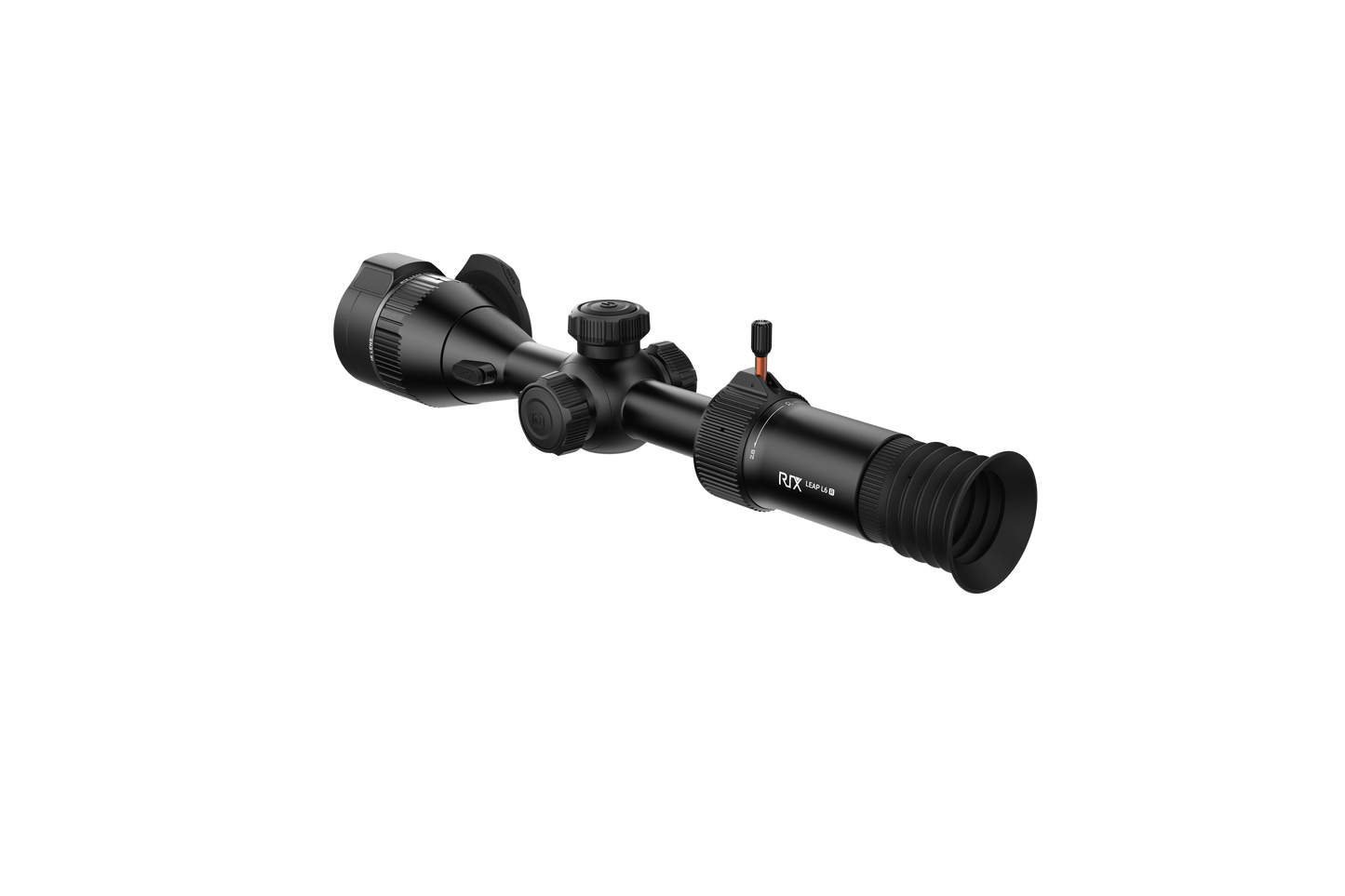
Why Choose this model
The Rix Leap L6R LRF is the 640-class mid-tier of Rix's three-scope Leap lineup. At $3,899, it sits between the entry-level Rix Leap L3R LRF at $2,299 and the flagship Rix Leap L12R LRF at...
Who this is for
Best for
Best for hog, coyote, and predator hunters who want stronger image detail than entry-level thermal without jumping straight to top-tier 1280 pricing.
Not ideal for
Not ideal for buyers who only hunt close range, mainly need a handheld scanner, or want the lowest-cost starting point.
Quick specifications
- Category
- Thermal Rifle Scopes
- Sensor Resolution
- 640x480
- Magnification
- 3-8.4x
- Objective Lens
- 50
- Detection Range
- 2850
- Rangefinder
- Yes
Why buy from Thermal Bros
With premium thermal scopes, the expensive mistake is buying the wrong fit. Thermal Bros helps you compare sensor tier, lens size, and rangefinding value in plain English so you end up with the right optic, not just the most expensive one.
Full product description
The Rix Leap L6R LRF is the 640-class mid-tier of Rix's three-scope Leap lineup. At $3,899, it sits between the entry-level Rix Leap L3R LRF at $2,299 and the flagship Rix Leap L12R LRF at $6,899 and it's the scope most predator hunters will end up on. The L6R LRF delivers the image quality serious nighttime hunters expect, with the onboard intelligence (integrated laser rangefinder, built-in ballistic calculator, ultra-fine reticle) that justifies the step up from entry-tier optics.
The Leap series is built around three things RIX gets right: clean thermal imaging powered by a sub-20 mK NETD sensor, an integrated rangefinder-and-ballistics package that does the math on the scope itself, and an F0.9 lens that pulls in 20% more light than the F1.0 standard. The L6R LRF gives you all of that without paying flagship pricing for the 1280-sensor L12R LRF.
What You Actually Get at the Mid-Tier
The L6R LRF is the scope that proves you don't need to chase the highest sensor resolution on the market to get a serious thermal package. Three specs do the heavy lifting:
Sub-20 mK NETD thermal sensor. NETD measures how small a temperature difference the sensor can distinguish lower numbers mean sharper thermal contrast. At under 20 mK, the L6R LRF reads cleaner than most 640-class scopes on the market, especially in marginal conditions like rain, snow, or high humidity when ambient temperature and animal body heat start to converge on less sensitive sensors.
F0.9 germanium lens. A faster lens (lower f-stop) pulls in more thermal energy. The L6R LRF's F0.9 lens captures roughly 20% more light than the F1.0 lens you'll find on most competing thermal scopes which translates directly to a brighter, more detailed image when conditions get tough.
1280 — 720 video output. The image you see through the scope and the image you see on your phone are both rendered at 1280 — 720, which means clean review footage and live phone display without quality loss when you're using the companion app.
Integrated LRF and Ballistic Calculator
A built-in laser rangefinder changes what kinds of shots you can ethically take in the dark. The L6R LRF's rangefinder is accurate out to 1,312 yards well past the practical identification range of a 640 sensor at this magnification, which means you'll never out-range the LRF before you out-range the scope's ability to confirm a target.
The onboard ballistic calculator takes the ranged distance and converts it into a holdover solution directly on the scope, no app required, no math in your head. Load your rifle's ballistic profile once and the scope does the work for every shot after.
The Ultra-Fine Reticle
The L6R LRF runs a 0.35 MOA reticle equivalent to 0.37 inches at 100 yards. That's significantly finer than the standard reticles on most thermal scopes, which matters for two reasons: at distance, a thick reticle covers up the target you're trying to shoot, and a finer reticle keeps the sight picture cleaner so you can place the shot precisely without the crosshair eating the kill zone.
Key Specs
- Thermal sensor: 640-class with <20 mK NETD
- Lens: F0.9
- Video output resolution: 1280 — 720
- Laser rangefinder: Integrated, accurate to 1,312 yards
- Onboard ballistic calculator: Yes
- Reticle: 0.35 MOA (0.37" at 100 yards)
- Price: $4,499.00
Who This Scope Is For
- Serious predator hunters working coyote and hog at typical hunting distances (100–500 yards) who want better image quality than entry-tier scopes deliver
- Long-range thermal shooters who need integrated ranging and ballistic support but don't need the 1280 sensor of the L12R LRF
- Hunters upgrading from a 384-sensor scope who want a meaningful jump in image quality and onboard intelligence
- Hunters in marginal-weather climates rain, snow, humidity where the F0.9 lens and sub-20 mK NETD genuinely show their value
- Precision-focused buyers who care about reticle clarity and shot placement, not just heat detection
If your shots stay inside 200 yards or you're stepping into thermal for the first time, the Rix Leap L3R LRF at $2,299 is the entry-tier option in the same Leap platform. If you regularly push past 500 yards or want the sharpest image RIX builds, step up to the Rix Leap L12R LRF at $6,899.
How It Compares in the Leap Lineup
The L6R LRF is the mid-tier of Rix's three-scope Leap series. Step down to the Rix Leap L3R LRF at $2,599 for the 384-sensor entry point strong performance for hunters working inside 200 yards. Step up to the Rix Leap L12R LRF at $6,899 for the 1280-sensor flagship with a 60mm objective built for hunters consistently working past 500 yards or in marginal conditions. The L6R LRF is the right pick when you want serious 640-class image quality, integrated LRF and ballistics, and don't need to pay flagship pricing to get them.
Frequently Asked Questions
What's the difference between the Rix Leap L6R LRF and the L12R LRF?
Same Leap platform, same onboard LRF, same built-in ballistic calculator, same F0.9 lens technology. The difference is sensor resolution and objective lens size. The L6R LRF runs a 640-class sensor at $4,499. The L12R LRF runs a 1280 — 1024 sensor with a 60mm objective at $6,899. The $2,400 spread buys you 4x the pixel count on target, longer practical identification range, and a cleaner image at high magnification. If you push past 500 yards or hunt in marginal conditions, the L12R LRF is worth the spread. If you're working typical predator-hunting distances inside 500 yards, the L6R LRF delivers the same Leap experience for less.
What's the difference between the Rix Leap L6R LRF and the L3R LRF?
Both run on the same Leap platform with integrated LRF and onboard ballistics. The L3R LRF is the entry tier at $2,599 with a smaller sensor and a more compact lens. The L6R LRF steps up to the 640-class sensor at $4,499, giving you meaningfully better image quality, longer practical identification range, and more usable detail at extended distance. The L3R LRF is the right pick for sub-200-yard work or first-time thermal buyers; the L6R LRF is the right pick when image quality starts driving the decision.
Is the Rix Leap L6R LRF good for coyote hunting?
Yes. The 640-class sensor and sub-20 mK NETD give you the contrast needed to confidently ID a coyote from background heat signatures well past typical calling distance. The 1,312-yard LRF and onboard ballistic calculator handle holdover calculations for shots at distance, and the 0.35 MOA reticle keeps the sight picture clean for precision shot placement.
How accurate is the laser rangefinder?
The LRF is rated accurate out to 1,312 yards on reflective targets in good conditions. Real-world performance on a coyote-sized target at night is typically shorter expect reliable returns well past the practical identification range of a 640 sensor, which means the LRF won't be your limiting factor.
Does the onboard ballistic calculator require an app or subscription?
The ballistic calculation runs directly on the scope. No subscription is required to use it. The companion app is used to load and manage ballistic profiles on the scope.
What does "F0.9 lens" mean and why does it matter?
F-stop describes how much light a lens lets through lower numbers mean more light. An F0.9 lens lets in roughly 20% more thermal energy than the F1.0 lens you'll find on most competing thermal scopes. In practical terms, that translates to a brighter, more detailed image, especially in low-contrast conditions like fog, rain, or right after a temperature swing.
Frequently asked questions
What is this product best for?
Best for hog, coyote, and predator hunters who want stronger image detail than entry-level thermal without jumping straight to top-tier 1280 pricing.
Who should probably skip it?
Not ideal for buyers who only hunt close range, mainly need a handheld scanner, or want the lowest-cost starting point.
Does it include a rangefinder?
Yes. This product is configured with rangefinding support according to the current product data.
Why buy from Thermal Bros?
With premium thermal scopes, the expensive mistake is buying the wrong fit. Thermal Bros helps you compare sensor tier, lens size, and rangefinding value in plain English so you end up with the right optic, not just the most expensive one.
Is this a scope or a scanner?
This is a rifle-mounted optic. Use a handheld thermal monocular or binocular if your main need is scanning before the shot.
Rix Optics App
Wi-Fi integration with iOS and Android devices


Technical Specifications
-
Sensor Resolution (px)
640x480 -
Display Resolution (px)
1920x1080 -
NETD Rating
20 -
Detection Range
2850 -
Refresh Rate (Hz)
50 -
Field of View
8.8
-
Weight
2.6 lb -
Dimensions
14.2 in 3.5 in 3 in -
HZ - refresh rate
50 -
Category
Thermal Rifle Scopes -
Handhelds
No -
Thermal Sensor Resolution
640x480 -
Display Resolution
1920x1080 -
Pixel Pitch
12 -
NETD Rating
20 -
Detection Range
2850 -
Range Finder
Yes -
Clip-On
No -
Magnification Base
3 -
Magnification Max
8.4 -
Objective Lens
50 -
Field of View
8.8