


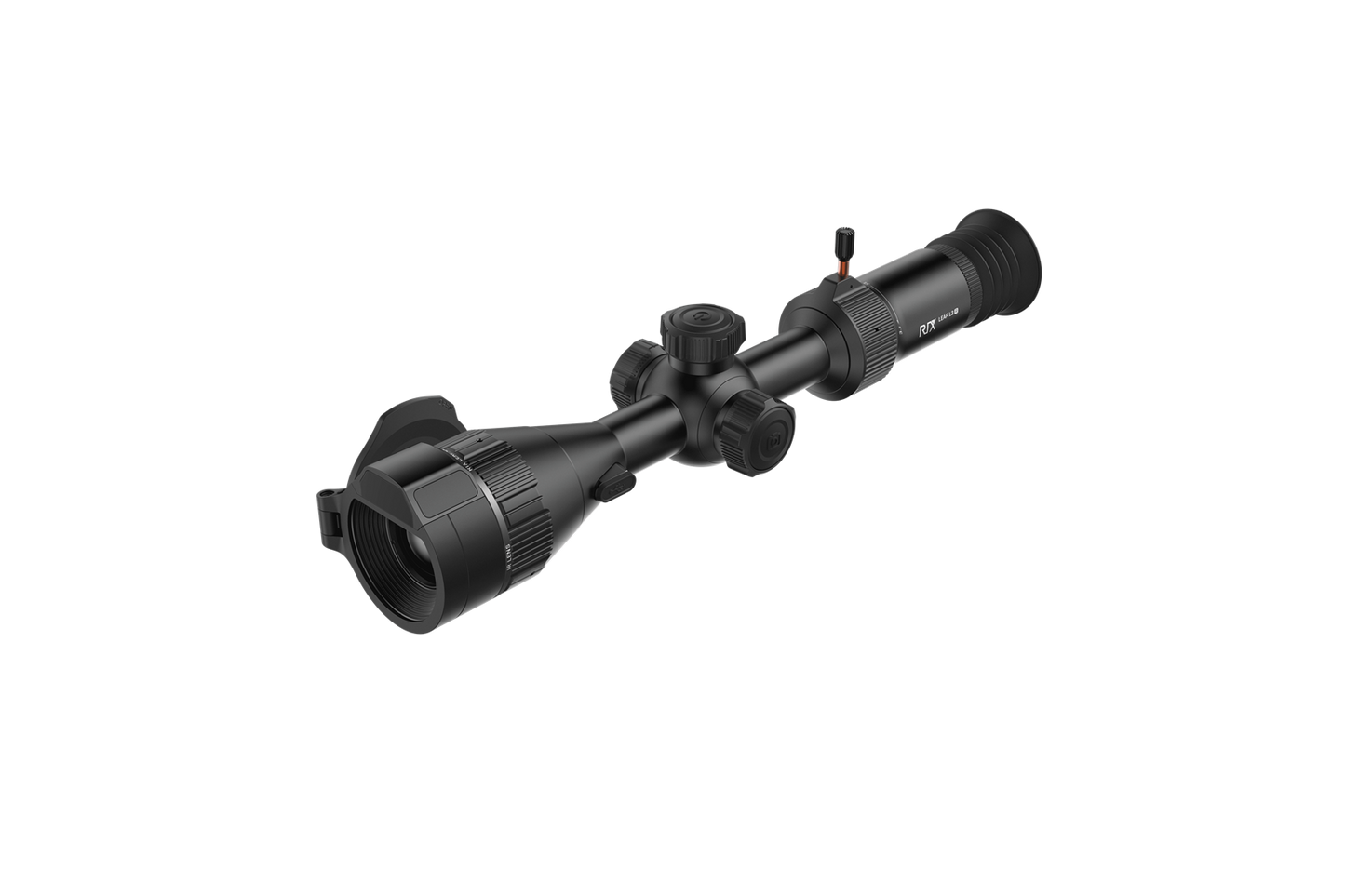
Why Choose this model
The Rix Leap L3R LRF is the entry-tier of Rix's three-scope Leap lineup and the scope that punches the hardest above its price point. At $2,299, the L3R LRF gets you nearly the full Leap...
Who this is for
Best for
Best for hunters who want a practical thermal rifle scope for common hog and predator ranges without overbuying premium resolution.
Not ideal for
Not ideal for open-country identification at longer distances or buyers who already know they need cleaner 640-class detail.
Quick specifications
- Category
- Thermal Rifle Scopes
- Sensor Resolution
- 384x288
- Magnification
- 3.5-9.6x
- Objective Lens
- 35
- Detection Range
- 1969
- Rangefinder
- Yes
Why buy from Thermal Bros
With premium thermal scopes, the expensive mistake is buying the wrong fit. Thermal Bros helps you compare sensor tier, lens size, and rangefinding value in plain English so you end up with the right optic, not just the most expensive one.
Full product description
The Rix Leap L3R LRF is the entry-tier of Rix's three-scope Leap lineup and the scope that punches the hardest above its price point. At $2,299, the L3R LRF gets you nearly the full Leap platform: the same F0.9 lens, the same 1,312-yard integrated rangefinder, the same onboard ballistic calculator, the same 0.35 MOA reticle precision, and the same IP67-rated rugged construction as the mid-tier Rix Leap L6R LRF and the flagship Rix Leap L12R LRF. What you trade for the lower price is sensor resolution the L3R LRF runs a 384 — 288 VOx thermal sensor instead of the 640-class sensor in the L6R LRF or the 1280 sensor in the L12R LRF.
For most hunters working typical predator and hog distances, that's a smart trade. The L3R LRF gives you serious Leap platform performance at the lowest entry point Rix builds.
What You Get for $2,299
This is the section that matters most on an entry-tier product page, because the surprise is how much of the Leap platform comes standard on the L3R LRF:
F0.9 lens. Same fast lens as the rest of the Leap lineup. An F0.9 lens lets in roughly 20% more thermal energy than the F1.0 lens on most competing thermal scopes translating directly to a brighter, more detailed image in low-contrast conditions like fog, rain, or temperature swings.
Sub-20 mK NETD VOx sensor. NETD measures how small a temperature difference the sensor can distinguish. At under 20 mK, the L3R LRF reads cleaner than most 384-class scopes on the market, especially in marginal weather when ambient and animal heat signatures start to converge.
Continuous optical zoom from 3.2x to 9.6x. This is true continuous optical zoom, not digital magnification stepped through fixed levels smooth, pixel-free magnification across the full range. Combined with a wide 7.5° field of view at base magnification, the L3R LRF lets you scan broadly, then dial in tight on a target without breaking image quality.
Integrated 1,312-yard laser rangefinder. Identical LRF capability to the L6R LRF and L12R LRF. The rangefinder is built into the optical axis for accurate distance measurement out to 1,312 yards with ±1 meter accuracy.
Onboard ballistic calculator. Same ballistic engine as the higher-tier Leap scopes. The LRF reading feeds directly into a holdover solution on the scope itself no app required, no math in your head.
0.35 MOA reticle (0.37" at 100 yards). Same ultra-fine reticle precision as the rest of the lineup. A finer reticle keeps the sight picture clean for precision shot placement without covering up the target at distance.
The 384 Sensor Trade-Off, Explained Honestly
The headline trade for the lower price is sensor resolution. The L3R LRF's 384 — 288 sensor has roughly one-quarter the pixel count of the L6R LRF's 640-class sensor and one-sixteenth of the L12R LRF's 1280 — 1024 sensor.
In practical terms, that affects two things:
Practical identification range. Detection range registering that heat is present is similar across the lineup. Identification range confirming species and making an ethical shot decision is shorter on a 384 sensor. Most hunters can confidently ID a coyote-sized target inside 300–400 yards on the L3R LRF in good conditions.
High-magnification image quality. Push toward the 9.6x ceiling on the L3R LRF and you'll see less fine detail than you would on a 640 or 1280 sensor at the same magnification, because there are fewer pixels resolving each part of the target.
If your shots stay inside 300 yards, neither limitation matters and the L3R LRF delivers a strong image. If you regularly work past that distance or push the zoom hard, the L6R LRF at $4,499 buys you the 640-class sensor that handles it cleanly.
Built to Survive
The L3R LRF is rated to handle 1,000 g shock and 6,000 joules of recoil well above what any conventional hunting rifle generates. IP67 waterproofing means the scope is rated for full submersion at depth, not just rain resistance. The redesigned eyepiece expands the forgiving eye box by 30% over previous-generation Rix scopes, which matters when you're shooting from awkward field positions and don't have time to perfectly align your head.
Key Specs
- Thermal sensor: 384 — 288 VOx
- NETD: <20 mK
- Lens: F0.9
- Magnification: 3.2x – 9.6x continuous optical zoom
- Field of view: 7.5°
- Display: 1920 — 1080 AMOLED
- Video recording: 1280 — 720 with 32 GB onboard storage
- Laser rangefinder: Integrated, 1,312 yards, ±1 meter accuracy
- Onboard ballistic calculator: Yes
- Reticle: 0.35 MOA (0.37" at 100 yards)
- Recoil rating: 1,000 g / 6,000 joules
- Waterproofing: IP67
- Price: $2,599.00
Who This Scope Is For
- First-time thermal buyers who want a real Rix scope without committing to mid-tier or flagship pricing
- Coyote and predator hunters working inside 300 yards on open ground, food plots, or property edges
- Hog hunters running stand and stalk setups at typical engagement distances
- Property owners managing predators or destructive game on smaller acreage where shots stay close
- Hunters who prioritize features over sensor resolution buyers who want the integrated LRF, ballistic calculator, and F0.9 lens of the Leap platform without paying $1,900 more for the 640 sensor
If you regularly push past 300 yards or want noticeably better image detail at high magnification, step up to the Rix Leap L6R LRF at $4,499 for the 640-class sensor. If you're chasing maximum image quality and shooting in marginal conditions, the Rix Leap L12R LRF at $6,899 is the flagship 1280-sensor option.
How It Compares in the Leap Lineup
The L3R LRF is the entry point into Rix's three-scope Leap series. Step up to the Rix Leap L6R LRF at $4,499 for the 640-class sensor meaningfully better image quality and longer practical identification range while keeping the same Leap platform features. Step up further to the Rix Leap L12R LRF at $6,899 for the 1280-sensor flagship with a 60mm objective. The L3R LRF is the right pick when you want the Leap platform LRF, ballistics, F0.9 lens, fine reticle, IP67 durability at the lowest entry point Rix offers.
Frequently Asked Questions
What's the difference between the Rix Leap L3R LRF and the L6R LRF?
Both run on the same Leap platform same F0.9 lens, same integrated 1,312-yard LRF, same onboard ballistic calculator, same 0.35 MOA reticle, same IP67 durability. The difference is sensor resolution. The L3R LRF runs a 384 — 288 sensor at $2,599. The L6R LRF runs a 640-class sensor at $4,499. The $1,900 spread buys you longer practical identification range, more usable detail at extended distance, and a cleaner image at high magnification. If your shots stay inside 300 yards, the L3R LRF does the job. If you push past that distance, the L6R LRF is worth the spread.
Is the Rix Leap L3R LRF good for coyote hunting?
Yes. The combination of the 384 — 288 VOx sensor, sub-20 mK NETD, F0.9 lens, and 3.2–9.6x continuous optical zoom is well-suited for typical predator calling distances (50–300 yards). The integrated 1,312-yard LRF and onboard ballistic calculator handle distance and holdover calculations for shots at the longer end of that range, and the 0.35 MOA reticle keeps the sight picture clean.
What does "continuous optical zoom" mean and why does it matter?
Continuous optical zoom means the magnification adjusts smoothly across the full range (3.2x to 9.6x on this scope) rather than stepping through fixed levels. It's optical, not digital, so the image quality stays clean across the zoom range no pixelation when you push toward the high end. Most thermal scopes use digital magnification stacked on a single optical base, which degrades image quality as you zoom in. The continuous optical zoom on the Leap series is one of the platform's defining features.
How accurate is the laser rangefinder?
The LRF is accurate out to 1,312 yards with ±1 meter accuracy on reflective targets in good conditions. That's identical LRF performance to the L6R LRF and L12R LRF same rangefinder hardware, same integration into the optical axis.
Does the onboard ballistic calculator require an app or subscription?
The ballistic calculation runs directly on the scope. No subscription is required to use it. The companion app is used to load and manage ballistic profiles on the scope.
How rugged is the L3R LRF?
The L3R LRF is rated for 1,000 g shock and 6,000 joules of recoil well above what any conventional hunting rifle generates, including heavy magnums. The IP67 waterproof rating means the scope is rated for full submersion in shallow water, not just rain resistance. Combined with the F0.9 germanium lens and a redesigned eyepiece with a 30% larger forgiving eye box, the L3R LRF is built for hard field use.
Can the L3R LRF record video?
Yes 1280 — 720 video with onboard 32 GB storage. Footage is transferred via the companion app or direct USB connection.
Frequently asked questions
What is this product best for?
Best for hunters who want a practical thermal rifle scope for common hog and predator ranges without overbuying premium resolution.
Who should probably skip it?
Not ideal for open-country identification at longer distances or buyers who already know they need cleaner 640-class detail.
Does it include a rangefinder?
Yes. This product is configured with rangefinding support according to the current product data.
Why buy from Thermal Bros?
With premium thermal scopes, the expensive mistake is buying the wrong fit. Thermal Bros helps you compare sensor tier, lens size, and rangefinding value in plain English so you end up with the right optic, not just the most expensive one.
Is this a scope or a scanner?
This is a rifle-mounted optic. Use a handheld thermal monocular or binocular if your main need is scanning before the shot.
Rix Optics App
Wi-Fi integration with iOS and Android devices


Technical Specifications
-
Sensor Resolution (px)
384x288 -
Display Resolution (px)
1920x1080 -
NETD Rating
20 -
Detection Range
1969 -
Refresh Rate (Hz)
50 -
Field of View
7.5
-
Weight
2.4 lb -
Dimensions
14.2 in 3.5 in 3 in -
HZ - refresh rate
50 -
Category
Thermal Rifle Scopes -
Handhelds
No -
Thermal Sensor Resolution
384x288 -
Display Resolution
1920x1080 -
Pixel Pitch
12 -
NETD Rating
20 -
Detection Range
1969 -
Range Finder
Yes -
Clip-On
No -
Magnification Base
3.5 -
Magnification Max
9.6 -
Objective Lens
35 -
Field of View
7.5