

Quick answer
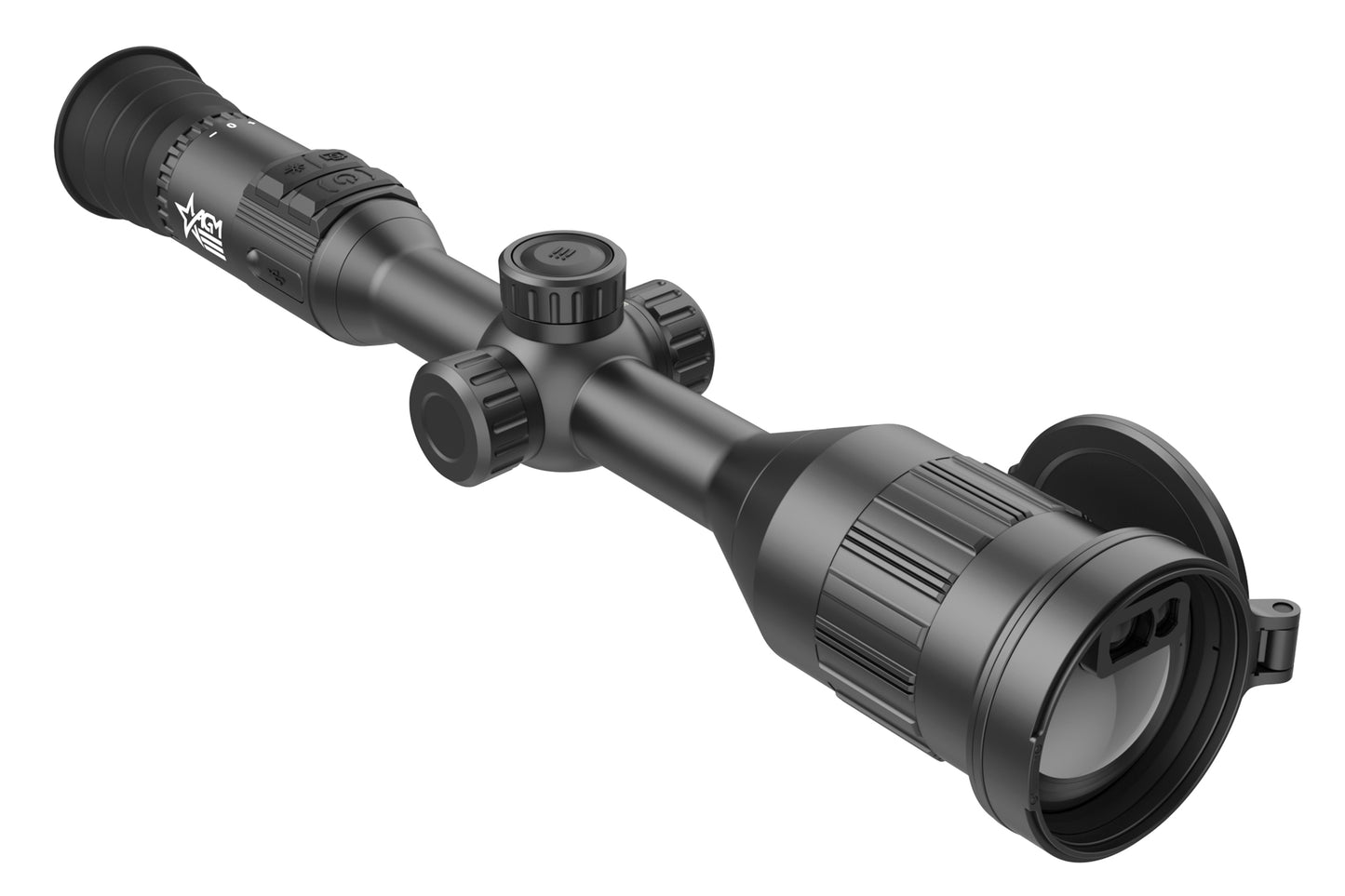
The AGM Adder V2 LRF 60-1280 is the flagship of AGM's Adder V2 LRF thermal rifle scope family — and AGM's first-ever 1280×1024 thermal riflescope, doubling the resolution of the highest-end 640 scopes. Built around a 1280×1024 sub-15 mK sensor, a 60 mm F/1.0 germanium objective with the 1,000-yard LRF integrated into the lens assembly, AGM's first shutterless NUC system, and a 2,560×2,560 semi-circular OLED display. 2.5×–20× magnification with 0.5× incremental zoom, onboard ballistic calculator with 5 profiles, 64 GB storage, dual-battery system with up to 9-hour runtime, Shot Activated Recording, 1,000 g recoil rating, IP67 build, and the American-made ADM Recon QD mount included ($220 value). Built for precision long-range hunters who need 1280 image quality to make positive target identification at distances where 640 scopes start to fall off.
Who this is for
Best for
Best for experienced hunters or professionals who know they need premium image detail, longer identification confidence, and a rifle-mounted thermal optic.
Not ideal for
Not ideal for first-time buyers, short-range hunters, or anyone trying to keep the setup simple and budget-conscious.
Quick specifications
- Category
- Thermal Rifle Scopes
- Sensor Resolution
- 1280x1024
- Magnification
- 2.5-28x
- Objective Lens
- 60
- Detection Range
- 3000
- Rangefinder
- Yes
Why buy from Thermal Bros
With premium thermal scopes, the expensive mistake is buying the wrong fit. Thermal Bros helps you compare sensor tier, lens size, and rangefinding value in plain English so you end up with the right optic, not just the most expensive one.
Full product description
The AGM Adder V2 LRF 60-1280 is the flagship of AGM's Adder V2 LRF thermal rifle scope family and AGM's first-ever 1280—1024 thermal riflescope, doubling the resolution of the highest-end 640 scopes on the market. It pairs that 1280 sensor with a 60 mm germanium objective lens, AGM's first shutterless NUC system, the same fully integrated 1,000-yard laser rangefinder tucked inside the front lens, a 2,560—2,560 semi-circular OLED display, and the American-made ADM Recon QD mount all in a traditional 30 mm tube housing that mounts and feels like a conventional precision rifle scope.
This is the Adder V2 you buy when the question your scope needs to answer is "can I positively identify this target at this distance," and the answer needs to be yes. The 1280 sensor delivers roughly four times the pixel count of a 640, the 60 mm lens gathers the thermal signal that resolution needs to be useful, and the 2.5— base magnification gives you a traditional scope feel without sacrificing the field of view you need to find and track targets.
Where the 60-1280 LRF fits in the Adder V2 family
The Adder V2 LRF series is a tiered family on a shared platform. Same internal LRF, same shutterless NUC, same 2,560—2,560 display, same UI, same 64 GB onboard storage, same dual-battery system, same ADM Recon QD mount. What changes between tiers is sensor resolution and lens size.
- Adder V2 LRF 35-384 384—288 sensor, 35 mm lens, 4—–24— zoom. Entry tier.
- Adder V2 LRF 50-640 640—512 sensor, 50 mm lens, 3.5—–26— zoom. The versatile middle of the line.
- Adder V2 LRF 60-1280 1280—1024 sensor, 60 mm lens, 2.5—–20— zoom. The flagship.
Step up from the 50-640 LRF to the 60-1280 LRF when 1280-resolution image quality at extreme range is what your hunting demands when positive target identification on small, distant, or partially obscured animals is the deciding factor, not the cost.
Why the 1280 sensor matters
A 1280—1024 sensor has roughly four times the total pixel count of a 640—512 sensor. More pixels collecting thermal data across the same scene means finer resolution at distance, cleaner edge definition on warm bodies against cooler backgrounds, and easier positive identification when a target is small, far, or partially obscured. AGM's 1280 sensor is paired with a 60 mm F/1.0 germanium objective a lens sized to gather the thermal signal that a 1280 sensor needs to actually use its resolution. Sensor and lens work together: the 1280 without a big enough lens is wasted; the 60 mm without a 1280 sensor doesn't fully leverage the optics. The 60-1280 puts them together.
The 2.5— base a traditional scope feel
Most flagship thermal scopes climb in base magnification with their tier. The Adder V2 LRF doesn't. The 60-1280 has the lowest base magnification in the line 2.5— and that's deliberate. The 1280 sensor's extra pixel count means digital zoom doesn't soften the image the way it does on lower-resolution scopes. So AGM started the base low to give the scope a more traditional, lower-mag feel wider field of view at base, easier to find and track moving targets and let the 1280 sensor do the magnification work in software up to 20— without losing the detail that makes positive ID possible.
The result is a flagship that scans like a hunting scope at base and resolves like a precision optic at zoom without the trade-off most thermal scopes force.
The integrated LRF and why the design matters
Open the magnetic lens cap on the Adder V2 LRF and the 1,000-yard laser rangefinder is built into the germanium lens assembly itself, not bolted on as an external module. This is a first in the thermal market. The result is a cleaner profile, no added rail real estate consumed, and no separate housing to align or protect. On a flagship optic where every element matters, this is the kind of design detail that earns the price.
What you get with the Adder V2 LRF 60-1280
- 1280—1024 thermal sensor with 12 μm pixel pitch. AGM's first 1280 sensor roughly four times the pixel count of a 640. Doubles the resolution of the highest-end 640 scopes.
- Sub-15 mK NETD. Industry-leading thermal sensitivity. Sharp contrast and clean edge definition even in fog, light rain, marginal heat conditions, or any situation where target-to-background heat difference is small.
- 60 mm F/1.0 germanium objective. Sized to gather the thermal signal a 1280 sensor needs to use its full resolution.
- 2.5— base magnification, 2.5—–20— total range with digital zoom. Supports both full-step and 0.5— incremental zoom adjustments no wasted sections of the magnification range.
- Fully integrated 1,000-yard laser rangefinder tucked inside the germanium lens assembly a first in the thermal market.
- Onboard ballistic calculator with five user-saved profiles for different cartridges or loads. Range a target, get drop data instantly.
- 2,560—2,560 semi-circular OLED micro display. AGM's highest-resolution display, with a redesigned semi-circular interface that puts battery life, magnification, range, time, and vertical/horizontal pitch scale readouts where you can see them without losing the target.
- Shutterless NUC system. AGM's first shutterless non-uniformity correction no mechanical shutter blink interrupting your view during recalibration.
- 10 brightness and 10 contrast settings for tailored viewing in any lighting condition.
- Pitch scale activation. Vertical and horizontal pitch scale readout for awareness of rifle cant important on long-range shots where small angular errors compound.
- Picture-in-Picture mode with target zoom alongside the wider field of view.
- Shot Activated Recording (SAR) automatically starts video capture when the rifle fires.
- 64 GB onboard storage with media albums viewable on-device.
- Onboard video and audio recording, plus image capture.
- Multiple color palettes including white hot, black hot, red hot, fusion, plus red and green monochrome designed to reduce night blindness during extended viewing and cold and warm hue modes.
- Multiple reticle types.
- Dual power system: two internal rechargeable lithium batteries plus a removable 18650. Up to 9 hours continuous operation. USB Type-C accepts 5 V DC / 2 A and supports QC3.0 fast charging for the internal batteries.
- 1,000 g recoil rating. Rated for big-bore calibers including .375 H&H.
- IP67-rated waterproof and shockproof construction.
- 50 Hz refresh rate for smooth real-time imaging on moving targets.
- AGM Connect app compatibility for file transfer and remote viewing via Wi-Fi.
- ADM one-piece Recon 30 mm QD mount included ($220 value). American-made, field-proven, designed around the Adder V2's 30 mm tube housing.
- 5-year manufacturer warranty.
Who the Adder V2 LRF 60-1280 is built for
- Precision long-range hunters who need 1280 image quality to make positive target identification at extreme distance
- Experienced thermal hunters stepping up from a 640 who want the resolution jump and have hit the limits of what a 640 sensor can resolve
- Hog, coyote, and predator hunters who want a flagship optic that scans like a traditional hunting scope at base and resolves like a precision instrument at zoom
- Buyers entering thermal at the top of the line who want a platform that won't outgrow their hunting
- Hunters running larger-caliber rifles (up to .375 H&H) who need the 1,000 g recoil rating
- Anyone who wants the most refined optical and display package the Adder V2 platform offers 1280 sensor, 60 mm lens, 2,560—2,560 display, shutterless NUC, integrated LRF, ballistic calculator, and ADM mount in a single integrated system
Full specifications
- Thermal sensor: 1280 — 1024, 12 μm pixel pitch
- NETD: <15 mK
- Objective lens: 60 mm F/1.0 germanium
- Base optical magnification: 2.5—
- Magnification range: 2.5— to 20— (with 0.5— incremental and full-step zoom modes)
- Refresh rate: 50 Hz
- Detection range: up to 3,000 yards
- Display: 2,560 — 2,560 OLED semi-circular micro display
- NUC: shutterless (no mechanical shutter blink)
- Brightness / contrast: 10 settings each
- Laser rangefinder: built-in, 1,000 yd integrated into germanium lens assembly
- Ballistic calculator: integrated, 5 user profiles
- Reticles: multiple selectable
- Color palettes: white hot, black hot, red hot, fusion, red monochrome, green monochrome
- Viewing modes: cold and warm hue
- Picture-in-Picture: yes
- Pitch scale activation: yes
- Single-shot zero: yes
- Shot Activated Recording (SAR): yes
- Recording: video, audio, image capture
- Onboard storage: 64 GB eMMC
- Connectivity: Wi-Fi, AGM Connect app
- Battery system: two internal rechargeable lithium batteries + removable 18650; up to 9 hr runtime
- External power: USB Type-C, 5 V DC / 2 A, QC3.0 supported (internal batteries only)
- Recoil rating: 1,000 g (.375 H&H rated)
- Weatherproofing: IP67
- Mount: ADM one-piece Recon 30 mm QD included ($220 value)
- Housing: 30 mm tube
- Weight: 2.2 lb
- Warranty: 5-year manufacturer warranty (AGM)
Frequently asked questions
Where does the 60-1280 LRF fit in the Adder V2 LRF family?
It's the flagship of the three-model Adder V2 LRF series. The "60" is the 60 mm objective lens; the "1280" is the 1280—1024 sensor. Below it sit the 50-640 LRF (640 sensor, 50 mm lens) and the 35-384 LRF (384 entry tier).
What's the difference between the 60-1280 and the 50-640?
The 60-1280 steps up to a 1280—1024 sensor roughly four times the pixel count of a 640 with a 60 mm lens (vs. 50 mm). Finer thermal resolution, better target identification at extreme range, and a longer-reach lens. Both share the full Adder V2 LRF platform same display, integrated LRF, ballistic calculator, shutterless NUC, mount. Step up to the 60-1280 when 1280 image quality is the deciding factor. Stay with the 50-640 when 640 image quality is enough and the price step doesn't earn its keep.
Is a 1280 sensor worth the upgrade from a 640?
For hunters who need positive target identification at extreme range, work in marginal heat conditions, or want to make confident calls on small or partially obscured animals yes. The 1280 gives you roughly four times the pixel count of a 640, which translates into finer detail and easier identification at distance. If your hunting happens at distances where a 640 is making positive ID confidently, the upgrade may not pay off. If you're hitting the limits of a 640's resolution, the 1280 is what solves that.
Why is the base magnification only 2.5— on the flagship?
This is deliberate. The 1280 sensor's extra pixel count means digital zoom doesn't soften the image the way it does on lower-resolution scopes. AGM started the base low to give the 60-1280 a traditional, lower-mag scope feel wider field of view at base, easier to find and track moving targets and let the 1280 sensor handle the magnification work in software up to 20— without losing the detail that makes positive ID possible. The result is a flagship that scans like a hunting scope and resolves like a precision optic.
What is the shutterless NUC system and why does it matter?
Most thermal scopes use a mechanical shutter that periodically blinks across the sensor to recalibrate the image. That blink interrupts your view sometimes at the worst possible moment. The Adder V2 is AGM's first scope with shutterless NUC, which recalibrates without the mechanical shutter blink. Seamless, quiet, uninterrupted viewing.
What's the 0.5— incremental zoom and why does it matter?
The Adder V2 lets you switch between full-step zoom and 0.5— incremental zoom adjustments. Most thermal scopes step through zoom in fixed increments, which can leave you stuck between two zoom levels neither of which is quite right for your target. The 0.5— incremental mode lets you dial in finer adjustments no wasted sections of the magnification range.
What's Shot Activated Recording?
When the rifle fires, the scope automatically starts capturing video so the kill is recorded without you needing to start a recording manually at the moment of the shot.
How accurate is the integrated LRF?
The Adder V2 LRF ranges to 1,000 yards. The ballistic calculator uses your input bullet velocity and ballistic coefficient to compute drop for the ranged distance. Five user profiles let you save settings for different cartridges or loads.
Will the Adder V2 LRF 60-1280 hold up to big-bore calibers?
Yes. The Adder V2 LRF is rated to 1,000 g of recoil impact and AGM specifies it as appropriate for calibers up to .375 H&H.
What's the battery system?
A dual-power setup: two internal rechargeable lithium batteries (up to 9 hours runtime combined) plus a removable 18650. USB Type-C accepts external power at 5 V DC / 2 A and supports QC3.0 fast charging for the internal batteries.
What mount comes with it?
A field-proven American-made ADM (American Defense Manufacturing) one-piece Recon 30 mm QD mount a $220 value, included with the scope.
What's the warranty?
AGM backs the Adder V2 LRF 60-1280 with their 5-year manufacturer warranty.
AGM Connect
Wi-Fi integration with iOS and Android devices


Technical Specifications
-
Sensor Resolution (px)
1280x1024 -
Display Resolution (px)
2560x2560 -
NETD Rating
18 -
Detection Range
3000 -
Refresh Rate (Hz)
25 -
Field of View
14.6
-
Weight
2.2 lb -
Dimensions
17.8 in 3.7 in 3.2 in -
HZ - refresh rate
25 -
Category
Thermal Rifle Scopes -
Handhelds
No -
Thermal Sensor Resolution
1280x1024 -
Display Resolution
2560x2560 -
Pixel Pitch
12 -
NETD Rating
18 -
Detection Range
3000 -
Range Finder
Yes -
Clip-On
No -
Magnification Base
2.5 -
Magnification Max
28 -
Objective Lens
60 -
Field of View
14.6